Los Latinos del E/V Nautilus

Escrito por// Written by Science Communication Fellow Adolfo Rodríguez Velázquez
Cuando se piensa en una expedición a bordo del E/V Nautilus, en primera instancia se nos vienen a la mente los pilotos de los ROV que meticulosamente realizan maniobras para explorar el fondo marino, los expertos en sonares de mapeo que son quienes deciden los lugares donde se estará trabajando, los comunicadores científicos que transmiten al mundo el conocimiento sobre los diversos hallazgos, e inclusive los científicos que esperan las muestras colectadas. Sin embargo, existe otro grupo de profesionales sin los cuales ninguna de estas misiones sería posible y que, en muchas ocasiones, pasa desapercibido: la tripulación.
El E/V Nautilus cuenta con una tripulación de 17 personas, divididas en las siguientes funciones: puente (navegación), máquinas, cubierta y personal de cocina y hospitalidad. La tripulación está contratada por la compañía de gestión de embarcaciones Leeway Marine, un socio esencial para OET en las operaciones seguras que sustentan la exploración del océano. Once del total de los tripulantes son latinos, diez hombres y una mujer, provenientes de Honduras y México. Oficiales de navegación, ingenieros, jefes de máquinas y marineros de cubierta, entre otros, son algunas de las labores que estas valientes personas realizan.
Esta tripulación efectúan sus tareas con mucho orgullo por sus raíces, pero, ante todo, con un profesionalismo intachable. Cada maniobra requiere precisión, coordinación y trabajo en equipo. Mientras la comunidad científica concentra sus esfuerzos en responder preguntas sobre el océano, la tripulación labora silenciosamente para garantizar que el barco continúe siendo una plataforma segura y eficiente para la investigación.
“Trabajar en este lugar representa mucho; es un honor estar aquí como latino. Solo tenemos que conocer la historia del barco para entender lo importante que es para la ciencia. Sentimos mucho honor como hondureños al estar acá”, expresó el marinero de cubierta Wayne Romer, a quien siempre se le ve activo brindando mantenimiento a las diferentes áreas del barco y quien también asiste en el lanzamiento de los ROV al agua.
El orgullo latino se hace evidente en diferentes rincones del barco. Se percibe en sus conversaciones, acentos, costumbres y las historias que comparten durante los momentos de descanso. A miles de kilómetros de sus países, llevan consigo una identidad que no desaparece con la distancia. Por el contrario, se convierte en parte de la historia de una embarcación que recorre algunos de los lugares más remotos del planeta haciendo ciencia y explorando lo desconocido.
De acuerdo con datos del U.S. Bureau of Labor Statistics, en Estados Unidos cerca de 84,000 personas trabajan en ocupaciones relacionadas directamente con la operación de embarcaciones, incluyendo capitanes, oficiales, marineros, operadores e ingenieros navales. Sin embargo, las estadísticas laborales federales disponibles no permiten establecer con precisión qué proporción de estos trabajadores se identifica como hispana o latina. A bordo del E/V Nautilus, esa presencia latina deja de ser simplemente una estadística y adquiere nombres, rostros e historias de poder con décadas de experiencia en los océanos y mares del mundo. Para algunos de estos tripulantes, el Nautilus es uno de los muchos barcos que han formado parte de sus vidas. Al igual que los miembros del equipo científico, ellos están a bordo durante varias expediciones consecutivas, trabajando en rotaciones junto con otros integrantes de la tripulación. Cuando se está lejos de tierra, la confianza entre compañeros se convierte en algo indispensable.
“Llevo trabajando en barcos por más de 25 años. He trabajado en barcos de diferentes tamaños, con diferentes tipos de personas. Aquí (refiriéndose al Nautilus), es un ambiente laboral diferente; se siente como una familia”, expresó el marinero de cubierta hondureño Carlos Solano quien siempre saluda con una sonrisa y nunca falta su “Buenos días”.
Quizás la palabra familia adquiere un significado diferente cuando se trabaja en medio del océano. Laborar en una embarcación también implica sacrificios que pocas veces se observan. Detrás de cada uniforme hay una familia, un hogar e historias que, durante semanas o meses, permanecen a miles de kilómetros de distancia. Cumpleaños, aniversarios, bodas y un sinnúmero de momentos importantes pueden transcurrir mientras ellos se encuentran navegando. Para muchos, trabajar en el mar ha significado aprender a vivir entre despedidas y reencuentros, haciendo del barco un segundo hogar y de sus compañeros una familia extendida con la que comparten largas jornadas, dificultades y satisfacciones.
Reconocer estas historias no le resta protagonismo a la ciencia. Al contrario, nos permite comprender que explorar nuestro planeta nunca ha sido el trabajo de una sola persona. Detrás de cada descubrimiento existe una combinación de ciencia, tecnología, experiencia y, sobre todo, trabajo humano. Resulta meritorio destacar los rostros latinos del E/V Nautilus, especialmente en tiempos en los que hablar español y llevar con orgullo nuestras raíces todavía puede significar enfrentar barreras, perder espacios y luchar por el reconocimiento que nuestras historias y aportaciones merecen. Para quienes venimos de Latinoamérica, observar a trabajadores de nuestras regiones ocupando estas posiciones tiene un significado mayor. Su presencia demuestra que nuestras tierras también forman parte del engranaje humano que hace posible explorar algunos de los lugares menos conocidos de nuestro planeta. Las exploraciones oceánicas también tienen “ñ”, y palabras esdrújulas en las que se escribe un acento en la antepenúltima sílaba.
Respeto y agradecimiento para toda la tripulación del E/V Nautilus en especial para los latinos: Cathal Kirwan, Flavio Medina, Adrian Pascu, Amrah Ahmadov, Lino Portugal, Lendy Hernandez, Edward Zaldivar, Luis Patron, Thriston Ducker, Marvin Avery, Denny Eddward Hynds Bodden, Oleksandr Loyko, Oleksandr Nikolenko, Jose Ulloa, Carlos Enamorado, Wayne Romero, and Roberto Enamorado.
Para conocer más sobre el importante trabajo de la tripulación marítima en el Nautilus, visita la página del Equipo, que incluye una sección sobre carreras en la tripulación y biografías de nuestro personal a bordo.
The Latinos of E/V Nautilus
When we think about an expedition aboard E/V Nautilus, the first people who often come to mind are the ROV pilots who meticulously maneuver the vehicles to explore the seafloor, the mapping sonar experts who help determine where operations will take place, the science communicators who share discoveries with the world, and the scientists eagerly awaiting the samples collected during each dive. Yet there is another group of professionals without whom none of these missions would be possible, and whose work too often goes unnoticed: the ship’s crew.
E/V Nautilus has a crew of 17 people working across several essential areas: the bridge (navigation), engine room, deck, and galley and hospitality. The crew is staffed by vessel management company Leeway Marine, an essential partner to OET in the safe operations that underpin ocean exploration. Eleven of the crew members are Latino, ten men and one woman, from Honduras and Mexico. Navigation officers, engineers, chief engineers, deckhands, and other maritime professionals are among the people carrying out the essential work that keeps the ship operating.
The crew carries out these responsibilities with tremendous pride in their roots, but above all, with unwavering professionalism. Every maneuver requires precision, coordination, and teamwork. While the scientific community focuses its efforts on answering questions about the ocean, the crew works quietly behind the scenes to ensure that the ship remains a safe and efficient platform for research.
“Working here means a lot; it is an honor to be here as a Latino. You only have to know the history of this ship to understand how important it is to science. We feel a tremendous sense of pride as Hondurans to be here,” said deckhand Wayne Romero, who can always be seen actively maintaining different areas of the ship and also assists with launching the ROVs into the water.
Latino pride can be felt throughout different corners of the ship. It is present in their conversations, accents, traditions, and the stories they share during moments of rest. Thousands of kilometers from their home countries, they carry with them an identity that does not disappear with distance. Instead, it becomes an indisputable part of a vessel that travels to some of the most remote places on Earth in the pursuit of science and the exploration of the unknown.
According to data from the U.S. Bureau of Labor Statistics, nearly 84,000 people in the United States work in occupations directly related to vessel operations, including captains, officers, sailors, operators, and ship engineers. However, available federal labor statistics do not allow us to determine precisely what proportion of these workers identify as Hispanic or Latino. Aboard E/V Nautilus, that Latino presence becomes more than a statistic; it takes on names, faces, and powerful stories that represent decades of experience navigating the oceans and seas of the world. For some of these crew members, Nautilus is just one of many ships that have been part of their lives. Like science party members, they are onboard for a few expeditions in a row, working in rotations with other crew. When you are far from land, trust among crewmates becomes indispensable.
“I have been working on ships for more than 25 years. I have worked on ships of different sizes, with many different kinds of people. Here (referring to Nautilus), the work environment is different; it feels like a family,” said Honduran deckhand Carlos Solano, who always greets you with a smile and never misses the opportunity to say, “Buenos días.”
Perhaps the word family takes on a different meaning when you work in the middle of the ocean. Working aboard a ship also involves sacrifices that are rarely seen. Behind every uniform is a family, a home, and stories that remain thousands of kilometers away for weeks or even months at a time. Birthdays, anniversaries, weddings, and countless other important moments may pass while they are at sea. For many, working on the ocean has meant learning to live between goodbyes and reunions, turning the ship into a second home and their crewmates into an extended family with whom they share long working days, challenges, and accomplishments.
Recognizing these stories does not take anything away from the science. On the contrary, it allows us to understand that exploring our planet has never been the work of a single person. Behind every discovery is a combination of science, technology, experience, and, above all, human effort. It is important to recognize and celebrate the Latino faces of E/V Nautilus, particularly at a time when speaking Spanish and proudly carrying our roots can still mean confronting barriers, losing spaces, and fighting for the recognition that our stories and contributions deserve. For those of us who come from Latin America, seeing people from our region holding these positions carries an even deeper meaning. Their presence demonstrates that our homelands are part of the human machinery that makes it possible to explore some of the least-known places on our planet. Ocean exploration also has its ‘ñ,’ and its “esdrújulas” words that proudly carry an accent on the third-to-last syllable.
My respect and gratitude go to the entire crew of E/V Nautilus, and especially to its Latino crew members: Cathal Kirwan, Flavio Medina, Adrian Pascu, Amrah Ahmadov, Lino Portugal, Lendy Hernandez, Edward Zaldivar, Luis Patron, Thriston Ducker, Marvin Avery, Denny Eddward Hynds Bodden, Oleksandr Loyko, Oleksandr Nikolenko, Jose Ulloa, Carlos Enamorado, Wayne Romero, and Roberto Enamorado.
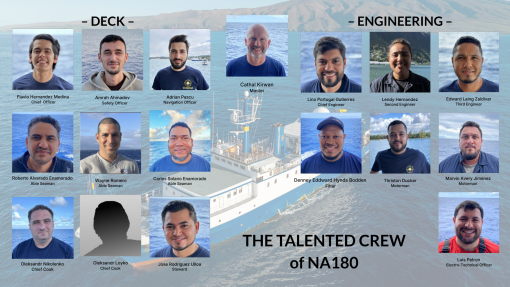
To learn more about the important work of the maritime crew on Nautilus, check out the Team page, which includes a crew career page and bios of our team onboard.
Deep-Sea Habitats in the Mariana Islands II
In our second expedition of the year in the Mariana region, E/V Nautilus will spend 22-days at sea.