Mysterious Hydrozoa of the Mariana Abyssal Plain
When you’re the first people to set eyes on a region of seafloor, it’s not surprising that you may come across what may be never-before-described deep-sea animals. During our exploration of the abyssal plain in the far northeastern corner of the US waters in the Commonwealth of the Northern Marianas, our Corps of Exploration witnessed numerous mysterious and beautiful deep-sea critters in class Hydrozoa. This dive is a beautiful reminder of how much we still have to learn about the animals of our global ocean!
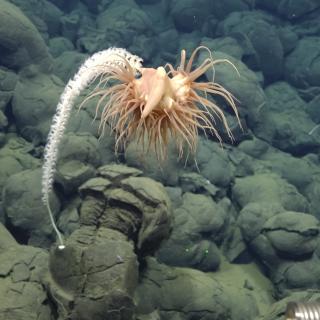
During the NA180 expedition, we dove our ROVs Little Hercules and Atalanta over 5,300 meters (17,388 feet) deep on this widely spread (yet little-studied) habitat. Popping up from the seafloor next to a biocast is a stunning stalked organism that our team on watch couldn’t immediately identify. With a little time, the team IDed this as a solitary hydroid, probably Branchiocerianthus sp., but at least in the family Corymorphidae, which can grow to up to 2 meters tall.
Later, we encountered an animal that experts could identify only to the point of believing we need a new family added to the order Narcomedusae! According to expert Dhugal Lindsay, from OET's Scientist Ashore network, this animal may need a new family, new genus, and new species, with a sister genus being Bathykorus. Narcomedusae have tentacles attached above the lobed edge of their bell, which they use to catch large, fast-moving prey. They hunt by holding their tentacles perpendicular to the direction they are swimming to cover a larger area. If something is caught they bend the tentacle inwards and coil them at the tips to their mouths.
Ocean Exploration Trust's Deep-Sea Habitats in the Mariana Islands I & II (NA179 & NA180) expeditions are primarily supported by NOAA Ocean Exploration via the Ocean Exploration Cooperative Institute, with additional support from the Bureau of Ocean Energy Management for AUV Sentry’s participation.
Deep-Sea Habitats in the Mariana Islands II
In our second expedition of the year in the Mariana region, E/V Nautilus will spend 22-days at sea.