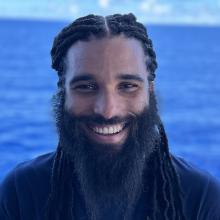
Adolfo Rodríguez Velázquez
Tell us about your work/research. What kinds of things do you do?
I am an Assistant Professor at the University of Puerto Rico, Cayey campus, where I teach courses such as Zoology and its laboratory, General Biology, Biology Seminar, and Introduction to Research. My work integrates teaching with an active research program focused on diverse ecosystems across Puerto Rico, including protected forests, subterranean systems, and coastal environments. I spend a significant amount of time conducting fieldwork, often in remote or lesser-known locations across the island, and I actively involve my students in these experiences so they can engage firsthand in the process of scientific research. My research examines the presence and distribution of invasive vertebrates in state forests and evaluates their impacts on native, endemic, and migratory species. I also study herpetofauna, particularly snakes, focusing on movement patterns, spatial ecology, home range, and human perceptions toward these species. Additionally, I conduct research in subterranean systems, where I monitor microplastic contamination and characterize the distribution and abundance of cave-dwelling organisms such as endemic cockroaches and millipedes. In coastal rocky shores, I analyze the abundance and distribution of Polyplacophora (chitons) in relation to microplastic presence, contributing to a broader understanding of ecological interactions and environmental stressors in Puerto Rico.
What sparked your initial interest in your career?
From an early age, I felt a strong connection to nature, particularly toward less charismatic species such as amphibians and reptiles. I grew up in the town of Las Piedras, Puerto Rico, a place rich in natural beauty and lush landscapes, which deeply inspired my appreciation for the environment and instilled in me a strong commitment to conservation. Wildlife documentaries further fueled my curiosity, motivating me to explore and understand nature beyond what I could see around me. During my school years, I participated in science fairs, which reinforced my desire to pursue a career in science while also incorporating communication as a tool to share knowledge and foster appreciation for the natural environment. When I entered university, I chose to study both Biology and Communications, a combination that allowed me to develop both scientific and outreach skills. I participated in several research internships that strengthened my abilities and confirmed my passion for scientific research. Throughout my academic journey, I became especially interested in snakes, focusing much of my work on Borikenophis portoricensis as a model species to study the stressors affecting colubrid populations. My interest in educating and motivating others stems from a desire to care for what surrounds us and to protect what is still unknown. Since then, I have consistently integrated communication into my work, using it as a powerful tool for research dissemination, education, and increasing public awareness about the importance of conserving biodiversity.
Who influenced you or encouraged you the most?
More than any single individual, what has influenced me the most is the desire to inspire others to pursue science, to value conservation, and to develop curiosity about the world around them. I am driven by the opportunity to contribute to the protection of unique species and ecosystems so that future generations can experience and learn from them. Growing up, I did not see many people like myself doing what I do today, and I did not have a clear role model to follow. Because of that, I had to become my own example. I understand how difficult it can be to find direction, but also how powerful and transformative it is when you do. That experience continues to shape my path and motivates me to serve as a source of inspiration for others. Ultimately, I hope to encourage people to do good for the environment around us and to understand that coexistence with nature is not only possible, but essential.
What element of your work/study do you think is the most fascinating?
One of the most fascinating aspects of my work is the opportunity to study unique species within equally unique environments and then translate that knowledge to others. Whether I am working in forests, caves, or coastal ecosystems, each setting offers new discoveries that deepen our understanding of the natural world. What I find especially meaningful, however, is the ability to share these experiences and insights with students and the broader community. The expressions of surprise, curiosity, and excitement—the smiles that come from understanding something new—are truly the fuel that drives my passion. Being able to make science accessible and inspire others to appreciate and care for the world around them is, to me, one of the most rewarding parts of what I do.
How did you get involved with the Ocean Exploration Trust?
I had been familiar with the Nautilus expeditions for quite some time and was always fascinated by the work of the Ocean Exploration Trust. However, my path toward becoming involved became much clearer in the summer of 2022, when I was working as a Fellow writing science news for El Nuevo Día. During that time, I had the opportunity to interview Yashira Cruz Rodríguez, who had participated as a Science Communication Fellow aboard the Nautilus. I was truly inspired by her story and the impact of her experience, and from that moment on, I knew I wanted to be part of it. When the application calls were later announced on the Ocean Exploration Trust website, I immediately saw it as my opportunity and decided to apply.
What other jobs led you to your current career?
Throughout my undergraduate years, I participated in a variety of research internships and field experiences that helped shape my career path. These opportunities allowed me to work in diverse ecosystems and gain hands-on experience in ecology, conservation, and wildlife monitoring. I was involved in projects ranging from studying species behavior and biodiversity to monitoring threatened species and exploring the impacts of environmental change. These experiences not only strengthened my technical and research skills but also reinforced my passion for fieldwork and scientific inquiry. In addition, my involvement in science communication further shaped my career by allowing me to connect research with broader audiences. Overall, these early experiences played a key role in guiding me toward my current career, where I integrate research, conservation, and education.
What are your degrees and certifications?
BS in Biology with a Minor in Ecology (Universidad del Sagrado Corazón, San Juan, PR) 2016
BA in Communications Specialty in Digital Film (Universidad del Sagrado Corazón, San Juan, PR) 2016
PhD in Biology with a focus on Tropical Ecology (University of Puerto Rico, Rio Piedras Campus, San Juan, PR) 2023
What are your hobbies?
I enjoy spending time outdoors, especially hiking, running, and exploring caves, as these activities allow me to stay connected with nature beyond my professional work. I also have a strong appreciation for the arts, particularly theater and live music, and I enjoy attending concerts whenever I can. These interests help me maintain a balance between my work and personal life while continuing to explore different forms of inspiration and discovery.
What advice would you give someone who wants to have a career like yours?
If you don’t believe in yourself, no one else will. Rejection is part of the process—those “no’s” are necessary for both personal and professional growth. Many doors will close, and there will be people who may not understand your passion or may even question your path, especially when your work takes you into challenging environments, long days in the field, covered in mud, exhausted, and searching for species that others might overlook or undervalue. But if you are truly passionate, you have to keep going. Embrace what makes you different, celebrate who you are, and never be afraid to stand out—those qualities will not only make you happier, but also more successful. The sky is not the limit—there is an entire universe of possibilities waiting to be explored. Stay curious, stay resilient, and never lose sight of why you started.
Expeditions
Adolfo participated in the following Ocean Exploration Trust expeditions:
Related Posts

OET is proud to welcome Adolfo Rodríguez Velázquez from Puerto Rico to our 2026 Science Communication Fellow cohort! Learn more about this science communicator and professor from the UPR Cayey via Primera Hora.
¡OET se enorgullece de dar la bienvenida a Adolfo Rodríguez Velázquez, de Puerto Rico, a nuestra cohorte de Becarios de Comunicación Científica de 2026!
