Look Outside Your Comfort Zone

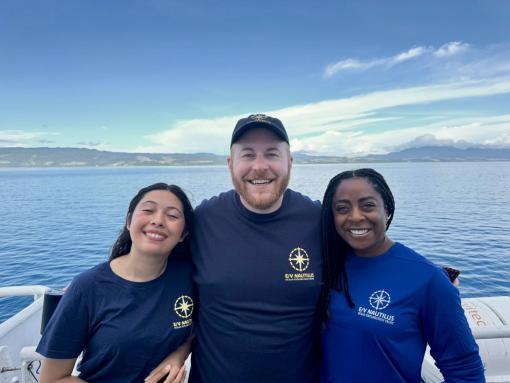
This blog was written by NA174 Science Communication Fellow Matt Holden.
Gazing at a saturated evening sky from the top deck of E/V Nautilus evokes a feeling of disbelief. I chat with my shipmates – remarkable people from around the world – and wonder inwardly: Is this real life? How did I get here?
At home, I teach high school science in the land-locked state of Arkansas – I never imagined I would get to be part of a deep-sea expedition. Working as a Science Communication Fellow (SCF) aboard E/V Nautilus feels like entering another world, full of awe and curiosity.
While the cutting-edge technology aboard Nautilus is impressive, the most spectacular component of this expedition is our team – unbelievably talented, intelligent, and kind people from a wide range of places and professional experiences. For example, our expedition leader, Noelle Helder, is a marine ecologist who lives in Alaska and raised over $260,000 while participating in The World’s Toughest Row across the Atlantic Ocean (spoiler: her team won!) Other members of our expedition team include folks from across the United States, France, Canada, and the Marshall Islands. They all bring a variety of expertise and a passion for exploration.
As we transit to Majuro, I listen to Dr. Annette Govindarajan explain her new eDNA multipuffer sampler, and I immediately begin to brainstorm lesson ideas. I already teach my students about eDNA, but I wonder if they could actually collect and analyze eDNA samples? Luckily, Annette explains that there is a citizen science sampler that is portable and perfect for high school students. I can’t wait for my students to utilize this new technology in our local rivers and lakes!
After a busy morning of learning how to conduct ship-to-shore interactions and more about my role in the control van, I take a break to head down to the lounge and listen to deep sea coral expert Dr. Fanny Girard. Her talk is fascinating! She shows graphics of her previous work studying deep sea coral communities and how many deep sea species such as crustaceans, cnidarians, and molluscs seem to associate with specific coral colonies. This presentation lights a fire in the science teacher side of my brain. Using data from Fanny’s previous studies I plan to develop lessons to see if my students can also find the connections between specific coral colonies and other deep sea species.
Deep sea volcanoes, oceanic hotspots, the shifting of the tectonic plates, what is not to love! I am sitting in the ship lounge listening to Dr. Val Finlayson speak about her geology research and explain how the data she collects can help us understand more about the history of life on Earth. As a biology teacher, I love learning about Earth’s geological processes because they contribute to the distribution of organisms around the globe. In other words, geology begets biology. Again, ideas are popping into my head – there are many ways I can use her research in my classroom to help students understand the integral role geological processes play for life on this planet.
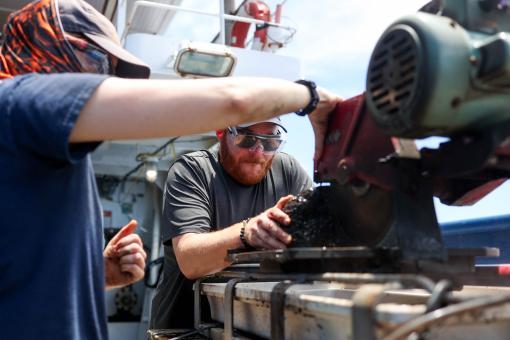
The people on this ship are truly inspiring and have reignited my love for science and education. I know my students will benefit from my experience and what I bring back to the classroom.
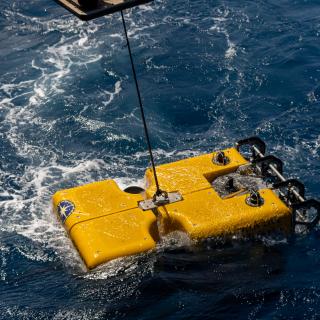
We begin our first dive of the expedition on a Sunday afternoon at 2pm. I take my seat in the dimly lit control van as part of the 12-4 pm watch. The energy in the room is palpable as ROV Hercules begins to descend to the depths of the ocean floor around 2200 meters. I can barely contain my excitement as I ask each member of our team to introduce themselves, before turning to Dr. Steve Auscavitch, a deep sea biology expert.
“Steve, can you tell us how you first became interested in ocean exploration?” I ask.
Steve explains that he grew up along the Connecticut coast and explains that the more he learned about marine science, the more it fascinated him. His first exploration experience was turning over rocks along the shore as a kid.
“You never know what you are going to find, it could be a crab or starfish or piece of seaweed,” Steve says. “What I do now is like turning over rocks, but on a bigger, more expensive scale.”
This simple statement from Steve really hits home for me. When I was younger, I never thought I would become a teacher. My path to education has not been linear and that is okay. I try to instill this lesson in my students: you do not have to know what you want to do in high school, college, or even later in life. Be flexible. Follow your passions. Look for opportunities outside your comfort zone.
After earning a master’s degree and working for a few years, I found myself out of job due to budget cuts. I thought to myself, what am I going to do now? I knew that I loved conservation biology and wanted the next generation to have that same passion for protecting our Earth. I went back to school, got my masters in teaching and obtained a job teaching high school biology. It has now been seven years since I started teaching, and I could not love it more!
The excitement and curiosity of my students is contagious and continues to inspire me on a daily basis. However, teaching is hard! Educators work long hours outside of the classroom, do not get paid the most lucrative salaries, and it is not uncommon for educators, especially new educators, to get bogged down by all the difficulties that come with the career. This is why I think opportunities like the OET Science Communication Fellowship are so critical. It has helped to reignite my passion for education and remind me why I became an educator in the first place.
Throughout my career, I have participated in several similar professional opportunities. Venturing outside of the classroom and outside my comfort zone enables me to bring real-world experiences back to my students. I actually heard about OET’s Science Communication Fellowship from a naturalist while participating in the National Geographic and Lindblad Expeditions Grosvenor Teacher Fellowship in Antarctica. The Grosvenor Teacher Fellowship helps educators to develop an Explorer Mindset which emphasizes knowledge, skills, and attributes such as curiosity and collaboration which are important to instill in the next generation of global changemakers.
I have also participated in the Fund for Teachers Fellowship which allows educators to create their own professional development experiences across the globe to better meet the needs of their students, the Bimini Biological Field Station Teacher and Educator Fellowship focused on marine biology (specifically elasmobranchs), the Earthwatch Project Kindle Fellowship which teaches educators how to develop international travel for students to perform hands-on environmental research, and the Ecology Project International Teacher Fellowship designed to provide educators with opportunities to collaborate on real-world environmental issues. In addition, I just found out I was selected as a Fulbright Teachers for Global Classrooms Fellow for the 2025-2026 school year and am so excited to learn more about global education and teach my students about global citizenship.
Similar to my Ocean Exploration Trust Science Communication Fellowship, these experiences allowed me to collaborate with scientists, educators, artists, and cultural leaders from around the world to develop engaging content for my classroom and community. More importantly, participating in these opportunities and stepping outside my comfort zone helped to reignite my passion for education. This experience has been one of the most rewarding of my life! I want to advocate for all educators and share my story in hopes that more teachers will learn about and take part in these life-changing experiences.
Deep-Sea Habitats of the Marshall Islands
The Republic of the Marshall Islands is an atoll-based country of over 1,200 islands surrounded by 2.13 million square kilometers of ocean, the vast majority of which has never been mapped or surveyed.