The Art of Sampling: Inside the Skill of Deep-Sea Collection

This blog was written by Science Communication fellow Rikki Lee Marzan.
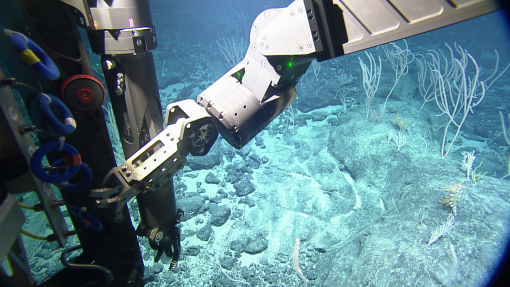
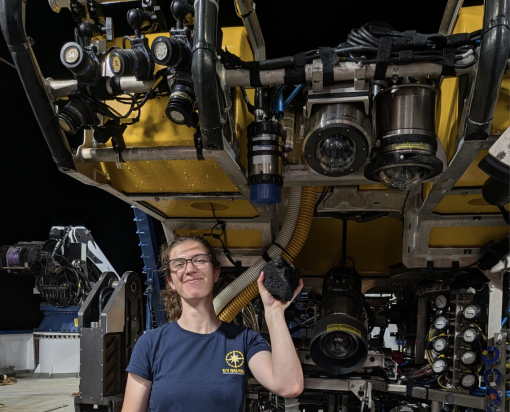
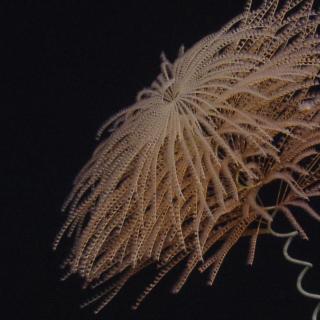
Four thousand meters below the surface, an arm of anodized aluminum and stainless steel reaches out to sample a deep-sea coral. With the precision a surgeon would envy, the remotely operated vehicle (ROV) team snips a single branch and, with a wrist capable of 200 degrees of pitch and yaw, places it gently into a biobox for scientists to analyze once it returns to the surface.
Meet the ROV pilots of the NA181 expedition: Dan Cormany, Mackenzie Hilburn, Simon Jones, Dave O'Hara, and Rhye Rolls-DeWolfe, and intern Ana Hoffman Sole. Their paths into this work are as varied as the seafloor itself: from specializing in ROV technology to serving as a mechanical technician with the Royal Air Force and Royal Navy, to mechanical engineering and robotics. The pilots’ common thread is their love of the ocean.
What Brings an ROV Pilot Onboard E/V Nautilus?
Veteran pilot Dan, who grew up in East County San Diego and now lives on a farm in Oregon, began his path with a chance encounter: a visit from Dr. Robert Ballard, whose stories of shipwrecks, black smokers, and exotic deep-sea life planted a seed that never stopped growing. Since then, Dan has sailed on 35 expeditions over nearly a decade with OET. That experience has made him somewhat of an in-house inventor—Dan has designed and 3D printed custom attachments for ROV Hercules’ arm, refining the fit and grip to sample delicate specimens.
Simon, originally from the UK and now living in Canada, built his career specializing in ROV technology after serving in the Royal Air Force. He was drawn to the challenge of operating complex machines underwater, where every dive brings a new problem to figure out.
Dave, an explorer and co-founder and director of The InDepth Group in the United Kingdom, came to the team through military service, working as a mechanical technician with the Royal Navy—experience that gave him the mechanical skills and problem-solving mindset needed to keep ROVs Hercules and Atalanta running thousands of meters below the surface. Rhye, also based in Canada, brings a background in mechanical engineering and robotics, having spent years engineering biomedical prototypes, crafting custom parts for hybrid electric race cars, and mastering precision computer numerical control (CNC) machinery on the shop floor before eventually beginning a career piloting ROVs in some of the least-explored places on Earth.
For Mackenzie and Ana, their school robotics teams introduced them to the world of ROVs—a first taste of building and troubleshooting machines that sparked a love of engineering. That interest led them to apply for the Ocean Exploration Trust (OET) engineering internship, where they now train under the watchful eye of seasoned pilots. Mackenzie recently graduated from Missouri University of Science and Technology with a Bachelor of Science in Aerospace Engineering. Ana just earned her Bachelor of Science in Biological Sciences from Cornell University and is now in the process of moving to Oregon.
What Does an ROV Pilot Do?
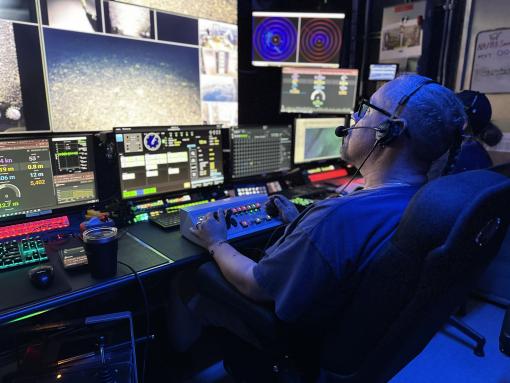
But how does one train to pilot a 2,500-kilogram (5,500-pound) piece of equipment thousands of meters below the sea? It starts with a the role of copilot on ROV Atalanta—checking dozens of camera feeds and keeping an eye on ROV Hercules during the early weeks of an expedition.
Soon, trainees practice with the manipulator arm while still on deck or during an ascent, learning to move one joint at a time and point to marked spots on the aft deck or the ROV's porch.
Then it's time to put practice into motion. The copilot typically operates the arm during sampling, and at any given moment, three pilots are on watch, allowing for breaks and space for training alongside the work itself.
Collecting some samples presents more risk than others. Triggering a Niskin bottle with the arm, for instance, requires constant awareness—a wrong angle and the arm can strike another part of the ROV or damage the equipment. Collecting a specimen is its own kind of art.
A pilot also works across multiple camera angles at once, weighing questions in real time: Does the scientist want the whole organism, or just a branch? Is it mobile or fixed in place? Are there currents to fight, or uneven terrain to navigate? Where is the ship in relation to the ROVs? Or Atalanta in relation to ROV Hercules? A skilled pilot calculates collection angle, camera zoom, nearby specimens to avoid, depth perception, attachment points, and size—a constant stream of information processed mid-motion, like a dance.
And when the sample comes up clean, the control room erupts: "That was simply art."
For an intern learning to sample, the moment can be nerve-racking. Not only are they operating in a room full of people they may have met only days before, but the world is watching live. What carries them through is the steady presence of their mentors — seasoned pilots guiding them through instructions in calm, even voices, pointing out views they might be missing, encouraging them every step of the way.
For this Science Communication Fellow, watching the chat explode with cheers at a perfect grab—and just as often, with applause for the veteran pilots' patience in teaching—has been one of the quiet highlights of every dive.
Asked what his own highlight of the expedition was, Dave O'Hara didn't hesitate: "Teaching our interns and watching them grow and learn. It's been a pure joy."
As NA181 comes to a close and we walk through the wet lab to see everything collected over the course of the expedition, one thing is clear: we are grateful to the ROV pilots. The samples you brought home are essential to all of our ocean exploration work.
Exploration of Wake Island's Deep Sea
Located roughly midway between the Hawaiian and Mariana Islands, Wake Island is one of the most isolated land masses on Earth. While there have been some recent expeditions to this remote region, the vast majority of the 407,241 square kilometers of seafloor surrounding Wake remains unmapped and uncharacterized, thereby representing one of the most poorly surveyed areas under US jurisdiction.