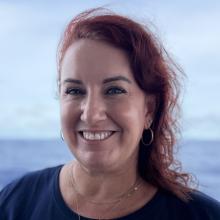
Rikki Lee Marzan
Tell us about your work/research. What kinds of things do you do?
In my classroom, I aim to create an interactive environment where science feels tangible and accessible. Marine specimens line the walls, and students are encouraged to handle and explore them. Over time, students have even begun bringing in items they find on beaches or during travel to contribute to our evolving marine “mini museum.” As the AP Biology and Marine Science instructor, I guide students in analyzing real-world data, asking meaningful scientific questions, building scientific literacy, and thinking like scientists. Alongside teaching, I develop marine science curriculum for our district’s Division of Instruction and support new teachers as they build their practice and become part of our science learning community.
Outside the classroom, I serve as our school’s Cultural Arts Coordinator, where I organize more than 15 field trips each year. These experiences include Broadway performances, opera, museums, aquariums, whale watching, and other cultural and scientific experiences. I have also developed student travel programs with a STEM focus, taking students across the world—from Europe, Iceland, and Japan to the Galápagos Islands, Cuba, and Panama.
More recently, I completed a five-year NOYCE STEM Fellowship at California State University, Dominguez Hills, which supported my growth as a mentor teacher. During this time, I collaborated with the Natural History Museum of Los Angeles on the DigIn grant, helping develop workshops that connected museum researchers and educators to bring collections-based science into the classroom.
What sparked your initial interest in your career?
Before becoming a teacher, I worked in research as well as in education at SeaWorld, where I had the opportunity to teach marine biology to students of all ages and help spark interest in protecting marine life. Over time, I realized how much I enjoyed making science engaging and accessible to others.
One moment has always stayed with me: a visitor once told me they wished they had a teacher like me because I made science fun. Around that same time, I was considering my next career step, and I realized I had found my calling—bringing my passion for marine science into the classroom.
I was fortunate to find a position where I could continue to stay connected to marine science while also inspiring students. Since then, I have continued to seek out opportunities to bring real-world exploration into my teaching and help students discover their own passions.
Who influenced you or encouraged you the most?
My biggest influences have been my family, especially my parents. On a family vacation, my dad took me snorkeling, and I was suddenly surrounded by sea turtles and vibrant, colorful fish. In that moment, I knew I wanted to study the ocean.
When we returned home to San Diego, I was lucky to live just a short drive from the beach, which allowed me to keep exploring that interest. My parents fully supported my passion for marine biology and even helped me earn my SCUBA certification at just 14.
My sisters and parents have always encouraged me to follow my curiosity and pursue what I love. Now, I feel inspired by my niece and nephew, who share that same sense of wonder and love exploring the world with me.
What elements of your work/study do you think are the most fascinating?
As someone who works with students across all grade levels—not only in science, but also as the Cultural Arts Coordinator for our school—the most fascinating part of my work is watching students grow. I love seeing them step outside their comfort zones, experience new things, and develop their curiosity about the world.
I have been fortunate to take students beyond the classroom into meaningful learning experiences, from musicals, ballet, and opera performances to museums and STEM programs in Boston and Japan. I have also led experiences connected to reef restoration projects in the Dominican Republic and Belize, as well as studies of endangered species in the Galápagos Islands and Costa Rica. In each of these experiences, I see the same transformation: students’ curiosity deepens, their confidence grows, and they begin to see themselves as capable of engaging with the world in new and meaningful ways.
How did you get involved with the Ocean Exploration Trust?
Each year, my classes participate in a live Ship-to-Shore interaction with the E/V Nautilus. During summer teacher workshops at the Natural History Museum of Los Angeles County, we also connect with the E/V Nautilus to introduce fellow educators to this amazing resource.
These interactions reignited my passion for scientific research and exploration, inspiring me to apply to become a Science Communication Fellow. Through this opportunity, I’m excited to show my students that I continue to practice what I teach and remain actively engaged in the scientific community.
What other jobs led you to your current career?
I began my career in the laboratory, researching benthic foraminifera and investigating ways to reduce desiccation rates in sea anemones. During this time, I also worked in the education department at SeaWorld San Diego, where I engaged with the public and introduced visitors to marine life and conservation efforts.
After several years in that role, a conversation with a visitor inspired me to consider graduate school and ultimately transition into a traditional classroom setting. That experience helped me realize how much I valued not only sharing science, but also teaching and mentoring students directly. Since becoming a teacher, I have continued to seek out opportunities for professional growth and curriculum development, with a focus on bringing authentic, real-world science experiences into the classroom.
What are your degrees and certifications?
Bachelor of Arts, Marine Science with a Biology emphasis - University of San Diego
Masters of Education, Teacher Education Program - University of California, Los Angeles
National Board Certified Teacher
What are your hobbies?
I set a goal to run a half marathon before I turned 30. Now, 73 half marathons, 11 marathons, and a substantial amount of other races later, I guess it’s safe to say I’m a runner. I love the feeling of crossing the finish line—and, of course, the shiny medals at the end. After a few races, I became involved with Students Run LA, an incredible organization that trains high school students to complete the Los Angeles Marathon. Supporting and running alongside students has been one of the most rewarding parts of my journey.
Outside of running, I love to travel—especially over New Year’s—to experience how different cities and cultures celebrate. I’ve also always enjoyed getting lost in a good book and trying out new recipes to share with friends and family.
What advice would you give someone who wants to have a career like yours?
We each write our own paths, and the story is always evolving. With our lived experiences, the people we surround ourselves with, and the choices we make, the path toward our dreams is rarely a straight line—it is more like a winding road of adventure. Be open to change and open to opportunity. If you encounter a roadblock, don’t be discouraged—adjust your course and keep moving forward. Every experience, even unexpected ones, can help shape where you end up.
If you find something you are passionate about, nurture it and cultivate it. Stay curious, seek out new experiences, and never stop learning. Growth often comes from the moments you didn’t plan for, and those moments can lead you exactly where you are meant to be.
Expeditions
Rikki Lee participated in the following Ocean Exploration Trust expeditions:
