The Deep-Sea at the Intersection of Science and Policy: Chatting with Members of the Cordes Lab

This piece was written by NA179 Communications Lead and OET Media and Outreach Coordinator Jamie Zaccaria.
“I’m not supposed to be doing this,” Chloé Berger tells me as we stand over a circular black barrel inside the wet lab on board E/V Nautilus.
She’s only half kidding, since the sneak peek I’m about to get involves briefly opening her most precious research material of this cruise: liquid nitrogen. Berger lifts the lid and lets the white smoke signaling evaporation waft upwards briefly before resealing and putting it away. She goes on to explain why this massive barrel has been lugged onto our ship in the first place.
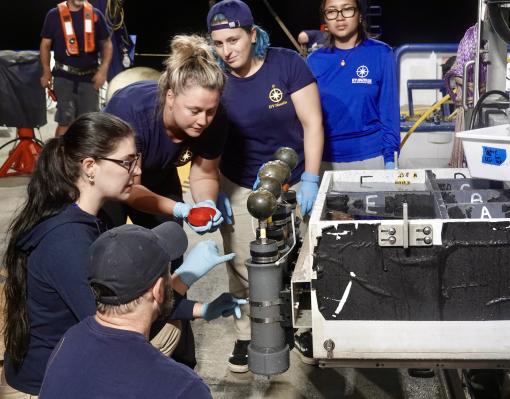
During the NA179 expedition to explore the deep-sea near the Mariana Islands, Berger is collecting deep-sea sediment samples using push cores on ROV Hercules. After the vehicle returns to deck, part of each sample will be flash frozen in liquid nitrogen to preserve the integrity of its genetic material. Then, back at the Cordes Lab (headed by NA179 Co-Science Lead Dr. Erik Cordes) at Temple University, Berger will analyze the genetics of the sample’s microbial community living among the grains across multiple depth layers and attempt to design live incubation experiments. It's precise, challenging science, but she’s up for the challenge.
“Flash freezing samples with liquid nitrogen is the gold standard for preserving the integrity of the genetic material; RNA in particular, since it degrades really fast,” says Chloé Berger. “Given that we’re taking these samples literally from kilometers beneath the sea, it’s important to freeze and preserve them for later.”
Chloé is part of the Erik Cordes Eco-Oceanography Lab at Temple University. As an undergraduate, she’s worked on many different projects in the lab relating to deep-sea biogeochemistry, but her biggest interest lies in studying microbe-mineral interactions. Specifically, how do microbes in their feeding and lifecycles interact with metals on the seafloor?
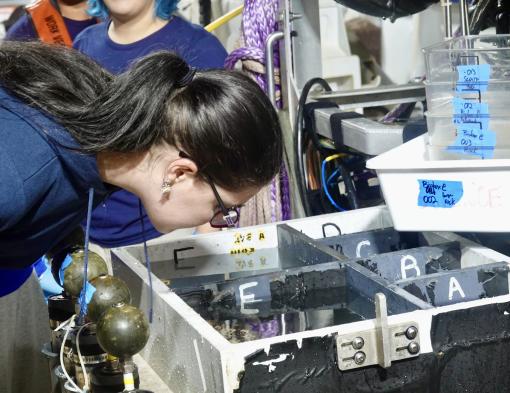
Learning how microbes cycle rare earth elements in the deep-sea is especially critical now as the world's attention focuses on polymetallic nodules and critical minerals found across the deep-sea environment. Up until this point, the mechanisms behind nodule mineral accumulation have been broadly attributed to inorganic chemical reactions, but Berger believes this simplification ignores the impact of microbes. That’s why she’s hoping her genetic sequencing and live incubation experiments will shed some light on this ecological process. Back at the lab, the sediment cores will undergo chemical composition analysis to better understand the association between microbes and mineral accumulation.
“I think it’s wild that microbes can eat and create rocks and make such large-scale changes in the deep-sea, despite being so small,” says Berger. “Understanding all the elemental and mineral cycling in the ocean is incredibly complicated, and there’s much more to learn.”
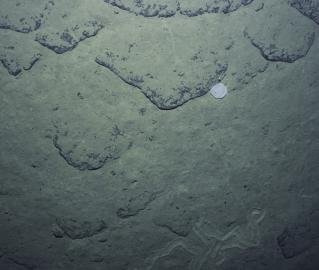
Berger tells me that deep-sea sediments are notoriously undersampled worldwide. This region of the Western Pacific is especially data-poor in terms of sediment sampling, partly because of the regional ocean's depth.
Before Nautilus set sail from port in Guam, I accompanied Berger to the famous island K-Mart to stock up on snacks and sunscreen. While browsing the outdoor aisle, she nodded toward a pair of basic metal BBQ skewers, telling me that they might be a good backup tool for dipping samples into the liquid nitrogen. This is a good reminder that much of deep-sea exploration is driven by personal creativity. You have to work with what you've got, and sometimes that includes a trip to the supermart store.
“These sought-after metal deposits take millions of years to accumulate, and yet we’re not entirely sure how that process works or what will happen if we disrupt it. There’s so much we still don’t know about the interactions between the biotic and abiotic factors of these metal deposits,” says Berger.
A cursory visual glance at her samples shows color banding, a clue toward differences in chemical composition throughout the core’s depth. Chloé is excited to see how microbial communities may reflect this pattern. She also refers to deep-sea science being inherently unique because it lives at the frontier of exploration, requiring more interdisciplinary knowledge than many other specialties.
“This expedition team just dove in places that no one has ever seen before, and that is so special,” she says.
Marina Garwood is another member of the Cordes lab who recognizes how special deep-sea exploration is. A PhD student at Temple, Garwood also serves as the Science Policy Advisor for the Deep-Ocean Stewardship Initiative (DOSI). Her research focuses on developing a baseline study for the deep-sea in a post-Biodiversity Beyond National Jurisdiction (BBNJ) agreement environment.
I chatted with Marina right after she presented a lightning talk on the BBNJ to the Corps of Exploration aboard the ship in the mess. Framed by condiment bottles and all the sounds of a moving vessel, Marina delivers a clear, concise, and informative explanation of the agreement, which sets out for United Nations countries to ensure conservation and sustainable use of marine biological diversity in the high seas. She is incredibly passionate about it, and it shows.
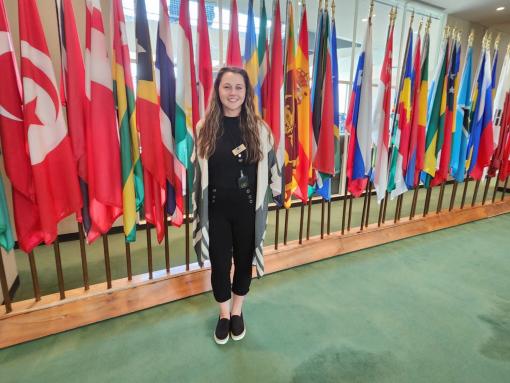
“There’s no one-size-fits-all for this. Each environment is unique and will need its own subject matter expertise. My baseline study is only going to be an example of how implementation may look,” Garwood says.
For her work, Marina is collecting data from the sediment, from microbes to megafauna in the water column and benthic environment. “With baseline studies, you want to leave no angle unchecked and no stone unturned,” she adds.
Comparing the process to “3D chess,” Garwood explains that baseline studies are crucial for knowledge growth, especially in light of increasing conversations around deep-sea mining.
“The discussion around deep-sea ecology and exploitation is exploding. My position at DOSI didn’t exist five years ago,” she says. Although daunting in the face of ongoing climate change and potential impacts of expanded human impacts in the deep-sea, Marina believes she has “no choice but to be optimistic about the future” because she “wants to do good work.”
Luckily for Marina, Dr. Cordes chose to integrate marine policy into his research laboratory, and her graduate goals happened to perfectly align. This connection eventually led her to this expedition on board E/V Nautilus.
“Being on Nautilus means I get to live in both worlds; I can work with policy and decision-makers at home while getting to experience being out here living and working with the scientists collecting actual data,” Garwood says. “To be an explorer in this day and age is so rare and wonderful. I couldn’t do a desk job after this!”
Marina recalls being at the United Nations and feeling frustrated with issues facing international ocean governance. She wanted to make sure science was part of the ongoing conversation, especially around areas like the Mariana Islands and other regions in the Pacific designated as Pacific Small Island Developing States (PSIDS).
“PSID communities will be disproportionately affected by decisions made about how all nations treat the Pacific Ocean. They live and breathe the sea and deserve access to the ocean that is so environmentally and culturally important to them,” she says. “You can’t have the global without the local.”
Marina reminds me the deep ocean controls so much of what we love about our planet, and it’s imperative we study every aspect of it, like Chloé is doing with her sediment core samples.
“Chloé’s samples will be very important to future baseline studies. That's why we’re both out here- to understand our ocean and make the best possible decisions around its use.”
Stay tuned for more updates from our NA179 and NA180 expeditions exploring the deep-sea of the Mariana Islands, and tune in for LIVE streaming exploration of the ocean floor at NautilusLive.org
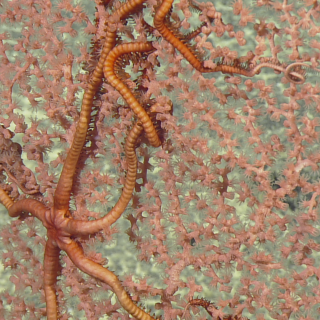
Deep-Sea Habitats in the Mariana Islands I
This expedition will focus on exploring the Mariana region- one of the ocean's most tectonically and volcanically dynamic locations, marked by the Earth’s deepest oceanic trench, some of the most active submarine volcanoes, and some of the oldest seafloor on the planet.