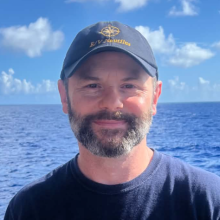
Erik Cordes
Tell us about your work/research. What kinds of things do you do?
I am a deep-ocean ecologist and oceanographer specializing in cold-water corals and natural gas and oil seeps. I also worked on the damage assessment after the Deepwater Horizon oil spill, and I am now helping with the restoration of the deep-sea communities that were impacted. It led to my work with the Deep Ocean Stewardship Initiative on offshore drilling and, more generally, the environmental impact process for the deep sea. But my day job is as a Professor and the Chair of the Department of Biology at Temple University.
What sparked your initial interest in your career?
I always wanted to be a Marine Biologist (like many of the people reading this) but I didn’t really know what that meant. In college, I had an internship where I learned that most of the species in the deep sea are still undescribed. That immediately determined the course of my career.
Who influenced you or encouraged you the most?
My advisors in my graduate studies, Dr. James Nybakken at Moss Landing Marine Labs and Dr. Chuck Fisher at Penn State, both had a huge influence on the direction of my career and were always very supportive. But there are always a lot of ups and downs in your studies and your career. My family and an incredible group of life-long friends have always helped to support me in those tough times.
What element of your work/study do you think is the most fascinating?
I have been fortunate in my career to explore new areas of the seafloor all over the world. It is such an amazing feeling any time you get to see something completely new, that no one has ever seen before. Now I get to share that experience with students and early-career researchers.
What other jobs led you to your current career?
I had along path to my career. I didn’t always think that I wanted to be in academia, so I tried out a lot of different things. These included: building a sewage treatment plant on an island in the Gulf of Maine (Star Island), repairing a wooden ship in someone’s backyard, dune restoration in California, working in facilities at Moss Landing, construction laborer, teaching community college, and docent at a small marine lab.
What are your degrees and certifications?
Ph.D. in Biology from Penn State, M.S. in Marine Science from Moss Landing Marine Labs, and B.S. in Marine Science with a concentration in Biology from Southampton College.
What are your hobbies?
I love music and I am an avid record collector. Everywhere I travel, I find the part of town with the most record stores and go hang out there. I buy records as souvenirs and find really interesting parts of cities that way.
What advice would you give someone who wants to have a career like yours?
Try lots of different things. Every career consists of lots of little skills that you will pick up along the way. Plumbing really comes in handy as a marine biologist… But the most important thing is to learn what you do NOT want to do. Don’t get stuck in a job you hate.
How did you get involved with the Nautilus Exploration Program?
I first heard about Nautilus when they were still in the Mediterranean, and I sent some students out to sea on a few of those cruises. The first time I had a chance to sail on Nautilus in 2013 when it came into the Gulf of Mexico and I was working on the damage assessment from the Deepwater Horizon.
"My favorite part of my job is to visit parts of our planet that no one has ever seen, and there's no better way to do that than on the Exploration Vessel Nautilus."
Expeditions
Erik participated in the following Ocean Exploration Trust expeditions: