The People You Meet

This blog was written by NA178 Communication Lead Marley Parker.
Boarding Nautilus in Honolulu Harbor comprises a familiar routine: haul my bags up the gangplank, exchange greetings with shipmates, review handover notes, and settle back into the rhythm of ship life. On my way up to the control van, I stop on the social deck to introduce myself to one of our seafloor mapping and hydrography interns, Richie Valdez. As we shake hands, I ask Richie if he’s ever been to sea before.
“Oh yeah, it’s just been a while,” he says casually. “I used to be in the Navy.”
It will be another week before I find out that Richie not only served in the Navy, but he was a navigator on submarines. And he hasn’t just been to sea before – he has ventured as far away as the North Pole.
Meeting folks like Richie is one of the most special aspects of working on Nautilus. Our shipmates come from all over the world and from all walks of life. And if you ask the right questions at the right time, they might tell you about some extraordinary experiences.
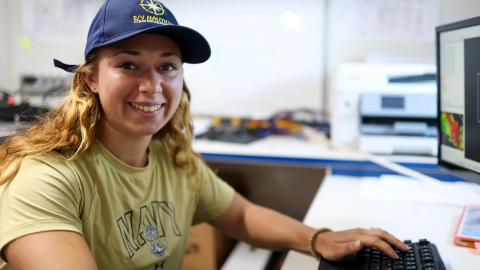
During this expedition, I have enjoyed learning from three people who share a common thread in their life tapestry: US military service, specifically in the United States Navy. Over the past two weeks, Gaby Espino, Richie Valdez, and Laura Gilfert have told me about what they’ve gained from the Navy and how those experiences have served them in building STEM careers and during their time aboard Nautilus.
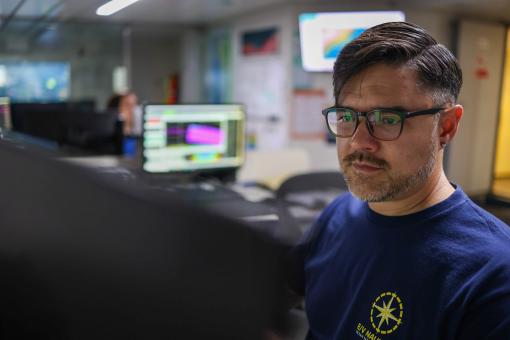
NA178 seafloor mapping and hydrography intern Richie Valdez onboard E/V Nautilus.
Hearing the Stories
It starts with a story – or many stories. A childhood spent listening to tales of a parent or grandparent demonstrating courage and discipline in the service of their country. When Gaby was little, she was fascinated by stories of her grandparents in World War II. “My grandmother in Australia was in the women's army service,” Gaby explains. “She drove officers around, and that’s how she met my grandfather.”
Laura grew up listening to her dad talk about his 20-year career in the Navy. By the time Laura was born, he had retired from the Navy, but the stories persisted.
“He told me about all the traveling he did and the friends he made. He also told me about how he started working when he was 14-years-old,” Laura says. “Joining the Navy was a way to create stability for himself and to support his family.”
For Richie, the tales of Navy service, patriotism, and camaraderie came from his grandfather, who was a fighter pilot in World War II.
“He absolutely loved the Navy, so I guess some of that rubbed off on me,” Richie says. “I joined right after I graduated from high school when I was 17-years-old.”
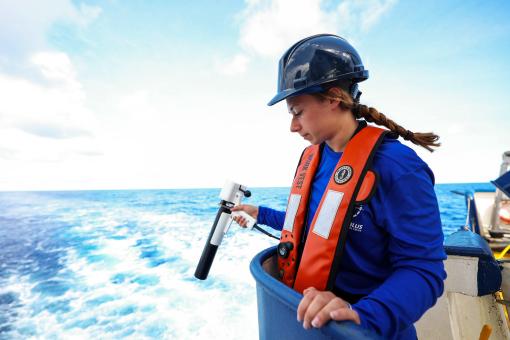
NA178 seafloor mapping and hydrography intern Laura Gilfert onboard E/V Nautilus.
Seeking out Opportunities
For many people, the Navy (and other branches of the military) can serve as a pathway to opportunities and possibilities that might not be possible otherwise – that was certainly the case for Richie. Right after high school, he left a volatile environment in Albuquerque, New Mexico, and entered the stringent structure of boot camp in Great Lakes, Illinois. Richie then completed a year of specialized training to work on submarines and was assigned to the USS Santa Fe, a Los Angeles-class submarine stationed in Pearl Harbor.
“I chose submarines because they sounded cool,” Richie says with a grin. “Remember – I was 17.”
Richie describes submarine qualification as a brutal experience. “It’s designed that way intentionally,” he says. “I was a clueless teenager, and I was thrown into one of the most complex environments in the world – I had to learn a lot of complicated things really quickly.”
While daunting at the time, Richie believes those experiences accelerated his brain's processing speed. At a young age, the Navy forced him to become a fast learner – and his mind has functioned that way ever since. To this day, Richie can pick up new skill sets very quickly.
As he learned all about electrical, mechanical, and computer systems, Richie gained a better understanding of how everything is connected and integrated. “In all these processes, you learn how things interact, and it allows you to see the bigger engineering picture,” he says. That mindset served Richie well when he completed his Navy enlistment contract and started working as a technician and eventually an engineer.
Gaby and Laura took a different path to service by gaining acceptance into the United States Naval Academy in Annapolis, Maryland.
A highly disciplined and motivated child, Laura first learned about the Naval Academy while her older brother was applying to colleges. “I thought it was something I wouldn’t be able to do,” Laura says. “But I kept learning about it and thinking about it – I thought it was really awesome.”
She was only 13-years-old at the time – still in middle school – but her mind was made up. She was going to attend the United States Naval Academy.
Over the next four years, Laura invested all of her energy into this goal. She met with current and former military members, obtained letters of recommendation, and secured the necessary nomination by political leaders in her home state.
This fall, Laura will enter her final year at the Academy, where she is majoring in Oceanography. After finishing school, she hopes to become a Navy pilot.
Gaby demonstrated a similar sense of drive and determination in her youth. Growing up with an older brother, Gaby says she was a tomboy, intent on doing everything the guys did. She excelled in athletics and joined Junior ROTC in high school.
“I think it’s in my blood,” she says. “The women in my family have always been very driven.”
Gaby entered the Naval Academy in 2010 and studied Oceanography. Growing up in Hawai’i and listening to stories passed down by watermen, Gaby always felt a connection to the ocean and a deep sense of appreciation for our planet.
“I joined the Navy because I wanted to see the world, but then I got stationed in Oklahoma,” she says, laughing. “I was there the majority of my time.”
For four years, Gaby worked as a Naval Flight Officer (NFO) aboard the E-6B Mercury aircraft, often referred to as the “Doomsday Plane”. Its primary mission is to ensure unbroken command and communication between the President, the Pentagon, and US strategic forces in the event of a nuclear attack.
Running through simulations and training for apocalyptic scenarios was fascinating but also a bit depressing. Gaby knew she didn’t want to do it forever.
“I loved flying, and I loved my crew, but I wanted to do something with my oceanography education,” Gaby says. “I wanted to do something that helps our planet.”
She decided to make a career pivot, from air to sea.
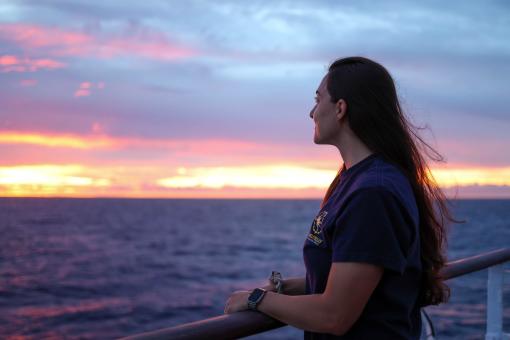
Seafloor mapper Gabby Espino onboard E/V Nautilus.
Working on Nautilus
“When we look at a globe, we often take for granted how much work has gone into knowing what our planet looks like,” Gaby says. “And we are just now starting to really see what is underneath the ocean. It’s still a major frontier.”
Gaby first sailed on E/V Nautilus as a mapping intern in 2023, and she now works as a regular contractor for the Ocean Exploration Trust. While collecting seafloor data can often feel repetitive or even tedious, Gaby maintains a steadfast enthusiasm and appreciation for the work.
“Not many people can call themselves professional explorers,” she says. “We don’t always have that mentality when we’re staring at computer screens for hours – but we should. The thrill of exploration is always here.”
Richie echoes some of Gaby’s sentiments as he reflects on his first expedition aboard Nautilus.
“It’s one thing to use nautical charts – it’s another thing to collect the data that they are based on,” he says.
Richie has found the hands-on nature of the work highly beneficial as well. Even with years of experience on submarines, Richie has learned many new aspects of sonar operations that he didn’t know before joining this expedition. “Sonar technology is an insane feat of physics and engineering,” he says. “I’ve learned a lot about mapping while we’ve been out here.”
When I ask Richie, Gaby, and Laura about the biggest life and career lessons they gained from the Navy, their responses are similar. Learning how to stay calm in stressful environments. Multi-tasking effectively. Communicating clearly. Living with people in tight quarters.
“The submarine I worked on was a similarly sized vessel, but we had a much bigger crew in a more confined space,” Richie says. “You have to rely on your shipmates.”
“I think the best part of the Academy is also the best part of Nautilus,” Laura says. “It’s the people you meet.”
With support from the Office of Naval Research, Ocean Exploration Trust proudly partners with the United States service academies to offer training opportunities for US Naval Academy midshipmen and US Coast Guard Academy cadets, providing real-world at-sea STEM experience in navigation, ocean science, and engineering through participation in the Nautilus Exploration Program.
Pacific Mapping
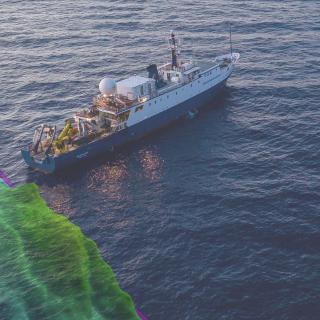
Our first expedition of the 2026 season is a seafloor mapping expedition from Hawaiʻi to Guam, where E/V Nautilus will support subsequent expeditions exploring deep-sea habitats around the Mariana Islands.