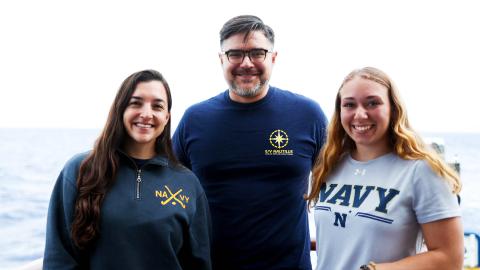
Richie Valdez
Tell us about your work/ research. What kinds of things do you do?
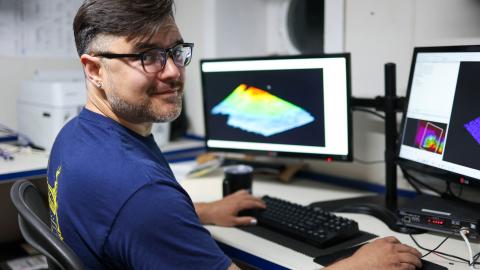
My research focuses on using remote sensing and mapping tools to better understand and measure real-world environments. In the field, I collect photos and video, then turn that data into 3D models that let me explore landscapes from new perspectives. I also work with data from tools like sonar and lidar, which are used to map the seafloor and large areas of the Earth. I’ve used these methods in both ecological and archaeological settings, including studying what wildlife cameras can see and reconstructing environments to measure distance and space. A lot of the work happens after data collection, when I use these models to take measurements and check how accurate they are. I’m especially interested in applying these techniques to underwater environments, where mapping can be more difficult, and finding ways to make these tools more practical for research and exploration.
What sparked your initial interest in your career?
My interest in this field really started during my time in the U.S. Navy, where I worked as a submariner and was exposed to navigation and seafloor mapping. Seeing detailed images of the ocean floor made me realize how much of the world is still unexplored. After returning to school, I became interested in archaeology and began to see how the same mapping tools could be used to study the past. I’m especially interested in finding and studying archaeological sites underwater, where so much history is still hidden. The idea that there are still places we haven’t seen or fully understood is what keeps me coming back to this work.
Who influenced you or encouraged you the most?
I’ve been influenced by a mix of family, mentors, and people I’ve worked with along the way. My grandfather, who served as a Navy pilot, helped spark my early interest in the ocean, and explorers like Robert Ballard showed me how much there is still to discover beneath the surface. In school, my professors encouraged me to combine my interests in technology and archaeology, which helped shape the direction of my work. Having people who believed in me and shared their knowledge has made a big difference.
What element of your work/ study do you think is the most fascinating?
What I find most fascinating is the idea that there are still entire archaeological sites that haven’t been discovered yet, especially underwater. Many of these places have been buried, eroded, or hidden over time, and using mapping tools to study them feels a bit like solving a puzzle, where small pieces of data come together to reveal something much bigger. In many cases, you’re looking at landscapes that haven’t been seen for thousands of years. That sense of discovery is what makes the work exciting for me.
How did you get involved with Ocean Exploration Trust? How did you become part of the expedition team?
I first learned about Ocean Exploration Trust while researching graduate programs and came across the work of Robert Ballard, whose discoveries first got me interested in ocean exploration as a kid. While looking into his work and academic programs connected to it, I discovered the E/V Nautilus and started following expeditions through Nautilus Live. Seeing that work in real time made me want to be part of it, so I applied to the seafloor mapping internship last December. I was fortunate to be selected for the expedition team.
What other jobs led you to your current career?
I served in the U.S. Navy as a submariner, where I worked in navigation and was involved in seafloor mapping. That experience gave me my first exposure to ocean exploration and technical problem solving in real-world conditions. After leaving the military, I worked in engineering, building experience with complex systems and applied problem-solving. I later transitioned into archaeology and geospatial science, where I could apply those same skills in a new context.
What are your degrees and certifications?
Bachelor of Science in Anthropology (Archaeology) and Geography — University of New Mexico 2026
Associate of Applied Science in Aviation Maintenance — Central New Mexico Community College 2012
What are your hobbies?
I enjoy traveling and exploring new places, especially outdoors. In my free time, I play guitar, practice archery, and go roller skating. I also like tinkering with electronics and working on small technical projects.
What advice would you give someone who wants to have a career like yours?
If you’re interested in a career like this, focus on building a mix of skills and finding ways to combine them. Try different things early on, even if you’re not sure they’ll stick, and take opportunities to see what the day-to-day work is actually like, because it’s often different from what you expect. Don’t be afraid to take a non-traditional path, since a lot of opportunities come from unexpected directions. Most importantly, stay curious and keep learning, because there’s always more to explore.
What excites me most is the idea that at any moment, you could be looking at something no one has ever seen before.
Expeditions
Richie participated in the following Ocean Exploration Trust expeditions:
2026
Gallery Highlights