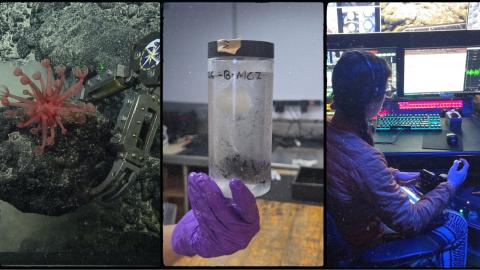
Wake Island: Searching for a Battlefield Beneath the Waves

This blog was written by the Director of Education and Outreach Megan Cook.
“December 7, 1941, a date which will live in infamy,” boomed President Franklin D. Roosevelt as he addressed Congress and a bereft nation following the attacks on Pearl Harbor, announcing the US’s launch into the Second World War. But did you know that Pearl Harbor was only one of five simultaneous attacks launched that fateful December day?
More than 2,000 miles west, the remote atoll called Wake was also hit with a surprise air assault. On this extremely isolated island cluster, the United States Navy had been constructing a military base to support long-distance bombers and Marine Fighter Attack Squadron VMF-211 since January 1941. Eleven months later, there were nearly 1,200 construction contractors and military personnel on Wake when Japanese bombers appeared within hours of the attack on Pearl Harbor.
This began a 16-day assault — the Battle of Wake — one of the first engagements of the United States’ participation in World War II (WWII).
During the Exploration of Wake Island's Deep-Sea expedition (NA181), the E/V Nautilus team will search for maritime heritage sites from the Battle of Wake and hope to explore them through systematic, non-invasive archaeological surveys. As the team explores this battlefield, we honor the stories of service and sacrifice by Japanese and American WWII service members and Chamorro public contractors, and uncover history together from the details of the Battle of Wake Island's final seafloor resting place.
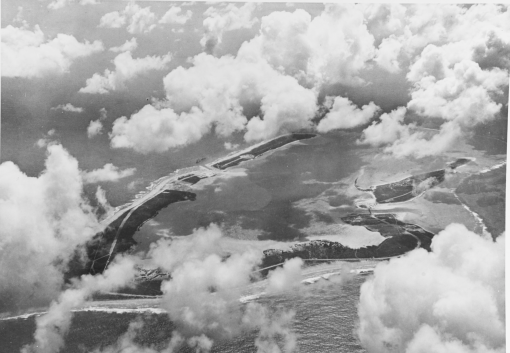
Aerial view of Wake Island (25 May 1941)
A Remote Island on the Eve of War
What we know as Wake Island is not one island but three: Wake, Wilkes, and Peale. Ringing a shallow lagoon on the rim of a submerged volcano that rises from the seafloor 5400 meters deep, they sit more than 2,000 miles from Hawaiʻi and roughly 450 miles from the nearest land in the Marshall Islands. There is no natural water source on any of the three islands, with a maximum elevation of only 21 feet above sea level. The United States claimed and annexed the atoll in 1899, and for decades it remained little more than a stopover for birding, whaling, and coal refueling. In the 1930s, Pan American Airways used it as a fueling and overnight stop for its first transpacific “Clipper” seaplane flights, complete with a small hotel for passengers.
As U.S. tensions with Japan grew through the late 1930s, naval planners began to see Wake differently, as a forward outpost that could extend American reach deep into the Central Pacific. Construction of a larger naval air station began in 1941 under a civilian firm, Morrison-Knudsen Corp., which by December had more than 1,100 workers on the atoll racing to finish airfields, fuel storage, and defenses. That August, roughly 400 Marines of the 1st Defense Battalion arrived under Major James P. S. Devereux. Twelve Grumman F4F Wildcat fighters of Marine Fighter Squadron VMF-211, ferried west aboard the carrier USS Enterprise, landed on Wake on December 4, just four days before the war reached them. The base was still unfinished: radar equipment meant for the island remained back in Pearl Harbor, rudimentary coastal battery emplacements, and protective aircraft revetments had not yet been built.
Wake at War
Word of the attack on Pearl Harbor reached Wake at 6:50 a.m. on December 8 (December 7 across the International Date Line). Devereux immediately ordered the Marines to battle stations, but low cloud cover and heavy surf noise, combined with the absence of radar, let 36 Japanese Mitsubishi G3M3 bombers from the Chitose air group approach undetected shortly before noon. This raid destroyed 8 of 12 Wildcat fighter planes on the ground and killed or wounded half of the squadron’s personnel. Subsequent bombing raids continued for days afterward, destroying the island’s civilian hospital and Pan-Am air facility.
On December 11 (local time), a Japanese invasion force under Rear Admiral Sadamichi Kajioka approached Wake’s southern shore with three light cruisers (Yūbari, Tenryū, and Tatsuta), six destroyers (Yayoi, Mutsuki, Kisaragi, Hayate, Mochizuki and Oite), two transports, two patrol boats, two submarines, and 450 Special Naval Landing Force troops. Despite barrages from the warships inching closer, US Major Devereux held his gunners’ fire until the ships got within range of Wake’s 5-inch coast-defense guns. Ships closed within 4,500 yards, and the coastal guns opened up. The destroyer Hayate, hit by three two-gun salvos, broke apart and sank almost immediately with the loss of all but one of her crew of 168 sailors. It was the first surface Japanese warship sunk in WWII.
After Hayate was sunk, US forces struck commanding Admiral Kajioka’s flagship Yubari 11 times, who ordered the invasion force to disengage. As the Japanese ships retreated, four remaining US Wildcat fighters pressed the attack. A 100-pound bomb dropped by F4F pilot Captain Henry T. Elrod struck the destroyer Kisaragi, setting off an explosion and sinking the ship with all 157 hands.
This effort marked the only successful repulse of a Japanese amphibious landing by coastal artillery alone during the entire war. However, Marine air cover was now non-existent, with only two Wildcats remaining in working condition. While this US victory was the first in the Pacific, it was short-lived. Japanese bombing raids continued daily.
Word of the defensive victory prompted a hurried relief effort at Pacific Fleet command in Honolulu. Task forces built around the carriers Saratoga and Lexington were planned to depart Pearl Harbor to reinforce Wake and evacuate civilians. Yet, the heavy toll of the attack on Pearl Harbor and logistical refueling issues delayed their departure. On December 20, a PBY Catalina flying boat arrived at Wake with secret orders to prepare for a large-scale evacuation. But reports that Japanese carriers were still operating near the atoll led Vice Admiral William Pye, the temporary commander of the Pacific Fleet, to recall the entire Wake relief force on December 22 rather than risk some of the few operational U.S. carriers in what he judged as an increasingly hopeless position.
That same day, the Japanese returned to Wake in far greater strength, reinforced by the bombers aboard aircraft carriers Sōryū and Hiryū, fresh from the Pearl Harbor strike, along with additional cruisers and destroyers. In the early hours of December 23, roughly 1,500 Japanese naval infantry came ashore. The defenders, worn down after two weeks under siege and with no further hope of relief, fought through the morning before the U.S. Navy Commander Winfield Scott Cunningham ordered the surrender. Both sides suffered tragic losses, including Pilot Elrod, who was killed that day providing covering fire for fighters resupplying a gun position; he was later posthumously awarded the Medal of Honor, as the first Marine pilot to score air-to-air victories and the first Marine to receive the medal in World War II.
The Battle of Wake’s toll on both sides was heavy, with the loss of over 650 lives, including Japanese and American soldiers, as well as Chamorro civilian contractors. More than 1,600 American military personnel and civilians were taken prisoner. The 16-day battle also lost Hayate, Kisaragi, US supply boat Nisqually, Imperial Japanese Navy submarine RO-66, and 21 aircraft- none of which have been located.
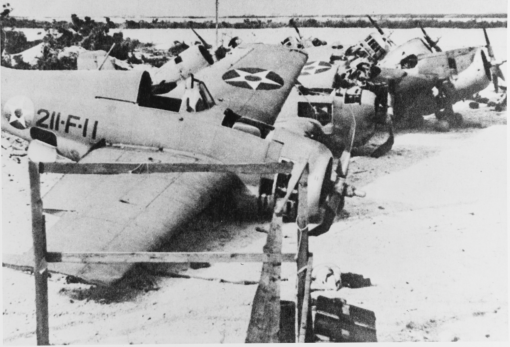
Wrecked Grumman F4f-3 Wildcat fighters photographed 23 Dec 1941 80-G-179006
Occupation, Loss, & Liberation
Japan held Wake for the remainder of the war and reinforced it with formidable defenses, even as advancing American forces bypassed it rather than retaking the island. Submarine patrols and periodic U.S. air raids cut off resupply, leaving the Japanese garrison and the American prisoners still held on the island to face severe shortages. Starvation was rampant. Conditions grew so desperate that hunting local wildlife for food contributed to the extinction of the Wake rail, a small flightless bird found nowhere else.
For the prisoners still on Wake, the war’s final years were especially brutal. Most of the American servicemen captured in December 1941 had already been shipped to prison camps in Japan or Japanese-occupied China, where they endured years of forced labor, starvation, and disease before being liberated at the war’s end. In October 1943, fearing an American landing that never came, the island’s Japanese commander, Rear Admiral Shigematsu Sakaibara, ordered the execution of 98 civilian contractors who had remained on the atoll as forced laborers. After the war, Sakaibara was tried, convicted, and executed for these war crime killings. The reality was two-fold, though, and both the 98 American contractors and all of the Japanese on-island suffered from horrific starvation and shortages caused by U.S. forces cutting off Japanese supply lines to Wake. Evacuation wasn’t possible, and tragically led to the deaths of over 1,200 Japanese from starvation and related illnesses. Following Japan’s surrender in September 1945, the remaining Japanese garrison on Wake Island surrendered to a detachment of United States Marines.
Returning to Wake, Together
More than eight decades later, the maritime heritage sites of Hayate, Kisaragi, and the other planes and vessels lost off Wake remain where they fell, underwater war graves for the sailors and airmen of both nations. Expeditions like Ocean Exploration Trust's NA181 seek to uncover this history, share these stories of service and sacrifice with a new generation, and better understand maritime heritage in its historical and seafloor context. Today, ocean exploration is interdisciplinary and international, with teams from Japan, the United States, and nations worldwide collaborating in remembrance; nations once at war now working together to understand a history they share.
Learn more:
- The Forsaken Defenders of Wake Island (US Naval History & Heritage Command)
- The Battle of Wake Island: Nation’s Morale Lifted in 1941 (The National WWII Museum)
- A Magnificent Fight: Marines in the Battle For Wake Island, by Robert J. Cressman (US Marine Corps, World War II Commemorative Series 1992)
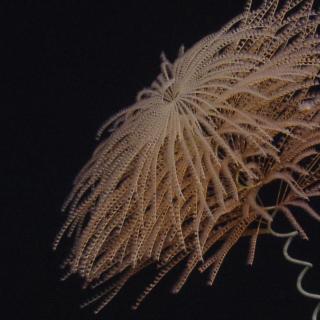
Exploration of Wake Island's Deep Sea
Located roughly midway between the Hawaiian and Mariana Islands, Wake Island is one of the most isolated land masses on Earth. While there have been some recent expeditions to this remote region, the vast majority of the 407,241 square kilometers of seafloor surrounding Wake remains unmapped and uncharacterized, thereby representing one of the most poorly surveyed areas under US jurisdiction.