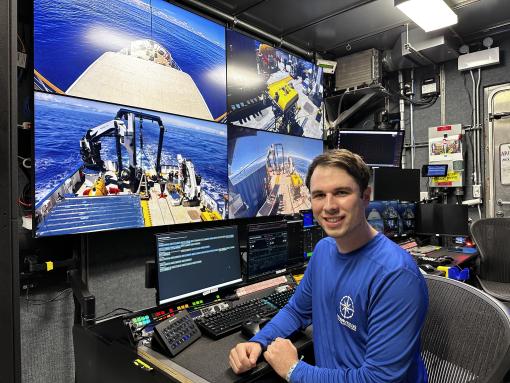
Meet Ocean Explorer Peter Webster!

OET proudly welcomes Peter Webster to the Corps of Exploration as part of the Science & Engineering Internship Program. This internship program supports community college, undergraduate, and graduate students in building professional workforce experience and exploring STEAM-related careers that connect to research themes like robotics, ocean science, education, and exploration. Peter is joining E/V Nautilus for our NA180 expedition as an ROV engineering intern.
We sat with Peter to learn more about his experience at sea and the path that led him to Nautilus. He says,
"During this expedition, I’m working as an ROV engineering intern and helping to maintain both Atalanta and Little Hercules. During dives, I cycle through the co-pilot and pilot seat, driving both ROVs and maintaining dive logs.
I grew up exploring the outdoors in California, which planted a strong appreciation for nature and our planet. This appreciation has underpinned many of my career choices and led me to some incredible places such as here aboard E/V Nautilus. The root of my fascination with ocean technology likely started after hearing stories about my great-granddad, who was a renowned oceanographer at the Scripps Institution of Oceanography at UC San Diego. Stories of the discovery of hydrothermal vents and searches along the seafloor piqued my imagination. However, it wasn’t until much later that I ever considered I might want to be a part of that world.
Through elementary and middle school, my interests swung all over the place. I considered creative writing, acting, botany, and architecture. At that point, I didn’t even know what engineering was. That all changed when I joined a newly formed FIRST robotics team and realized I had a knack for design, which had been cultivated through years of obsessive Lego building and Minecraft. I poured everything I had into that team, and in return I built a valuable set of life and engineering skills which would go on to carry me through college.
Going into UC Davis for mechanical engineering, I knew I wanted to work in marine robotics, but didn’t believe that was a very realistic goal given the competitive nature of the field and scarcity of opportunities at my university. As a college freshman, I looked for a community like my high school robotics team and came up short, so I decided to take on the task of starting something from scratch. My roommate and I co-founded our own robotics team to build autonomous underwater vehicles and compete in the international RoboSub Competition. I saw this as a chance to set myself apart and create my own opportunities. Building a team from nothing was deceptively difficult and, looking back, I can confidently say that we didn’t know what we were doing at the start, but we kept going. I was slowly able to teach myself the basics of underwater robotics and relay what I had learned to the rest of the team.
Starting an underwater robotics team provided the experience needed to land internships in lake bathymetry and agricultural robotics. While these opportunities were not directly related to the ocean, I was still able to build useful skills that could relate to underwater robotics. My advice to anyone looking to build a background and break into any field, especially ocean science, is to be shamelessly enthusiastic about your interests, because people will resonate with that enthusiasm and will want to help you. Over my journey, I’ve always proceeded with the mindset that anything is achievable, as long as I am constantly improving.
During my undergrad, I had plenty of doubts. Every year I would apply to all of the top internship programs in ocean science technology, and I was never able to land a position. It took over two years for my RoboSub team to gain any sort of serious traction or team culture. It wasn’t until the end of my senior year that everything began to work out, and I was accepted into this internship program and graduate school. The RoboSub team I started back in my freshman year now has over 40 members and performed exceptionally well at our most recent competition.
I think the lesson here is that things will work out, often in unexpected ways, as long as you keep pushing to get better. This fall, I’ll be starting at the University of Rhode Island studying ocean engineering and building low-cost monitoring technologies for fisheries in the Philippines. My final recommendation to anyone looking to join this field is not to wait for opportunities. Take the initiative: reach out to someone, sign up for that course, tackle that personal project, start a movement. It’s not only a path that lets you bypass traditional avenues, but it also builds a unique set of skills that is highly valuable and opens new doors. And lastly, don’t forget to have fun!
Deep-Sea Habitats in the Mariana Islands II
In our second expedition of the year in the Mariana region, E/V Nautilus will spend 22-days at sea.