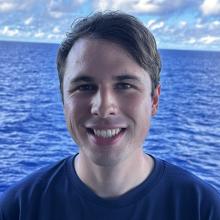
Peter Webster
Tell us about your work/ research. What kinds of things do you do?
While I’ve worked on a variety of projects, I’ve specialized in the mechanical and electrical design of marine robotic systems. At my university, I co-founded and lead a student design team that develops autonomous underwater vehicles (AUV) for the international RoboSub competition, while also supporting environmental researchers through geospatial data collection. I love designing and working with robotic systems built to operate in unusually harsh environments, such as the open ocean or remote field locations. My focus is on adapting underwater technologies to meet the specific needs of researchers, expanding the types and quality of data that can be safely collected. As an incoming ocean engineering graduate student, I will be developing low-cost, accessible monitoring technology to support fishery management in the Philippines.
What sparked your initial interest in your career?
It’s challenging for me to pin down what initially ignited my interest in underwater robotics because it was a combination of so many things. I’ve been told that I was always a curious child, and growing up, I consistently gravitated to designing and building-centered activities like Lego and Minecraft. This is probably what led me down the route of robotics and mechanical engineering, along with an exhilarating three years in the FIRST Robotics Competition as a high school student. The root of my fascination with the ocean was likely the summer visits my family used to make to San Diego, CA. While visiting, we would spend time at La Jolla Shores and the Birch Aquarium, which instilled a deep love and appreciation for the ocean. My grandmother’s father was an oceanographer and physicist at the Scripps Institution of Oceanography, and my younger self was always fascinated by the stories I’d hear of deep-sea escapades. These stories and experiences sparked a dream—I wanted to be a part of that world! (queue the “Little Mermaid” song)
Who influenced you or encouraged you the most?
Since high school, I’ve continued to look up to the mentors on my FIRST Robotics Competition team, specifically our head mentor, who was also my high school physics teacher. Having role models in my life who were extremely patient and willing to guide me, but also hands-off enough to let me safely fail and learn from my mistakes, has been instrumental in shaping who I am. Additionally, my biggest source of encouragement has been the students whom I now mentor on my high school’s robotics team, along with the members of my university’s RoboSub team. Having peers in college who back me, along with younger students who look up to me, has provided the motivation to aim higher than I ever thought possible.
What element of your work/ study do you think is the most fascinating?
I like to joke that the fun starts when things break, and I feel that there’s some truth to that. I love it when systems work as intended, but when things go wrong? That’s when it's up to you, the engineer, to take action and adapt. Deploying engineered systems in field environments is uniquely challenging because the conditions are unpredictable, and access to tools and supplies is limited. My best experiences have been repairing electrical equipment while floating on a boat and troubleshooting robot software issues mid-competition. I feel that moments like these are the best ways to learn how to calmly handle pressure and logically tackle new problems.
How did you get involved with Ocean Exploration Trust? How did you become part of the expedition team?
I first learned about the Ocean Exploration Trust (OET) by searching online to get a feel for the types of opportunities that exist in the field of underwater robotics, and I applied to the internship program for the first time in my third year of college. Funnily enough, while working on that application, I happened to duck into the back of a random lecture hall for some background ambiance, and it so happened that it was an oceanography lecture and the professor was talking about the E/V Nautilus and their internship program. It was too strange a coincidence to ignore, so I spoke with the professor and learned that she had sailed with Nautilus for her research. I proceeded to enroll in her oceanography course the next quarter. It wasn’t until my fourth year that I was accepted into the internship program, coincidentally at the same time that I was accepted into the University of Rhode Island for graduate school, which has strong ties to OET.
What other jobs led you to your current career?
Over the last few years, I’ve made a point of securing several types of experiences which have allowed me to strengthen and build a range of skills, both interpersonal and technical. Last summer, I lived on a research and development farm as a mechanical engineering intern, where I developed mechanisms for an agricultural robotics startup, and the summer before that, I was a bathymetry field intern at the UC Davis Tahoe Environmental Research Center. While working in Tahoe, my primary research project was a bathymetric survey of Donner Lake, CA, but I also had the opportunity to help with other field operations such as microplastic sampling and snorkel surveys, where we swam down two miles of the Truckee River, searching for evidence of native mussels and dodging river rafters.
At my university, I co-founded Cyclone RoboSub, an autonomous underwater vehicle (AUV) team that competes in the international RoboSub competition and has exponentially grown over my three years as a co-president. I also help to spearhead our research subteam, which builds environmental monitoring equipment for our AUV and collaborates with field researchers. I participated in the FIRST Robotics Competition as a high school student and have continued to support my team as a mentor through my four years of college.
I’ve kept my interpersonal and writing skills sharp by working as a peer advisor at my university’s Career Center, where I meet with students to review their application documents and provide support in the job search process.
What are your degrees and certifications?
Bachelor of Science in Mechanical Engineering – University of California, Davis 2026
(MS/PhD) Ocean Engineering – University of Rhode Island (starting Fall 2026)
What are your hobbies?
During the winter, I love to ski with friends or family, and in the summer, I try to get out to the beach to surf whenever I can. When I’m not buried in commitments, I love to read (mostly science fiction, fantasy, and scientific non-fiction), and I have a soft spot for books about mythology and exploration (outer space or deep ocean). I’m also an avid LEGO enthusiast and build semi-professionally, with some of my past designs being featured by a major videogame studio.
What advice would you give someone who wants to have a career like yours?
My heartfelt advice to anyone early on, seeking a career like this (or anything else), is to take initiative and be shamelessly enthusiastic. Taking initiative is especially important if you feel unsupported or that you are lacking entry-level opportunities. Getting an underwater robotics team started as a college freshman was incredibly challenging, but it also generated the experience needed to pursue opportunities like this. The trick is starting early and embracing the unknown. The other piece of the puzzle is cultivating enthusiasm and making it known to the world! Opportunities present themselves when you aren’t afraid to share your passions, even if you’re still working on gaining the experience to back them up. The happiest and most successful people I’ve met are driven by their enthusiasm, and their energy is contagious. My favorite speaker and educator, Karthik Kanagasabapathy, has an excellent TEDx talk on this topic!
If you are specifically looking to pursue a career in marine robotics, it is best to start small. Robotics, as a field, is challenging because it entails the intersection of mechanical, electrical, and software engineering. It can be really intimidating to figure out where to start. What I recommend is picking an aspect to focus on and slowly filling in the gaps as opportunities arise. A great way of doing this is surrounding yourself with people that you look up to and can learn from. The last piece of advice would be to create a simple portfolio website. If you are in engineering, you’ve probably designed some cool stuff, and you might as well show it off through a medium that allows people to SEE it. It doesn’t need to be complicated, but you’ll notice that many of the successful students in this field have one.
What excites me most about participating in deep ocean exploration is the potential to be a part of something completely new; to witness species that may have never been documented, or to see a ship that hasn't been touched by humans since it first disappeared from the surface. Exploring the deep sea is akin to exploring an alien world, filled with strange life and incredible landscapes to learn from.
Expeditions
Peter participated in the following Ocean Exploration Trust expeditions: