Situating for Success: Community College Pathways to Sea

This blog was written by NA179 Lead Science Communication Fellow Brandon Rodriguez.
For years, the Ocean Exploration Trust has made education and outreach a central mission priority, offering ship-to-shore live interactions to schools, camps, and student groups around the world throughout the expedition season. These conversations with E/V Nautilus explorers have resulted in over 7,600 interactions, reaching over 138,000 students. A library of free classroom and community resources also reaches thousands of educators and students, linking classroom topics to real-world problem-solving at sea.
Additionally, the E/V Nautilus Corps of Exploration hosts cohorts of young professionals through its Science and Engineering Internship Program, focused on ocean science, ROV engineering, seafloor mapping, hydrography, marine navigation, and video systems engineering. Each season, between 10 and 20 early-career students join the expeditions, shadowing experienced professionals, working and learning alongside the expedition team.
Yet for many students, being selected for internships can be daunting, as the process becomes ever more competitive. This is especially so for non-traditional students looking to start their careers. Community college students in STEM fields, for example, are particularly underserved, with only 16% of transfers indicating interest in a STEM major in some major university networks. These students may enter their four-year education only to face an uphill battle in accessing research opportunities. 32% of community college students are the first in their families to attend college, and 82% report having to work while attending school, making it difficult to juggle additional research experiences.
Yet, community college and technical programs are key steps in STEM educational journeys, with support and thoughtful design to ensure opportunities are well matched to students’ needs.
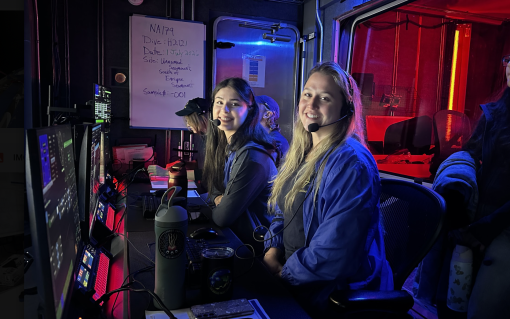
During the 2026 Deep-Sea Habitats in the Mariana Islands I (NA179) expedition exploring the Western Pacific, E/V Nautilus welcomed aboard an undergraduate student from Temple University, Chloé Berger. As part of the Cordes Lab, Chloé wrote a successful scientific proposal and was selected for a position on board to collect seafloor samples as part of the science team during the expedition. Her work explores the interactions between microbes in seafloor sediment and heavy-metal chemistry to elucidate metabolic pathways around mineral precipitation. Chloé attributes her success to her time as a community college student in Philadelphia before transferring to Temple. This particularly helped her learn to stay calm under the pressure of ocean exploration. She highlights how being a student at a junior college gave her time to focus on her future, developed her drive to balance work and school, and forced her to step out of her comfort zone to advocate for herself to potential advisors. Advisors such as Dr. Erik Cordes, who details why he is so amenable to making space for non-traditional students in his lab:
“I have always judged students more by their drive and commitment rather than grades and pedigree. This is because I was one of those students who stumbled through undergrad. It wasn’t until the last semester of my senior year in college when I did an internship that I discovered research.”
Chloé shared that it's not just their similar educational journey that drew her to the Cordes lab, but also the culture that values ambition and self-advocacy. She began attending lab meetings with the group even before transferring to Temple and started formulating her own research questions. Chloé knew that in order to stand out among the four-year students at universities, she needed to build her resume with research experience ashore before opportunities at sea would present themselves, and that meant starting locally;
“Before I transferred to Temple, I took advantage of the fact that I was a community college student and applied to programs that prioritized elevating students from similar institutions. I would advise other students to do the same by applying to REUs or other NSF-funded internships”
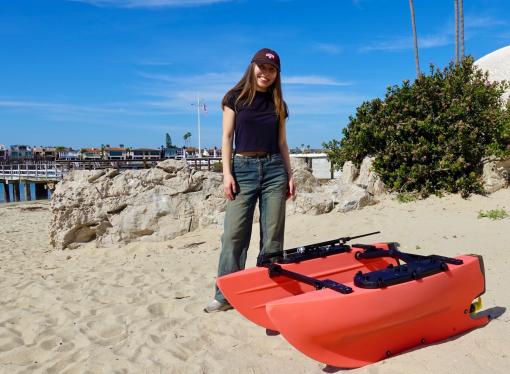
Meanwhile, back on shore in California, current community college students like Aidana Kudaiberenova are taking that advice. Aidana is completing her second major internship at Caltech’s Kerckhoff Marine Lab (KML). Aidana was part of a program specifically designed to provide research experience to community college students, called Caltech Connection. Based on her career interests in software engineering, she was paired with Dr. Victoria Orphan, a geobiologist and the director of KML. With Dr. Orphan's guidance, Aidana was tasked with helping to construct a data visualization dashboard for marine robotics to monitor local eelgrass populations. Dr. Orphan and the team at KML primarily focus on community college students, both for research and for maintaining aquatic life at the facility. Dr. Orphan writes:
“What the team at the Kerckhoff Marine Lab focuses on is not just providing students with hands-on research experience at the water’s edge, but ensuring the opportunity integrates their work and contributions with scientists and engineers engaged in cutting-edge marine research.”
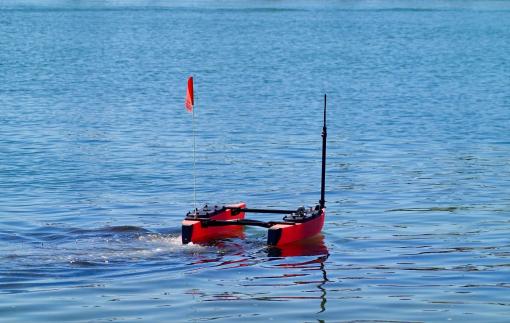
After five months in the Caltech Connection program, Aidana echoed a similar sentiment. Being entrusted with her own project, which included the deployment of her dedicated Autonomous Surface Vehicle (ASV), she developed a package that was delivered not only to the Orphan Lab but to several key mentors and passionate professionals working in similar fields, such as Caltech’s Dr. John Magyar and NASA Jet Propulsion Laboratory's Russell Smith and Dr. Andy Klesh.
Aidana has recently been accepted to a full-ride scholarship at the University of California, Los Angeles, where she will begin in the fall of 2026. She reflects;
“When I came in, I thought that I was mostly there to learn, but working on the BlueBoat dashboard made me realize that I can actually build something useful and be part of the team too. Working in the marine lab made UCLA feel less scary and even made grad school feel like something I could do one day!”
Students like Aidana and Chloé recommended that aspiring young scientists and engineers not wait to explore getting hands-on experience, even if it may not align exactly with what they think they’ll pursue as a career down the road. Instead, they urged the next wave of students, especially community college students, to get started by focusing on networks and relationships. As advice to students, Chloé closes with the following guidance:
“I encourage students to reach out to PIs at potential transfer institutions to get started building their network early, even before officially transferring. Traditional students at four-years have had two whole years to take classes with professors and establish relationships. There is no reason why you can't do the same, and it makes you stand out!”
Keep an eye on the Education page at Nautilus Live each fall as they open internship applications, sail aboard the E/V Nautilus.
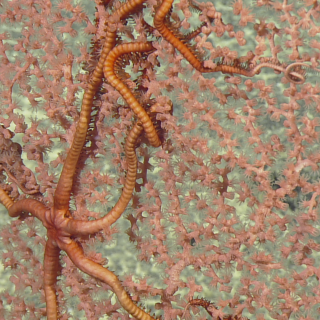
Deep-Sea Habitats in the Mariana Islands I
This expedition will focus on exploring the Mariana region- one of the ocean's most tectonically and volcanically dynamic locations, marked by the Earth’s deepest oceanic trench, some of the most active submarine volcanoes, and some of the oldest seafloor on the planet.