From Catamaran to Control Van

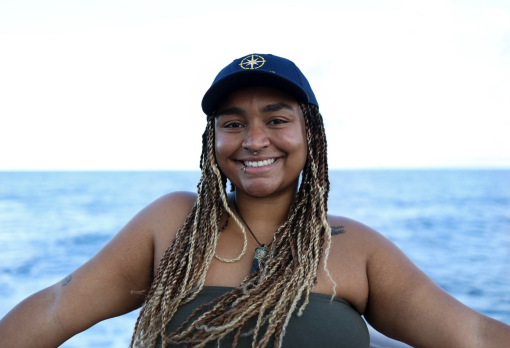
This blog was written by Science Communication Fellow Caitlyn Ogbaekwe.
I grip the bow rail of the R/V Kaholo, a 42-foot baby blue catamaran gliding through the Sampan Channel in Kāneʻohe Bay. In front of me, fluffy clouds rest atop the Koʻolau mountains—a seemingly permanent fixture, smoothing out the jagged tips of the ancient volcanoes. Sunbeams slice through the sky, illuminating the ridges in brilliant shades of green that snake down to the water’s edge.
This is pure wealth. The Kaholo is my classroom, and Kāneʻohe Bay is my laboratory. Most weeks during the semester, I spend three to five days out on these sheltered waters, driven by my own curiosity and the eager minds of my students. Protected by the only true barrier reef in the Hawaiian Islands, this semi-enclosed bay serves as a natural laboratory for coastal complexities. Restricted circulation and distinct bathymetry drive a hydrodynamic gradient across forty-plus patch reefs. It's micro-oceanography at its finest, where my goal is to connect students to the mechanics of a specific, beloved system.
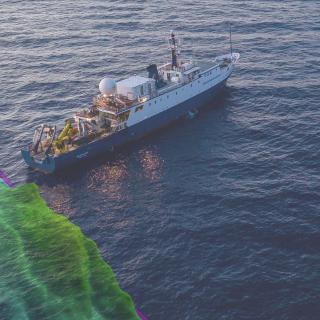
Now erase the coastline and multiply the depth by thousands. Instead of making day-trips within sight of the mountains, I am a Science Communication Fellow aboard the 224-foot E/V Nautilus, crossing thousands of miles of open Pacific from Honolulu to Guam. Out here, I’ve stepped out of the professor's seat and back into the shoes of an active learner.
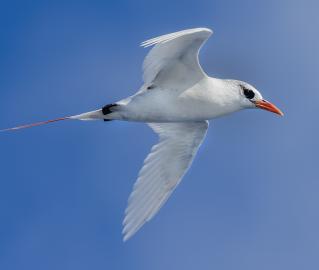
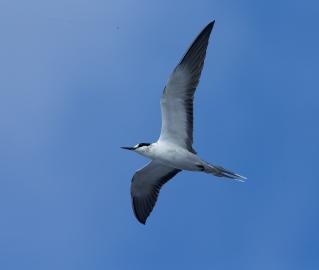
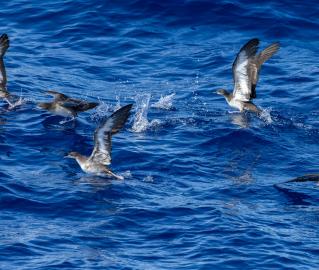
On the Kaholo, bird watching offers comfort in its predictability, mostly brown boobies balanced precariously on channel markers, or the occasional egret soaring past the vessel. Out here in the remote waters of the Central Pacific, pelagic birds claim the sky: red-footed and masked boobies try to hitch rides on our mast, wedge-tailed shearwaters skim the swells, and striking red-tailed tropicbirds streak past. I’m no expert on birding. In fact, tracking a fast-moving bird through binoculars while the ship rolls is an excellent way to lose your balance; I may or may not be constantly gripping the deck with all ten toes, trying to hang on whenever an unexpected swell catches me off guard. But thanks to the two resident "bird nerds" aboard, my watch on the monkey deck has become a crash course on seabirds.
That same educational joy translates perfectly to my hours in the Nautilus control van. This chilly, dark room, packed with glowing monitors, has become my new classroom. Back home, I teach face-to-face on the water, dripping sweat under the Hawaiian sun for hours; here, the reach is global, sharing the science done aboard the Nautilus with classrooms and communities everywhere. The medium has changed from a whiteboard that falls over every time we hit a swell to a live satellite stream. Even facing down the ominous glow of a million buttons while I shiver in the control van, the core thrill of satisfying curiosity remains exactly the same.
But my main objective on this transit unfolds in the data lab. This expedition tests the cutting-edge EM304 multibeam sonar system, mapping uncharted seamounts as we chug along the Pacific toward Guam. In the shallow, familiar waters of Kāneʻohe Bay, our work is visual and immediate. Out here, the seafloor lies miles beneath us, invisible to the naked eye, requiring acoustic signals to reveal its secrets.
Admittedly, I’m still finding my footing with the complexities of deep-sea sonar; luckily, our mappers demonstrate an abundance of knowledge and expertise. I make it a point to spend as much time as possible shadowing them. My goal goes beyond understanding the data for myself; I want to master the process so I can develop a brand-new ocean-mapping lesson plan for my university marine science students back home.
Whether I’m deploying a CTD in “Deep Hole,” the deepest part of the bay back home, or learning how to generate a high-resolution map of a massive, underwater mountain range on the way to Guam, the ultimate mission doesn't change. The ocean demands to be shared. I'm just lucky enough to gather stories from the deep blue to breathe new life into my classroom back on the coast. Living out my dream as a seagoing educator on this transit has only deepened my desire to be an ocean explorer and educator. This may be my first blue-water expedition, but it certainly won't be my last.
Pacific Mapping
Our first expedition of the 2026 season is a seafloor mapping expedition from Hawaiʻi to Guam, where E/V Nautilus will support subsequent expeditions exploring deep-sea habitats around the Mariana Islands.