Caitlyn Ogbaekwe
Tell us about your work/research. What kinds of things do you do?
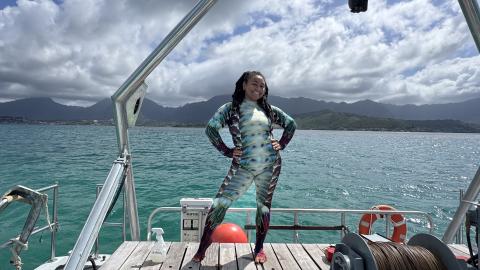
In my daily work at Hawai'i Pacific University, I wear many hats—from lecturer to internship coordinator—but my favorite 'office' is aboard the research vessel Kaholo. I specialize in teaching students how to become seagoing scientists, moving beyond the classroom to deploy state-of-the-art instruments like CTDs and sediment corers. Whether we are conducting plankton tows or monitoring fronts in Kāne‘ohe Bay, my goal is to provide students with the hands-on experience they need to understand the complexities of Oahu's nearshore waters.
What sparked your initial interest in your career?
My journey to marine science began far from the coast; growing up in landlocked cities, the ocean was a mystery I only glimpsed during family vacations to places like the Dominican Republic. Seeing algae on the shore and strange critters in the water made me wonder what else was hidden out there. That curiosity led to me pursuing an undergraduate degree in Oceanography. During my senior capstone project I stumbled upon a massive puzzle: estuarine fronts in Kāne‘ohe Bay. At the time, no one could explain why they were there—only that they existed and were acting as magnets for marine debris. Trying to solve the 'why' behind those fronts was the moment I realized I loved the challenge of scientific research, and I’ve been hooked on solving ocean mysteries ever since.
Who influenced you or encouraged you the most?
The greatest influences in my life weren't my professors, but rather my mother and my own tenacity. I didn't always fit the mold of a 'top student,' I often felt invisible in traditional classrooms. It was my mother who kept me grounded, and my own stubborn streak that kept me moving forward when the path wasn't clear. This experience is exactly what drives my work today as a lecturer and mentor; I am deeply committed to supporting the students who might be overlooked by others, showing them that passion and persistence matter just as much as a test score.
What element of your work/study do you think is the most fascinating?
What I find most compelling is helping students bridge the gap between curiosity and a career. I love guiding students through their first reef surveys, especially those who are new to the water. There is a profound transformation in their confidence from the moment they put on a snorkel to the moment they climb back on the boat. Seeing them realize they are capable of conducting real-world science in the waves—and then helping them turn that confidence into a career through internships or graduate school—is the most fascinating part of my job.
How did you get involved with the Ocean Exploration Trust?
I applied for SCF after learning about it through the Captain of the research vessel I work on. She saw it on instagram and brought it up to me thinking it would be of interest to me.
What other jobs led you to your current career?
I’ve always believed that science is most powerful when it’s shared with the community. Volunteering at different fishponds across the island and mentoring with 'Girl in Tech' gave me a deep appreciation for the human side of marine science. At the same time, my work as a MyAE influencer provided a unique foundation in digital outreach and event curation, teaching me how to communicate effectively with large, diverse audiences. These roles, paired with my technical lab experience, led me to a career where I can balance rigorous fieldwork with the storytelling needed to make that science accessible and impactful.
What are your degrees and certifications?
Bachelor of Science in Oceanography - Hawai'i Pacific University 2021
Masters of Science in Marine Science - Hawai'i Pacific University 2023
What are your hobbies?
I love camping and climbing. I frequently fall into craft based hobbies and currently that is beading. I have been loving making beaded flowers!
What advice would you give someone who wants to have a career like yours?
My biggest piece of advice is to be your own loudest cheerleader. In academia, it’s easy to feel invisible if you don’t fit a certain mold, so you have to be the one to advocate for your own potential. Focus on building a concrete toolkit—take as many skill-based courses as you can and seek out internships to see how that knowledge applied in the real world. Most importantly, be mindful of your mental health. This career is a marathon, not a sprint, and you need to take care of yourself to stay in the race.
Expeditions
Caitlyn participated in the following Ocean Exploration Trust expeditions: