Where the Wind Meets the Wing: Following Feathers Across the Pacific

This blog was written by NA178 Science Communication Fellow Preeti Pachauri.
On the first morning of sailing on Nautilus, I climb up to the monkey deck just as the sky begins to lighten. The wind presses against my shirt, warm and salty, carrying the promise of open water. Adrian Burke and Jory Teltser are already at the rail, binoculars lifted, cameras firing in quick bursts. When the first Laughing Gull sweeps across our bow, Adrian catches it instantly, his voice bright with excitement. Jory is already following the bird’s arc, adjusting his lens, murmuring field marks under his breath. Their joy is contagious. It sets the tone for everything that follows.
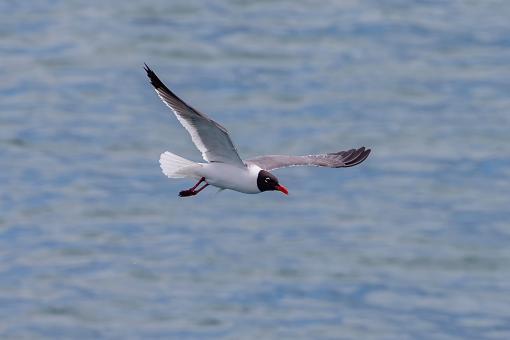
They move like a pair who have been doing this for decades—pointing out wing patterns, debating flight styles, sharing stories from their early birding days. Watching them work side by side, childhood friends reunited on a ship crossing the Pacific, adds a layer of warmth and wonder to every sighting. We are celebrating the species that will define our journey from Hawai‘i to Guam, and the week ahead feels like a tapestry waiting to be stitched with wings.
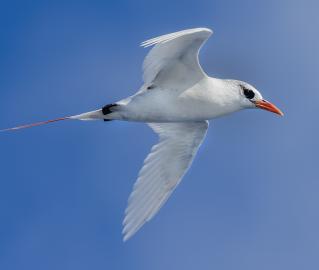
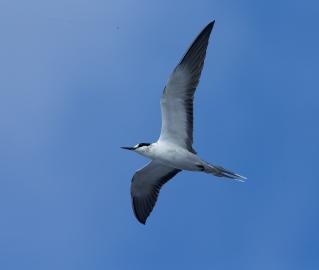
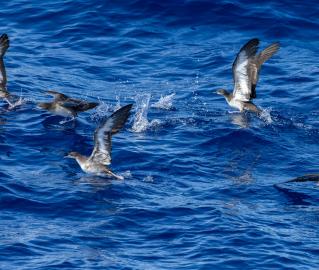
As Hawai‘i fades behind us, the ocean opens wide, and the seabirds begin to shape our days. Some mornings, the sky feels empty, washed clean by wind. Other times, the horizon erupts with wings—Brown Boobies diving like arrows, Red‑footed Boobies flashing their bright feet against the sky, Wedge‑tailed Shearwaters skimming the waves so closely they seem to stitch the ocean surface with their wings. Great Frigate birds appear like shadows carved from the wind, prehistoric and effortless. A White‑tailed Tropicbird drifts past one afternoon, its long streamer tail glowing in the sun. Sooty Terns call sharply overhead, their voices slicing through the wind before their bodies even come into view. These birds become our companions, our markers of distance and time, our reminders that even in the vastness of the Pacific, life is everywhere.
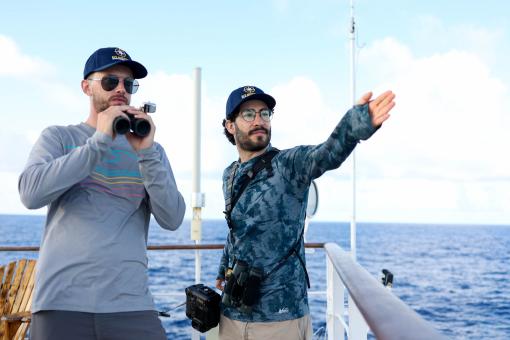
By mid‑week, after hours of watching Adrian and Jory scan the horizon with unwavering focus, I sit with them to learn more about the people behind the binoculars. Adrian tells me he grew up in New York City, just a few blocks from Central Park. At fourteen, he began wandering the park with a camera, photographing squirrels, robins, and cardinals. Everything changed the spring he encountered his first wave of migratory birds. “That was it,” he says. “I was hooked.” His earliest memory goes back even further—standing at his grandmother’s window, watching white‑breasted nuthatches visit the feeder, flipping through a backyard bird guide to name what he saw. He studied biology in upstate New York and built a career in conservation. Today, he works for the Natural Area Reserve System on the Big Island of Hawai‘i, protecting native birds and wildlife. His favorite bird is the ‘I‘iwi, a brilliant red Hawaiian honeycreeper with a curved pink bill.
“It’s charismatic,” he says. “It carries the forest in its wings.” He joined Nautilus to see seabirds in some of the most remote waters on Earth—places rarely surveyed, where anything might appear.
Jory’s story begins on the opposite coast, in Connecticut. When he is ten, a family friend takes him birding for the first time at Sherwood Island State Park. His spark bird is a Northern Saw‑whet Owl, a tiny, wide‑eyed creature that changes the course of his life. “I was hooked from that moment,” he says. He has been birding for sixteen years and is now pursuing a master’s degree in Ecosystem Science and Management at the University of Michigan. For the past seven years, he has worked professionally as a field ornithologist and biologist. He tells me he has spent “almost every waking moment” since 2010 studying field guides, eBird, calls, and identification techniques.
“But nothing replaces being outside,” he says. “The birds are the best teachers.” His favorite bird is the Red‑breasted Nuthatch, the bird he grew up with, a species that still feels like home. He didn’t choose Nautilus, he says with a grin.
“The Nautilus chose me. I would’ve been a fool to turn down this opportunity.”
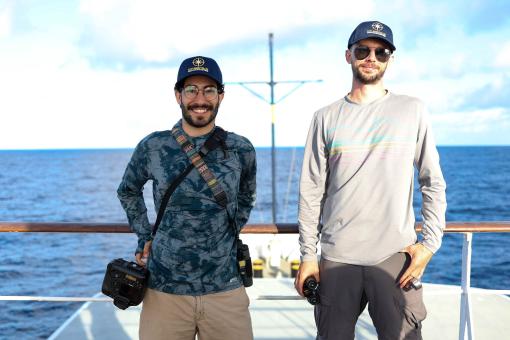
Adrian and Jory have been friends since 2016 or 2017. They text constantly, debate identifications, share sightings, and push each other to learn more. Watching them work side by side on the monkey deck—scanning, calling out, laughing, arguing gently over a distant silhouette—feels like watching a lifelong conversation unfold in real time. Their days onboard are long and demanding. They wake before sunrise, step outside into the wind, and stay out until dark. They eat quickly, return to the rail, and end each night by writing reports of every bird seen.
“It’s grueling,” Adrian admits. “But you never know what might fly by next.”
“It’s exciting,” Jory adds. “This part of the ocean is barely studied. Who knows what we might discover?”
Both offer the same advice to young birders: go outside, pay attention, protect what we have left. Learn from books, apps, and mentors. Share the marvels of nature with others. “Everyone benefits from being outside,” Adrian says. “We’re stewards of this earth,” Jory adds. “We have a role to play.”
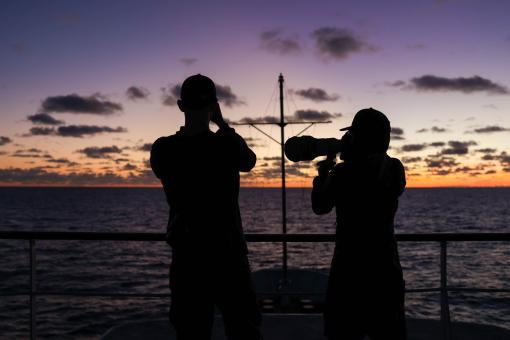
As our first week at sea comes to an end, I stand again on the monkey deck. The wind is stronger now, the swell deeper, the sky wider. Adrian and Jory are beside me, scanning the horizon with the same intensity they had on day one. A booby dives. A shearwater glides. A tropicbird flashes white against the blue. And I realize we are not just watching birds. We are watching the Pacific tell its story—one wingbeat at a time.
Pacific Mapping
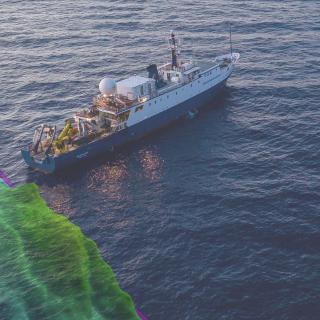
Our first expedition of the 2026 season is a seafloor mapping expedition from Hawaiʻi to Guam, where E/V Nautilus will support subsequent expeditions exploring deep-sea habitats around the Mariana Islands.