Towering Caulophacus Stalked Sponge
This is one looooooong deep-sea sponge! Spotted by our ROVs while diving over 4,700 meters deep in the southwest region of the Wake Island EEZ, this Caulophacus sponge is host to a number of associates. Caulophacus sponges are a type of glass sponge in the family Rossellidae. Often resembling cotton candy, marshmallows, or other fluffy objects, most of their body size is in their complex, large heads. For identification, look closely at the base! Their stalks attached to their bulbous heads on a concave surface like the inside of a bowl, rather than on the convex side like some other tall, large, frequently spotted deep-sea glass sponges like Bolosoma.
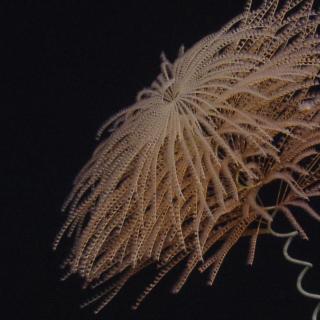
Spot fish floating by and zoom in for a look at the creatures that are perched and wrapped along the sponge’s multi-meter-long stalk. From crinoids to anemones to potential barnacles, deep-sea sponges like this one create habitat for other invertebrates that need to be situated up in the ocean current to feed. Glass sponges are also known for hosting small critters inside their hollow body channels, called spongocoels, supported by matrices of needle-like structural spicules.
Ocean Exploration Trust's Exploration of Wake Island's Deep-Sea expedition NA181 is supported by NOAA Ocean Exploration via the Ocean Exploration Cooperative Institute.
Exploration of Wake Island's Deep Sea
Located roughly midway between the Hawaiian and Mariana Islands, Wake Island is one of the most isolated land masses on Earth. While there have been some recent expeditions to this remote region, the vast majority of the 407,241 square kilometers of seafloor surrounding Wake remains unmapped and uncharacterized, thereby representing one of the most poorly surveyed areas under US jurisdiction.