Trio of Deep-Sea Fish in the Western Pacific
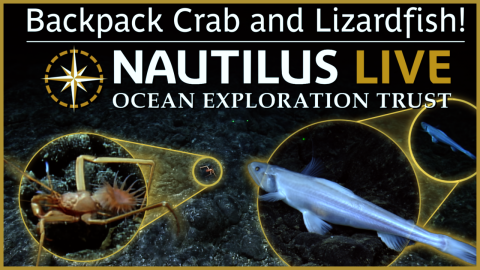
While diving ROVs Little Hercules and Atalanta 4,900 meters deep on the abyssal plain in the southwest region of the Wake Island EEZ, we came across a number of interesting deep-sea fish. First is a faceless cusk eel (Typhlonus nasus) that eerily floats in front of our cameras before giving chase. These abyssal fish are famous for lacking visible eyes in their bulbous head. Next, hanging out among the nodules, is a rarely observed cusk eel from the Leucicorus genus hosting a little parasite. After those two specimens, you’ll spot another type of benthic vertebrate: a deep-sea lizardfish (Bathysaurus mollis) that our team estimated to be around 50 cm long based on our ROV’s scaling lasers.
Located 2,138 nautical miles west of Honolulu, Wake Atoll National Wildlife Refuge is the northernmost atoll in the Marshall Islands geological ridge and the oldest and northernmost living atoll in the world. The refuge includes 495,515 acres of submerged lands and waters surrounding Wake Atoll out to 12 nautical miles and is home to hundreds of species of coral, fish, birds, and more wildlife.
Ocean Exploration Trust's Exploration of Wake Island's Deep-Sea expedition (NA181) is supported by NOAA Ocean Exploration via the Ocean Exploration Cooperative Institute.
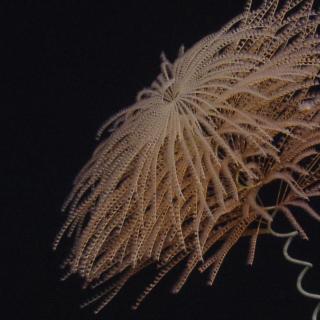
Exploration of Wake Island's Deep Sea
Located roughly midway between the Hawaiian and Mariana Islands, Wake Island is one of the most isolated land masses on Earth. While there have been some recent expeditions to this remote region, the vast majority of the 407,241 square kilometers of seafloor surrounding Wake remains unmapped and uncharacterized, thereby representing one of the most poorly surveyed areas under US jurisdiction.