Deep-Sea Sponges Delight Ocean Explorers in Micronesia
Attention deep-sea sponge lovers! While exploring our fourth never-before-seen seamount in the Federated States of Micronesia, our remotely operated vehicles captured some great footage of these deep-sea legends. Enjoy highlights of this dive that took us over 5,000 meters deep on this flat-topped seamount (Unnamed FSM Seamount 4), approximately 70 km north of Great Feather Bank and roughly halfway between Ifalik and Chuuk Islands.
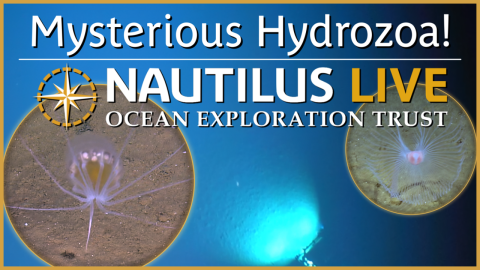
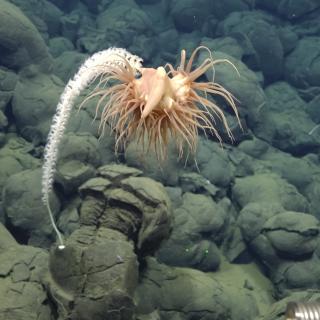
First up is the "inflatable Christmas tree", a member of the Cladorhizidae family. These sponges are carnivorous, meaning that, in addition to traditional filter feeding, they use tiny hook-like spicules to nab larger prey. Then it’s cauliflower Caulophacus time as we come across a number of these glass sponges growing from sturdy glass stalks with wide dome-shaped bodies. Explore a mystery with the team since other spotted sponges are less easily identifiable with their thinner stalks. We love how the deep-sea can leave our experts uncertain about their exact identification. Listen closely, and you’ll hear discussion on how these experts identify different deep-sea sponges! Pro tip: keep an eye on the connection point!
Ocean Exploration Trust's Deep-Sea Habitats in the Mariana Islands I & II (NA179 & NA180) expeditions are primarily supported by NOAA Ocean Exploration via the Ocean Exploration Cooperative Institute, with additional support from the Bureau of Ocean Energy Management for AUV Sentry’s participation. This dive was conducted under a scientific permit from the National Oceanic Resource Management Authority of the Federated States of Micronesia
Deep-Sea Habitats in the Mariana Islands II
In our second expedition of the year in the Mariana region, E/V Nautilus will spend 22-days at sea.