Deep Sea Fossilized Shark Teeth
Over the years, while exploring the deep sea, our Corps of Exploration has been fortunate enough to witness (and even sometimes sample) fossilized shark teeth from the deep seafloor. Many of these teeth belonged to the famous Megalodon or its relatives- something scientists can tell by examining the tooth’s shape and size. Most of the ones we come across are also covered in a crust of ferromanganese rock: a black mineral deposit that precipitates very slowly from seawater and coats objects found on the deep ocean floor. These mineral deposits form at an average rate of 2.5 mm per million years, and their thickness can be used to approximately age objects covered by this coating. Luckily for us, sharks lose many teeth over their lifetime, replacing them in a conveyor-belt fashion and leaving evidence behind for us ocean explorers.
All of the shark teeth spotted by our remotely-operated vehicles in this video were found while diving in the waters of the Cook Islands during the 2025 NA176 expedition. For three weeks, our Corps of Exploration explored at depths greater than 5,100 meters (17,000 feet). Much of that exploration was concentrated on the abyssal plain- a habitat with stable conditions perfect for finding shark teeth.
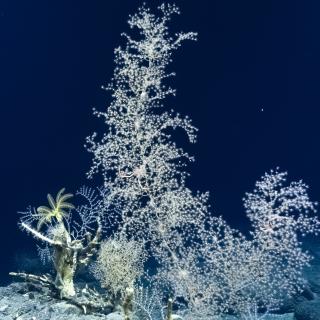
Deep-Sea Habitats of the Cook Islands
This 21-day expedition will utilize the ROV, mapping, and telepresence systems of E/V Nautilus to explore previously unsurveyed deep-sea priority areas identified by the management and science community in the Cook Islands.