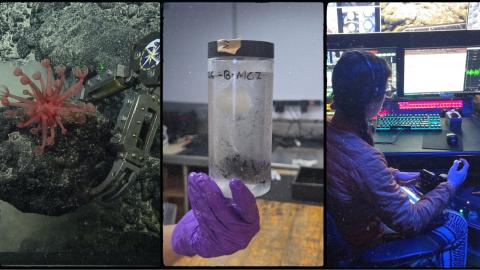
Meet Ocean Explorer Ana Hoffman Sole!

OET proudly welcomes Ana Hoffman Sole to the Corps of Exploration as part of the Science & Engineering Internship Program. This internship program supports community college, undergraduate, and graduate students in building professional workforce experience and exploring STEAM-related careers that connect to research themes like robotics, ocean science, education, and exploration. Ana is joining E/V Nautilus for our NA181 expedition as an ROV Engineering intern.
We sat with Angel to learn more about her experience at sea and the path that led her to Nautilus.
Describe your role with OET.
I am an ROV Engineering Intern on NA181, which means I am helping fix, maintain, and drive ROVs Atalanta, Hercules, and Little Hercules. When we aren't actively on a dive, I help with whatever upkeep projects the vehicles need, like making a new backup tether or mapping which wires go to which lights. Before and after the dive, I help check over the vehicles to make sure they are dive ready. And last but not least, during dives I sit mostly in the co-pilot's seat, where I drive ROV Atalanta and support the Hercules pilot. This expedition has a little of everything, from abyssal plains dives, to sea mount dives, to archaeological dives, so I'm excited to get a taste of so much of what deep sea research has to offer!
Can you tell us a little about your background? What influenced you as a child?
I grew up in Northern California, right next to the ocean. My family took me tide pooling pretty often, and by the time I finished elementary school I had collected a wonderful assortment of fun facts about every tide pool critter we came across. The Monterey Bay Aquarium and summer camps at the Marine Science Institute, a local non-profit, had a huge impact on my developing love of marine science. My interest in robotics and engineering kicked off my junior year of high school when I got over the intimidation factor and joined a robotics team. There I learned to break a problem down into manageable parts and got to see how a team of people working together can build something really cool. I loved it, so I joined a robotics team in college that built an autonomous underwater vehicle for competition every year, and kept building my skills there.
When you were a kid, what did you want to be when you grew up?
As a kid I was supremely annoyed when adults pushed too hard on this question. I was busy being a kid, having fun doing what I was doing, and I was in no rush to get to the future. It was pretty clear to the adults around me that I had a real passion for marine science, but I appreciate that they let me slowly come to that realization on my own. Today, I keep some of that same attitude I had as a kid. I love marine biology, earth history, robotics, mechanical engineering, and learning more about the world around me. I still don't know exactly where those passions are going to lead me career-wise, but I am confident that if I keep seeking out interesting and impactful experiences like this Nautilus internship, I can build myself a fulfilling career. I don't have a specific dream job, but I don't need one to end up in a role I love that makes me happy.
What would you consider to be your greatest challenge entering this field?
I should have joined robotics my first year of high school. I thought about it, but when I looked at the robot the team had built the year before, it looked so complicated I couldn't imagine how I could possibly build one, and I didn't join. When a friend finally talked me into it two years later, I realized that I didn't have to understand the whole thing all at once. I certainly didn't have to build a whole robot on my own. Once we broke the problem down into smaller pieces and everyone focused on something that they were interested in and good at, it seemed a lot more manageable. My high school robotics experience gave me confidence in my knowledge, my ability to figure it out on the fly, and to work with the capable people around me to get big things done. It's unfortunate that intimidation kept me from that initially, but I'm so glad I eventually got over it and got into this world.
Do you have any advice for someone looking to follow a similar path?
If you have found a field or topic that really interests and motivates you, that is a remarkable and wonderful thing. Don't take it for granted. If you have a couple of things that fit that bill, don't feel like you need to choose one. Although it was not always clear to me how marine biology and engineering were going to overlap, I still did both. I have a pretty unusual resume, but ultimately that has opened some doors for me. Being a scientist and an engineer makes me a great fit for some really cool roles, like this one. If you do the things you like doing, you might also find cool roles that need your unique combination of skills.
What's next for your ocean studies and career?
After getting off the Nautilus, I will be starting as a research technician at the Oregon Coast Aquarium. I'll be surveying the coastal subtidal up and down the Oregon coast to get a good picture of the ecosystem make up. To do that, I'll be assembling, maintaining, and driving a small ROV (a Blue Robotics ROV2) as well as SCUBA diving, and processing image data using an ML model. I'm so excited to keep building my skills in both science and underwater robotics while learning the ins and outs of working at an educational and community institution like an aquarium. That will keep me busy for the next three years, and then I might head to grad school, or whatever adventure life has in store for me.
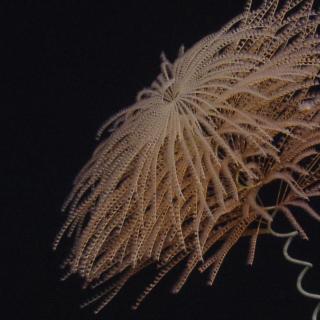
Exploration of Wake Island's Deep Sea
Located roughly midway between the Hawaiian and Mariana Islands, Wake Island is one of the most isolated land masses on Earth. While there have been some recent expeditions to this remote region, the vast majority of the 407,241 square kilometers of seafloor surrounding Wake remains unmapped and uncharacterized, thereby representing one of the most poorly surveyed areas under US jurisdiction.