Meet Ocean Explorer Jaida Lippy

OET proudly welcomes Jaida Lippy to the Corps of Exploration as part of the Science & Engineering Internship Program. This internship program supports community college, undergraduate, and graduate students in building professional workforce experience and exploring STEAM-related careers that connect to research themes like robotics, ocean science, education, and exploration. Jaida is joining E/V Nautilus for our NA179 expedition as a navigation intern.
We sat with Jaida to learn more about her experience at sea and the path that led her to Nautilus.
Describe your role with OET.
I am currently the Navigation Intern on expedition NA179. When we have ROVs in the water, I am being trained to be the Navigator whose role is to keep a big picture idea of what the goals are for the dives, keeping track of time on bottom, and making ship movements so the ROVs are able to move around to the areas that the science team would like to look at. When we do not have an ROV in the water, I am being trained as a mapper and learning how we use the new multibeam onboard the Nautilus and how we use sonar to map the seafloor.
Can you tell us a little about your background? What influenced you as a child?
I am currently studying Marine Environmental Science as my undergrad at the United States Coast Guard Academy, but other than my degree, I have always grown up loving the ocean. Being from Arizona, I wasn’t really around the ocean but every summer my family and I would drive to San Diego and get to visit the ocean. I remember this always being my favorite thing to do with my family, and it is where my love of the ocean really began.
When you were a kid, what did you want to be when you grew up?
When I was younger, I never really knew what I wanted to do. It rotated between a veterinarian, a pilot, and even a psychologist, but I still always had an interest in the ocean. This is how I ended up applying to attend the Coast Guard Academy and how I got the opportunity to join the Nautilus. This experience so far has really shown me that I would love to be able to be a part of something like the Nautilus and do this type of work in the future.
What would you consider to be your greatest challenge entering this field?
A challenge that I have faced entering this career field is finding a path to get here. However, after talking to others onboard the Nautilus, I have learned that there isn’t really a specific path to take to get onboard a research vessel such as Nautilus. Everyone onboard has a very diverse background with different specialties and, with perseverance and dedication, has gotten to a career field that they enjoy. So hopefully in the future, I can do the same.
Do you have any advice for someone looking to follow a similar path?
Since being an intern, I have learned that I have a lot to learn about all the different systems that go into research evolutions that happen onboard vessels such as the Nautilus. Knowing this ahead of time kind of made me nervous to step into the role of being an intern, but since I knew this would be an amazing opportunity to get to do it, I took the opportunity. Stepping out of my comfort zone has allowed me to grow and learn new hands-on experiences that I would never have gotten the opportunity to learn while at school. So, the advice that I would give would be to be comfortable, be uncomfortable, and step out of your comfort zone because you will never know what you might learn if you don’t.
What's next for your ocean studies and career?
Once finished with this expedition, I will head back to the Coast Guard Academy and finish my last year as a cadet studying Marine Environmental Science. During this last year, I will be working on my Capstone project, which is observing the effects of different types of oils in the Mackinac Straight of the Great Lakes by using oil spill models. This will allow us to create a dashboard tool that could be used in the planning process of other oil spill cases for the Coast Guard and to further support the already existing Environmental Response Management Application (ERMA) planning processes in our study area. I am also excited to take what I have learned while on board Nautilus and try to apply it to all my classes.
Deep-Sea Habitats in the Mariana Islands I
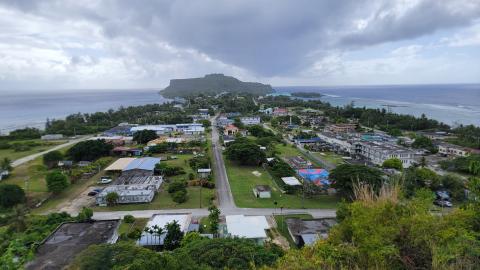
This expedition will focus on exploring the Mariana region- one of the ocean's most tectonically and volcanically dynamic locations, marked by the Earth’s deepest oceanic trench, some of the most active submarine volcanoes, and some of the oldest seafloor on the planet.