Patterns Beneath My Feet and Below the Waves

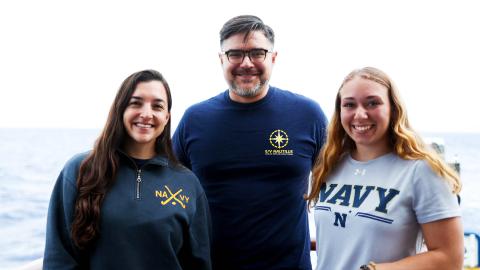
This blog was written by NA178 Science Communication Fellow Kim Etsitty.
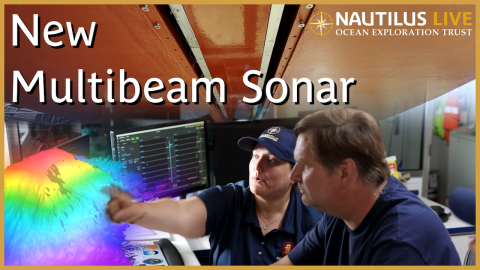
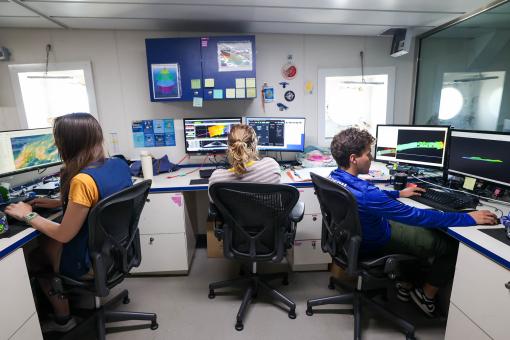
From teaching my students about seafloor mapping on land to conducting real-time seafloor mapping across the Pacific Ocean, I could not help but wonder about the natural patterns in our world. Then, when I visited the data lab aboard the E/V Nautilus, the sounds of mouse clicks and the swift movement across the screen, ensuring the data was being processed, while warm and cool colors filled the screen in many forms, made me realize that seafloor mapping is more than seeing the unknown; it is about seeing patterns.
Sonar lets us reach into the abyss and feel the shape of a world we cannot see. It sends sound into the deep and listens for the echo, turning those returns into mountains, canyons, and dunes. After spending days at sea, your eyes adjust to only the blue waters. However, the depths of the ocean reveal colors and patterns of the Earth. The hidden landscape reveals itself; then the blue waters don’t seem so blue.
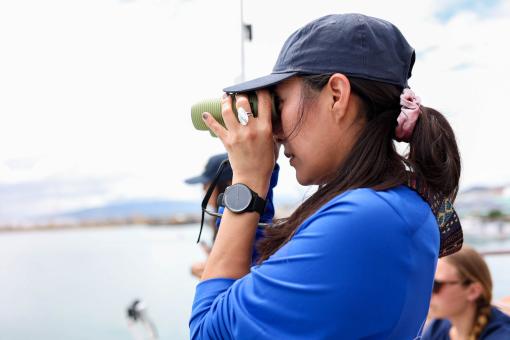
Kim Etisitty onboard E/V Nautilus.
On a seafloor expedition, you spend a lot of time reading screens while patiently waiting for the next feature to reveal itself. Over time, you realize that the ocean is not in disorder but rather a design. The patterns of the natural world begin to reveal their ancient movements, shaped by shifting plates of the Earth. The patterns become their own language; for example, the lines let you know the dunes that were shaped by deep currents, or the gentle curves hint at a landslide.
These patterns are not only on the seafloor; they are also happening in real time in the data room. The focus, colorful screens, and the processing procedures. Together, they mirror the landscape we are mapping. Understanding the patterns of the deep ocean connects the surface, making it tangible. Each person in the data room is contributing a piece, and together they reveal something larger that they could not see alone. Recognizing patterns is ultimately an act of connection. It connects the surface to the deep, the observer to the natural world, and the known to the unknown.
After I noticed the patterns underwater, I started thinking about the dry landscapes back home. Diné Bikéyah, or “the Land of the People,” which covers 27,000 square miles in Arizona, New Mexico, and Utah. The desert contains some of the most interesting geological features, recalling ancient oceans. The same natural forces, wind, water, uplift, and time, shape both places. These similarities show how Mother Earth repeats her designs in different environments. Growing up in Diné Bikéyah, the desert landscapes became my identity and shaped how I view the natural world. For example, submarine canyons correlate with the deep slot canyons we explored as children, which became playgrounds for hide-and-seek, unaware that they were carved by currents. The sand dunes we rolled down and sledded on in winter are the same patterns sculpted by steady flows of water, just like the abyssal dunes. Lastly, the ancient volcanic field in front of my school is now filled with ponderosa pines and pinyon-juniper, where we can only imagine it rising from the seafloor. The story of the landscape has become a skill I can now use to interpret the seafloor for my students back home.
Seafloor mapping trains the mind to look for shapes in the unknown and unexplored waters, or what we might think of as chaos. Hours spent reading seafloor data use the same process as learning about the desert: understanding how fragile sandstone is and finding natural pools of water by observing how the canyon walls flow. Over time, I have learned that patterns are not only in landscapes. They appear in weather, life cycles, and human behavior, like in our memories. Some details fade, and some grow stronger; new experiences build on top of old ones, just as sediments build on the seafloor or desert land.
Both worlds, the desert and the ocean, teach us to pay attention, be patient, and look closely. They show that our mother earth has patterns and that nothing is truly random; everything happens because of time, pressure, and movement. Once you learn to see the earth as a living vessel beneath your feet or below the waves, you also learn about the landscape inside yourself.
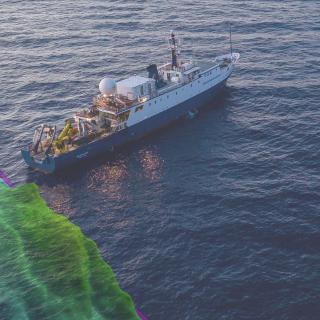
Pacific Mapping
Our first expedition of the 2026 season is a seafloor mapping expedition from Hawaiʻi to Guam, where E/V Nautilus will support subsequent expeditions exploring deep-sea habitats around the Mariana Islands.