Octopus Pounces on Lasers in Papahānaumokuākea
We spotted so many cute and curious cephalopods while venturing into shallower depths exploring the southwestern margin of St. Rogatien Bank in Papahānaumokuākea National Marine Sanctuary! At 323 meters (1,059 feet) deep, our team spotted saw a camouflaged individual that seemed to have the “zoomies” as it chased ROV Hercules’ green scaling lasers over the seafloor. Watching the cat-like curiosity behavior of this octopus reminds us of how intelligent cephalopods likely are, and hints at vision that is likely different for this twilight-depth living species, rather than its abyssal depth relatives. Further along the bank at 320 meters (1,049 feet), another octopus gave the explorers a fantastic view of its color-changing abilities. Using specialized pigment-filled cells called chromatophores, octopus can change their appearance to blend in (or stand out) amongst their environment.
Next up on this tentacled tour, at 318 meters (1,0430 feet), we witnessed an octopus hiding in a hole in the sediment. Thanks to their lack of bones, octopus can fit into small spaces to hide from predators. Watch it unfurl its tentacles while deciding if it wants to say hello to our ROVs from its protected home northwest of Lalo. Lastly, at 376 meters (1,233 feet) deep, the team spotted a unique-looking Pteroctopus sp. with its dark orange color, round yellow eyes, and bumpy-textured head. This genus of cephalopods currently as many as seven different species worldwide.
Ocean Exploration Trust's NA182 Exploration of the Hawaiian Islands is funded by NOAA Ocean Exploration via the NOAA Ocean Exploration Cooperative Institute.
Deep-Sea Habitats of the Hawaiian Archipelago
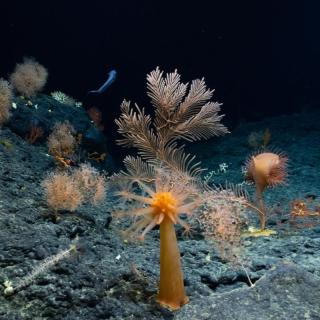
Our final OECI-sponsored expedition of 2026 brings E/V Nautilus back to the Hawaiian Islands. While nearshore waters surrounding the islands have been relatively well surveyed, many offshore areas remain completely unexplored, hindering efforts to effectively manage the resources of this unique region.