ROV Attempts Sample of Paper Nautilus Shell
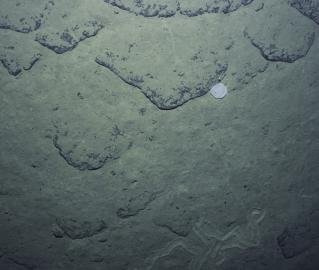
While diving ROV Hercules on a never-before-seen seamount east of the Mariana Trench, our Corps of Exploration came across a gorgeous paper nautilus shell at 3,795 meters (12,450 feet). Despite the common name confusion, a paper nautilus is not the same as a hard-shelled chambered nautilus- it’s an argonaut, an open-ocean octopus. Our ROV pilots attempted to sample the wafer-thin, fragile shell, but alas, the ocean did not want to let it go. These animals spend their life in the midwater, which explains the surprise spotting of another shell in a totally different habitat over 500 miles (810 km) away from the first. On another dive, flying over the abyssal plain at depths over 5,800 meters (19,000 feet) with the imaging-only ROV Little Hercules, the team had a good look at the second shell, showcasing how rich the open-ocean habitats above the seafloor are in the Marianas.
A paper nautilus is a pelagic (open-ocean) octopus found throughout the Western Pacific that preys primarily on mollusks. The females secrete a thin calcite shell to protect their eggs and help keep them buoyant in the midwater. Thanks to the two winged projections on either side of the shell, our onshore experts identified the first shell as Argonauta hians. Scientists have lots to learn about this elusive species, including still trying to determine whether the species' two forms (northern vs southern) should be split into two different species or not.
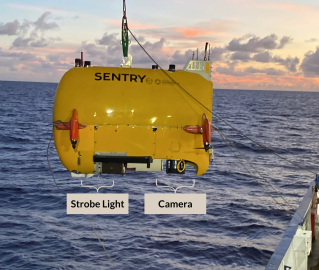
Ocean Exploration Trust's Deep-Sea Habitats in the Mariana Islands I & II (NA179 & NA180) expeditions are primarily supported by NOAA Ocean Exploration via the Ocean Exploration Cooperative Institute, with additional support from the Bureau of Ocean Energy Management for AUV Sentry’s participation.
Deep-Sea Habitats in the Mariana Islands I
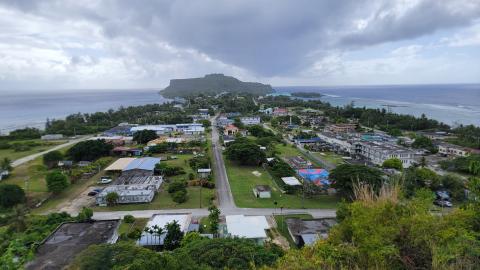
This expedition will focus on exploring the Mariana region- one of the ocean's most tectonically and volcanically dynamic locations, marked by the Earth’s deepest oceanic trench, some of the most active submarine volcanoes, and some of the oldest seafloor on the planet.