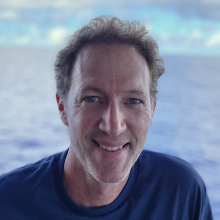
Michael Orr
Tell us about your work/research. What kinds of things do you do?
I study how animals and humans adapt to the challenges of life in the ocean. My research combines shark tracking, marine animal physiology, and the respiratory physiology of freedivers and spearfishers to better understand behavior, performance, and survival in marine environments. By combining field expeditions, ocean technology, and laboratory research, I investigate how environmental change, predators, and human activities influence life beneath the surface. My goal is to use these discoveries to advance marine conservation and sustainable ocean management.
What sparked your initial interest in your career?
I have always been drawn to the edge of the map—the places where exploration and discovery meet. Whether sailing across the Pacific, diving on remote reefs, tracking sharks, or studying the physiology of humans and animals in extreme environments, I have been motivated by a desire to understand how life adapts and thrives. Seeing both the fragility and resilience of marine ecosystems inspired me to pursue a career where science, adventure, and conservation all come together.
Who influenced you or encouraged you the most?
I have been influenced by a wide range of explorers, scientists, and mentors. Growing up, the documentaries of Jacques Cousteau showed me that science and adventure could be part of the same journey. Later, freediving pioneer Enzo Maiorca inspired me with his understanding of the connection between humans and the ocean. I was also fortunate to learn from outstanding professors during my undergraduate and graduate studies, as well as mentors like Louise Page, Ken Lukowiak and Bruce Hatcher, who encouraged me to pursue curiosity, embrace challenges, and seek experiences beyond the traditional academic path. Together, they helped shape my belief that exploration, discovery, and conservation are most powerful when they work hand in hand.
What element of your work/study do you think is the most fascinating?
What fascinates me most is uncovering how the natural world actually works through observation, experimentation, and evidence. Whether I am studying the physiology of freedivers, tracking the movements of sharks with underwater telemetry, or investigating how marine ecosystems respond to environmental change, I enjoy finding answers to questions that are often hidden beneath the surface. I am also fascinated by the connection between humans and the ocean through activities like freediving and sustainable ocean harvesting, where understanding biology and the environment can have immediate real-world applications. And, if I'm being honest, deploying and using cutting-edge underwater technology to explore places and collect data that would have been impossible to access just a few decades ago is pretty awesome too.
What other jobs led you to your current career?
My path to marine science was not exactly a straight line. Before becoming a scientist, I worked as a rock-climbing guide in Australia, a horse trekking guide and horse trainer, and later as a sailing captain leading expeditions in remote parts of the world. Each of these roles taught me valuable lessons about leadership, risk management, problem-solving, and working in challenging environments. They also reinforced my love of exploration and the outdoors. Looking back, those experiences were excellent preparation for a career that combines science, adventure, and discovery in some of the most dynamic environments on Earth.
What are your degrees and certifications?
I hold a BSc (with distinction) in Marine Ecology and Biology from the University of Victoria, a PhD in Neuroscience, Physiology and Biophysics from the University of Calgary, and completed a Postdoctoral Fellowship in Neuroscience at Washington University in St. Louis. In addition to my academic training, I am a commercially certified Yachtmaster Offshore (200GT) and qualified captain through the Nova Scotia Sea School, combining formal scientific training with extensive offshore sailing and expedition experience.
What are your hobbies?
Outside of work, I spend most of my time in the outdoors—rock climbing, backcountry skiing, and spearfishing. These activities keep me closely connected to the environments I study and reinforce the same curiosity and respect for natural systems that drive my scientific work. They also provide a hands-on perspective on ocean and wilderness conditions that continues to inform how I think about marine ecology, human performance, and life in extreme environments.
What advice would you give someone who wants to have a career like yours?
Be willing to follow curiosity more than a straight career path. The work I do now came from combining science with time in the field—on ships, underwater, and in remote environments—and that only happened because I said yes to opportunities that didn’t always look conventional at the time. Build strong scientific foundations, but don’t underestimate the value of skills learned outside the lab: navigation, seamanship, risk management, and teamwork under pressure all matter.
Most importantly, stay close to the real world. Go where the questions actually are—diving, sailing, exploring, observing—and let those experiences shape the science you choose to pursue. The best advice I ever received, implicitly, was to make sure your work doesn’t just describe nature from a distance, but engages with it directly.
Expeditions
Michael participated in the following Ocean Exploration Trust expeditions:
