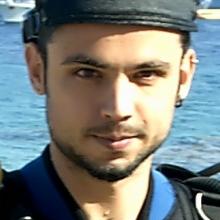
Maxim Rubin
Data Logger
Haifa University
Maxim Rubin is a Ph.D. candidate at the Department of Marine Biology at the Leon H. Charney School of Marine Sciences, University of Haifa, Israel, focusing his research on the deep sea benthic environments exploration. Previously, Maxim pursued his academic degrees from the Israel Institute of Technology (Technion) and his M.Sc from Bar Ilan University in related scientific fields. Beside the academic activity, Maxim has over a decade experience as diving professional, and he is using technical and rebreather diving for his research. Last year Maxim has participated in the Nautilus expedition during the Cyprus and Israel legs as a data logger and biologist.
Expeditions
Maxim participated in the following Ocean Exploration Trust expeditions:
Selected Publications
2025
(2025). Animal burrowing at cold seep ecotones boosts productivity by linking macromolecule turnover with chemosynthesis and nutrient cycling. Biogeosciences 22 (5): 1321–1340. https://doi.org/10.5194/bg-22-1321-2025
2024
(2024). Animal burrowing at cold seep ecotones boosts productivity by linking macromolecule turnover with chemosynthesis and nutrient cycling. EGUsphere https://doi.org/10.5194/egusphere-2024-1285
2023
(2023). Metabolic handoffs between multiple symbionts may benefit the deep-sea bathymodioline mussels. ISME Communications https://www.nature.com/articles/s43705-023-00254-4#Bib1
(2023). Metabolic handoffs between multiple symbionts may benefit the deep-sea bathymodioline mussels. ISME Communications https://www.nature.com/articles/s43705-023-00254-4
2021
(2021). The worm affair: Genetic diversity in two species of symbionts that co-occur in tubeworms from the Mediterranean Sea. bioRxiv
2014
(2014). Hydrocarbon-related microbial processes in the deep sediments of the Eastern Mediterranean Levantine basin. FEMS Microbial Ecology 87(3): 780–796. https://academic.oup.com/femsec/article/87/3/780/578119
(2014). First evidence for the presence of iron oxidizing Zetaproteobacteria at the Levantine continental margins. PLoS ONE 9(3): e91456. https://journals.plos.org/plosone/article?id=10.1371/journa…
(2014). Cold seep biogenic carbonate crust in the Levantine basin is inhabited by burrowing Phascolosoma aff.turnerae, a sipunculan worm hosting a distinctive microbiota. Deep-sea Research I 90(1): 17-26. https://www.sciencedirect.com/science/article/pii/S09670637…
(2014). Distribution of the Lamellibrachia spp. (Sibogilnidae, Annelida) and their trophosome endosymbiont phylotypes in the Mediterranean Sea. Marine Biology 161(6): 1229-1239. https://link.springer.com/article/10.1007/s00227-014-2413-y
2013
(2013). Multidisciplinary Study of Microbial Niches at the Deep Benthos of Lavantine Basin. Dissertation: University of Haifa https://www.proquest.com/dissertations-theses/multidiscipli…
