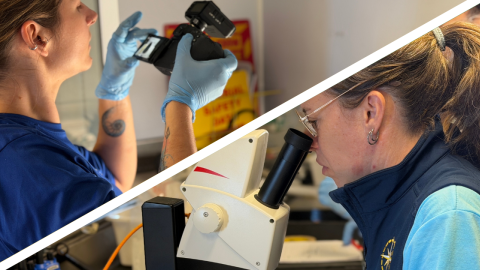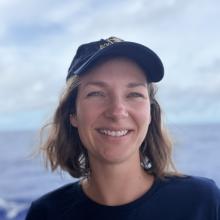
Jessica Eberle
Tell us about your work/research. What kinds of things do you do?
I get to do a little bit of everything, and that's one of the things I love most about my work. Over the years I've supported expeditions with organizations like MBARI and Schmidt Ocean Institute - coordinating logistics, troubleshooting equipment, helping scientists collect data, or processing and visualizing the information we've gathered.
One of my favorite parts of the job is connecting people and ideas. I enjoy turning deep-sea science into knowledge that can support ocean conservation, and developing tools that make scientific data easier to understand. I've also co-organized at-sea workshops that help train the next generation of ocean scientists. To me, science has the greatest impact when it's collaborative and accessible.
What sparked your initial interest in your career?
I've always been curious about the natural world, from animals and plants to microscopic organisms. Growing up, I watched every nature documentary and read all the books and magazines I could find. But learning to scuba dive was the moment everything clicked, and I knew then that I wanted to spend my life exploring and protecting the ocean.
Who influenced you or encouraged you the most?
There are many people to thank. My mom gave me a children's microscope and science books when I was little, and my dad taught me how to ask questions and think critically - together, they pretty much set me on my path to become a scientist.
Professionally, I'm especially grateful to my master's thesis advisor and her lab, where I learned so much about oceanographic research, data collection, and life at sea. She gave me the opportunity to join my very first offshore research expedition aboard MBARI's R/V Western Flyer - an experience that completely shaped my career. As it turns out, that trip also changed my personal life, because it's where I met my now-husband.
What element of your work/study do you think is the most fascinating?
The best part is that no two days are the same. I love jumping into new projects, learning about different areas of science, and working with people whose backgrounds and experiences are completely different from my own. I'm also endlessly fascinated by deep-sea microbes and the incredible ways they survive in the Ocean’s deepest, darkest and hottest environments, places we can only explore with advanced technology.
How did you get involved with the Ocean Exploration Trust?
I've followed OET's work for years, checking in on the live streams whenever I could, and during that time I worked on other research vessels alongside several people who were also part of the Nautilus team. They made the introductions, and after a few conversations, I was offered an opportunity to sail aboard.
What other jobs led you to your current career?
It all started with a childhood fish tank. That’s what first sparked my interest in aquatic ecology, and it eventually led to my first job at a pet shop. Looking back, I was learning about water chemistry and marine husbandry long before I ever got to see those ecosystems in the wild.
This job unexpectedly led to a role managing seawater systems at a brain research institute, and later, to a research project studying cuttlefish camouflage. That was a pivotal moment for me, it was the first time I got to see a scientific project through from the initial question all the way to publication. Since then, I've spent years working in various research labs. Today, that training allows me to connect lab and fieldwork, helping make the science at sea run as smoothly and successfully as possible.
I've learned that even the weirdest skills have a way of proving valuable down the line. If you approach every job with curiosity and dedication, it has a way of opening doors you could never have planned for.
What are your degrees and certifications?
B.Sc. in Biology - Goethe University Frankfurt 2018; M.Sc. in Oceanography (Biogeochemistry & Microbial Ecology) - GEOMAR Helmholtz Centre for Ocean Research Kiel 2022; Scientific and Rescue Diver; Boating and seafaring credentials (STCW Basic Safety)
What are your hobbies?
I love spending time on or in the water. Sailing and scuba diving are my favorite ways to explore, but I also enjoy photography, backpacking, hiking, and pretty much anything that gets me outside.
What advice would you give someone who wants to have a career like yours?
Don't worry if your path isn't a straight line- mine certainly wasn't. Some of the best opportunities can come from saying yes to experiences that seem a little unexpected or outside your comfort zone.
Ocean exploration is incredibly interdisciplinary. It takes scientists, engineers, technicians, mariners, communicators, and many others working together to make discoveries happen. Every skill you pick up along the way, even if it doesn't seem directly related at the time, helps you become a more adaptable and creative problem solver.
Most importantly, stay curious. Ask questions, don't be afraid to try something new, and remember that there are many different ways to build a career in ocean science.
Expeditions
Jessica participated in the following Ocean Exploration Trust expeditions: