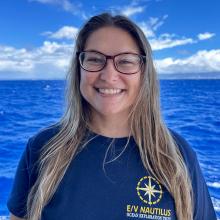
Isabella Iannotta
Tell us about your work/research. What kinds of things do you do?
My research is incredibly interdisciplinary, as I combine biological, geological, chemical, and physical oceanographic concepts in deep-sea environments. I study sediment biogeochemistry in abyssal polymetallic nodule fields in the Pacific Ocean (~4,000- 6,000 meters depth) to understand benthic ecosystem functioning. Deep-sea organisms rely on the rain of particulate organic matter, or marine snow, to the seafloor as a major food source. Therefore, my aim is to characterize changes in the deposition and consumption of this organic matter over time and space, as well as understand how physical anthropogenic disturbances to the seafloor affect the sediment chemistry and biology using organic matter to gauge these impacts. Major aspects of my work include going to sea for weeks to months on end collecting samples, mentoring students in the lab, using fluorescence spectroscopy and mass spectrometry to analyze samples, and presenting these findings in research papers and conferences.
What sparked your initial interest in your career?
I grew up in the Florida Keys exploring fishing spots with my dad, so when I moved to the suburbs of Washington, D.C., I realized how much I missed the ocean and wanted to learn more about it. I returned to the Keys for a summer while I was in high school and interned at a coral restoration lab, which inspired me to pursue my bachelor's degree in marine science at Eckerd College in St. Petersburg, Florida. There, I was introduced to the concept of deep-sea science and benthic ecology, where I developed a passion for deep-sea sedimentology, geochemistry, biology, and taxonomy while conducting an undergraduate research thesis project. I loved St. Petersburg so much that I decided to pursue my graduate degree at the University of South Florida College of Marine Science and continue studying deep-sea benthic environments and human impacts on them. There is still so much to learn about the deep sea, especially sediments and the organisms that live on and within them, which is what excites me most about this field.
Who influenced you or encouraged you the most?
My dad was a major contributor to my passion for marine science, always making sure to take me out on his boat or to some body of water to go fishing wherever we were living at the time. He also gave me the courage to pursue my ambitions, even when others had doubts. Thanks to him, I have the confidence to accomplish my goals of becoming a marine scientist and ocean explorer.
What element of your work/study do you think is the most fascinating?
The novelty of deep-sea research is what fascinates me the most. When I work with an organism or sediment from the abyssal seafloor, I know that it came from a dark environment untouched by any other human. Each sediment sample could contain an unknown infaunal species, relics of sponge spicules and radiolarian skeletons/tests, and new information about ocean processes from hundreds of thousands of years ago. Each deep-sea sample tells a story just waiting to be brought to light.
How did you get involved with the Ocean Exploration Trust?
I responded to an expression of interest in the expedition through the Ocean Census program, which led me to meet Ocean Exploration Trust staff and expedition leadership. I felt that my previous experience in the field and researching deep-sea environments applied to the expedition's mission of exploring unsurveyed benthic environments around the Hawaiian Islands.
What other jobs led you to your current career?
My career path up to this point has taken many twists and turns. During the beginning of the COVID-19 pandemic, I decided to pause my undergraduate education to work as a mate aboard sailing catamarans and a schooner sailboat for ecotours in Key West. This experience sparked my passion for boating and seafaring. When I returned to Eckerd to finish my undergraduate degree, I worked as a boat driver for wakeboarding trips at the college's waterfront program. I also joined a new professor's sediment geochemistry lab where I conducted my undergraduate research thesis and discovered my passion for the deep sea. I was also able to combine my seafaring and research experience by going on a 2.5-month-long research cruise in the remote Pacific Ocean, collecting samples for my undergraduate thesis. Once I graduated with my bachelor's degree, I spent a summer doing taxonomic analysis on zooplankton samples to validate the Aquatic Imager at OceanSpace LLC. After that, I spent a year working for the Florida state government aquatic preserves program managing outreach and volunteer events. This experience strengthened my science communication skills; however, I missed conducting research and working in the lab. I began reaching out to my network, which led me to connect with my current advisor at the University of South Florida College of Marine Science (USF CMS). I am now a graduate student at USF CMS, continuing my work researching deep-sea benthic environments, along with leading the student advisory committee, mentoring rising 9th-grade girls in oceanography camp, and helping my advisor maintain the NOAA PORTS program in Tampa Bay.
What are your degrees and certifications?
I graduated with my Bachelor of Science in Marine Science with a biology concentration and high honors from Eckerd College in 2023; I am currently a graduate student in interdisciplinary marine science at the University of South Florida; HUET-BOSIET offshore survival training; American Red Cross CPR/First Aid; Florida DEP small boat handling cert.
What are your hobbies?
I like to watercolor and draw in my spare time, as well as doing yoga and going on scenic walks at my local waterfront park where a group of dolphins always visit and put on a show. I also occasionally volunteer to help get rescue kittens adopted at my local pet store.
What advice would you give someone who wants to have a career like yours?
Careers in marine science require patience, hard work, and an open mind. I would advise anyone interested in a marine science career to embrace math and science, as these are fundamental subjects that help us understand the ocean. Everything leads back to the ocean, so if you're required to take a class that you don't see as relevant to your degree, it probably is. I've applied physics, calculus, statistics, chemistry, genomics, communications, literature, and more to my experiences in marine science; therefore, I advise keeping an open mind when pursuing an education in this field. I also suggest future marine scientists remain patient with themselves and others, as teamwork is a vital aspect of going on cruises, doing lab work, and writing papers. My final piece of advice is not to be afraid to introduce yourself and talk to people; you never know what you may have in common with someone. Also, be sure to apply to everything you're interested in; make sure to have no regrets. I've put myself out there many times and been rejected from opportunities I was interested in. However, more often than not, my networking skills have led to some incredible opportunities to advance my career. You miss 100% of the shots you don't take.
Expeditions
Isabella participated in the following Ocean Exploration Trust expeditions: