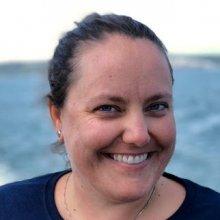
Colleen Peters
Tell us about your work/research. What kinds of things do you do?
Colleen Peters is a product manager for seafloor mapping software with a background rooted in hands‑on ocean exploration. She has spent much of her career at sea, supporting mapping and survey operations on research vessels, including NOAA Ship Okeanos Explorer and Schmidt Ocean Institute’s R/V Falkor, where she worked as a survey and marine technician.
At KONGSBERG, Colleen focuses on shaping and improving mapping software used by scientists and technicians at sea. Her work bridges real‑world survey operations and software development, helping ensure that mapping tools are practical, reliable, and easy to use in demanding offshore environments.
Colleen occasionally sails as a mapping technician to test and refine seafloor mapping software in active operations. Being back at sea allows her to directly connect user needs with software design and to bring operational experience into future product improvements.
Colleen holds degrees in Marine Science, Oceanography, and Business Administration, and remains especially interested in how clear, well‑designed maps can help scientists—and the public—better understand the seafloor.
What sparked your initial interest in your career?
I started working on boats at the Maine Maritime Academy. Through working on the waterfront on campus, internships with the MATE program, and a cooperative experience in Alaska, I found that working at sea was a natural fit for my interests in ocean science and being on the water.
What element of your work/study do you think is the most fascinating?
Mapping the unmapped!
What other jobs led you to your current career?
Early roles as a marine technician and survey technician aboard research vessels allowed her to work hands‑on with mapping systems while supporting a wide range of science missions, where she helped operate, maintain, and troubleshoot seafloor mapping and other scientific equipment.
Over time, this shipboard experience led her to roles with increasing responsibility—planning surveys, managing data, supporting science teams, and mentoring technicians. These experiences shaped her understanding of what works well at sea and what can be improved.
After completing graduate studies, Colleen moved into software product management, where she now focuses on developing and improving seafloor mapping software used by scientists and technicians. Her previous work at sea continues to guide her approach, ensuring that software tools are grounded in real operational needs rather than theory alone.
What are your degrees and certifications?
B.S. Marine Science, A.S. Small Vessel Operations from Maine Maritime Academy 2005
Master of Oceanography, Master of Business Administration, and Certificate in Geographic Information Systems and Remote Sensing from the University of Rhode Island 2019
USCG 200-ton Master's license and unlimited AB; plus a long list of multibeam and survey system training certifications.
What are your hobbies?
Travel is my favorite hobby! When I am home, I like to cook and try new recipes. Wherever I am, I like to stay active, especially outdoors, with walking, hiking, and kayaking.
What advice would you give someone who wants to have a career like yours?
Spend time at sea early if you can. Hands‑on experience is one of the best ways to learn what you enjoy, what you’re good at, and how science and technology actually work outside of the classroom. Internships, technician roles, and entry‑level shipboard jobs can open doors and help you build practical skills that last throughout your career.
Stay curious and be willing to learn from everyone around you—scientists, engineers, deck crew, and technicians alike. Some of the most valuable lessons come from watching how others solve problems in real time.
Finally, don’t feel like you have to follow a straight path. Careers in ocean science and technology can evolve in many directions over time. Being open to new opportunities and using past experience to guide your next steps can lead to work that is both interesting and rewarding.
How did you get involved with the Nautilus Exploration Program? How did you get on the ship?
I have worked on many similar ships and am happy to keep supporting the mission of exploration!
Expeditions
Colleen participated in the following Ocean Exploration Trust expeditions:
