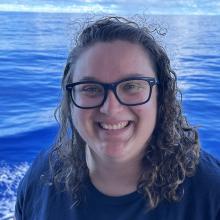
Caroline Edmonds
Tell us about your work/research. What kinds of things do you do?
I am a deep-sea ecologist, which means I study the animals and communities living on the ocean floor in some of the deepest, most remote parts of the sea. A big part of my job involves working with video footage collected by underwater robots called ROVs, going through hours of recordings and identifying every creature that appears on screen. I then take all of those observations and use statistics and computer modeling to look for patterns, like which animals tend to live together, what kinds of seafloor habitats they prefer, and how factors like depth or ocean chemistry shape where different communities show up. I also think a lot about what we do not yet know. The deep ocean is vastly understudied, and a lot of what we think we understand about it is shaped by where ships have happened to go, not necessarily where the most interesting or important ecosystems are. So part of my work is figuring out where the gaps in our knowledge are and what we might be missing. Right now this feels especially urgent because some of the areas I study are being eyed for deep-sea mining, and we need a much clearer picture of what lives there before those decisions get made. I am just getting started!
What sparked your initial interest in your career?
My interest in the ocean started early. In 7th grade I did a science fair project on flashlight fish, specifically investigating when giant flashlight fish light up the most and what might cause it, at the Aquarium of the Pacific, which eventually took me to the national competition in Washington D.C. and was later published in a scientific journal. But honestly, what I remember most from that experience was not the award or the publication. It was sitting for hours annotating video footage of marine organisms and realizing I genuinely loved it. I had no idea at the time that observing and identifying animals from video would become a central part of my actual research career. From there my curiosity kept pulling me deeper. Each class and internship revealed a new layer of complexity, from coral reef ecology to the biology of seamounts to the communities living in the darkest, most pressure-filled parts of the ocean. Taking my first deep sea biology course in college made something shift for me. I realized that the deep ocean is not just understudied, it is almost entirely unknown, and the questions we have not even thought to ask yet far outnumber the ones we have answered. That is what drew me in and what keeps me going.
Who influenced you or encouraged you the most?
The person who influenced me most was my mom, who encouraged my curiosity about the ocean from the very beginning. I grew up going to the aquarium and exploring tide pools. She helped me become an aquarium volunteer in 4th grade. One moment that truly set the direction of my career happened when I was 12, volunteering at the Aquarium of the Pacific, where I met an ROV pilot from the ship. What hooked me was hearing him explain how the cameras work and how they capture organisms for further study. The idea that you could explore the deep ocean through a lens got me very excited about all the places we have yet to see with our eyes/lens. Since then have been following various expedition live streams ever since, and that one conversation is a big part of why I am here today.
What element of your work/study do you think is the most fascinating?
The most fascinating part of my work is honestly the puzzle of it. When I sit down with hours of ROV footage from the deep ocean, I am looking at animals that most people have never seen, in places that have rarely if ever been visited, and my job is to figure out what everything is. Some creatures are so unfamiliar that identifying them requires digging through scientific literature, consulting experts, and sometimes sitting with uncertainty for a while. That challenge is what makes it so rewarding. To make sense of what I find, I get to learn and apply methods like machine learning and multivariate statistics. Machine learning can help detect patterns across thousands of hours of video that no single person could review alone. Multivariate statistics let me look at entire communities of animals at once, rather than one species at a time, revealing relationships and structures that would otherwise stay hidden. Each new method feels like getting a better lens to look at a world we barely understand. The deep sea keeps surprising me, and I think that is what keeps me coming back.
How did you get involved with the Ocean Exploration Trust?
I was recommended by folks who work for OET based on ecology expertise in the deep sea. It was a lot of fun years of networking to get invited so for those of you applying to SEIP or other awesome opportunities do not give up!
What other jobs led you to your current career?
I have had a lot of experiences that shaped the scientist I am today. Nine years as an education volunteer at the Aquarium of the Pacific taught me how to talk about science to anyone, from a curious five year old to a skeptical adult. Teaching oceanography and environmental science at a Boy Scout Sea Base pushed me to understand material deeply enough to explain it clearly to others. Then came the opportunities that truly redirected my path. Being a NOAA Hollings Scholar, and the first scholar to complete two separate research projects, opened the door to deep sea science in a meaningful way. From there, an internship at MBARI placed me in a real benthic ecology lab, annotating deep sea imagery and learning the statistical tools I now rely on every day in my PhD work. I am a firm believer in saying yes to opportunities even when you are not sure where they will lead, because it was that combination of communication, teaching, and hands on research experience that brought me to where I am now.
What are your degrees and certifications?
Bachelor of Science in Honors Marine Biology - University of Hawai'i at Manoa 2023
Master of Environmental Science and Management - Bren School University of California, Santa Barbara; AAUS Scientific Diver
What are your hobbies?
I love scuba diving, reading, building legos, conducting sports analytics, and learning how to make new dishes and drinks. I am a huge Chiefs fan!
What advice would you give someone who wants to have a career like yours?
Do not be scared of math. I know that might sound strange coming from a biologist, but physics underlies so much of what happens in the ocean that understanding it makes the biology click in a whole new way. Beyond that, ask for informational interviews as a student. The worst anyone can say is no, and you would be surprised how many researchers are happy to talk about their work. Keep asking questions, stay curious, and never feel like a question is too basic or too bold. Apply to as many internships as you can, because you genuinely never know who you might connect with or what research you will stumble into and find fascinating. Some of the most important moments in a science career come from opportunities that did not look obvious at the time.
Expeditions
Caroline participated in the following Ocean Exploration Trust expeditions:
