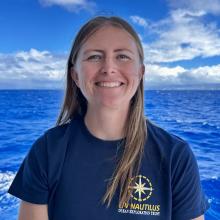
Shelby Gunnells
Tell us about your work/research. What kinds of things do you do?
I am interested broadly in marine critical minerals and the potential environmental impacts of deep-sea mining. During my PhD, I characterized baseline water-column chemistry in a polymetallic nodule mining lease region and assessed changes from baseline due to prototype mining activities. To do this, I went out to sea and collected water with either a trace metal-clean CTD rosette or a remotely operated vehicle (ROV), then analyzed samples back in the lab using a variety of methods. This process was collaborative. There was a wide suite of chemicals to measure, including dissolved organic carbon, dissolved inorganic carbon/total alkalinity, mercury species, macronutrients, and dissolved and particulate trace metals. One lab can’t do it all! Working on large-scale projects like this is inherently multidisciplinary and is only successful with the coordination and shared purpose of a united team. While lab work has been a large portion of my research, an equally important part has been communicating my findings to a wide audience.
What sparked your initial interest in your career?
I stumbled into the world of oceanography almost by happenstance. I grew up in Iowa with a natural curiosity about the earth and why it looked the way it did. I went to North Dakota State University for my undergraduate studies and majored in geology. One spring, I was applying for summer internships that were natural resources management and geology-focused. Later in the spring semester, an English course assignment directed us to make a cover letter and resume for a real job ad. Well, there happened to be an internship opportunity floating around my geology department with climate change and oceanography themes, so I did the assignment on that. Since I made the application materials, I might as well apply, right? That ended up being the one internship that I was accepted into that summer, and my project was chemically characterizing a hydrothermal vent chimney from the Mid-Atlantic Ridge. I was hooked! After that summer, I searched for trace metal-focused oceanography labs for graduate school, and I found a professor looking for a student to work on her deep-sea mining project. This felt like the perfect blend of my geology roots and my oceanography interests, so I accepted that project, and it has led me to where I am today.
Who influenced you or encouraged you the most?
It is hard to pick one, as I have been fortunate to be surrounded by many great people throughout my life. My parents have always been extremely supportive of me pursuing my passions, whatever they may be. They helped foster an environment that is encouraging and supportive, allowing me to try hard things and not be afraid of failing. Then throughout my schooling, truly from elementary school through graduate school, I’ve had some fantastic instructors and mentors who have helped guide me, challenge me, and inspire me to reach new heights. I have many people to thank for helping me get to where I am today.
What element of your work/study do you think is the most fascinating?
Discovering something new! This could happen at sea watching ROV cameras display a unique phenomenon, or it could happen working up your data and making graphs that show an exciting feature. The field of marine critical minerals and the deep-sea environments in which they are often found is relatively unexplored, making for so many potential new discoveries.
How did you get involved with the Ocean Exploration Trust?
As a Knauss Fellow, I have been placed within the NOAA Ocean Exploration office. As part of my Fellowship, I have the opportunity to see my office’s exploration work up close, and with the collaborative partnership between NOAA Ocean Exploration and Ocean Exploration Trust, this is the expedition I’ve been fortunate to be placed on!
What other jobs led you to your current career?
Prior to my transformative summer internship studying a hydrothermal chimney, I had a summer job as a forestry park-aid where I fostered the resurgence of native Iowan trees. After obtaining my undergraduate degree, I went straight into my PhD program, which I completed in May 2026. I have since started a one-year Knauss Marine Policy Fellowship.
What are your degrees and certifications?
B.Sc. in Geology, North Dakota State University.
Ph.D. in Oceanography, Texas A&M University.
What are your hobbies?
I used to be a competitive track and field athlete, and I still enjoy working out. I also love being outdoors, reading, and drinking fun sugary coffees.
What advice would you give someone who wants to have a career like yours?
Put yourself out there and don’t be afraid to try things outside of your comfort zone or expertise. These ventures into new territory will, at the very least, help you learn new skills, but you may also end up finding your passion!
Expeditions
Shelby participated in the following Ocean Exploration Trust expeditions:
