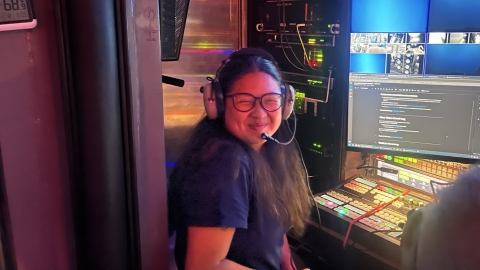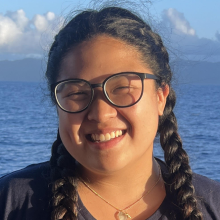
Samantha-Lynn Martinez
Tell us about your work/ research. What kinds of things do you do?
I am a wildlife ecologist and science communicator who loves to make nature, science, and wildlife accessible and exciting for all.
If I’m not outside counting salmon in a local stream in Seattle or filming beavers at a park, I might be designing educational materials or non-profit organization logos at home. I often get to travel for work and do it all, from photo-IDing Steller Sea Lion populations in the Western Aleutian Islands to filming ultra-slow motion footage of hummingbirds wearing tiny tracking backpacks from Colombia.
My work spans far and wide, but imagery technology has always been a driving tool for it all. I also work for Jackson Wild, an organization all about celebrating the natural history and wildlife documentary industry. I get to organize events for fellow science and nature storytellers and watch the latest nature documentaries as they compete for our Media Awards (Think the Oscars, but for nature storytelling!).
What sparked your initial interest in your career?
I was born in the Philippines and then moved to Seattle when I was about three years old. Given that I grew up surrounded by marine environments, I’ve always had a natural draw to these ecosystems from the moment I could explore them for myself.
I've always known I wanted to work with animals or the natural world in general. However, there didn't seem to be a clear route to follow or easily accessible opportunities for someone my age looking into natural history communications work from the ground up..
I started working with the Seattle Aquarium as a Youth Marine Science Interpreter in high school. I picked up nearly all of my in-person science education and public engagement skills through this particular program. When the COVID pandemic hit, I was forced into a position where in-person engagement was incredibly limited, so I started exploring media, videos, photography, and graphic design. All of these skills have been developing alongside my career as a scientist, so I'm excited to see where this road leads me next!
Who influenced you or encouraged you the most?
I've had so many powerful and inspirational women come into my life over the past few years, but Erin Ranney, another E/V Nautilus Video Engineer, is someone whom I credit much of my progression in this industry.
Since meeting her years ago after a cold email for a school research paper, she's helped me navigate the wild world of natural history filmmaking and introduced me to a whole community of other camerawomen who push me to be a better version of myself with each day that passes. Being unafraid to be open and honest about the ups and downs of this particularly niche field has been incredibly comforting and empowering for me and others in the same boat. Seeing my passions manifested in another person who is a few years further down the line has helped me realize that my own dreams are much closer and more feasible than I might think. Achieving these dreams is certainly not a shot in the dark.
What element of your work/ study do you think is the most fascinating?
It’s SO hard to pick! So here’s my top three:
First, I adore how quickly people can fall in love with new critters or environments just from hearing a new story about them. I've seen countless kids get all giddy after getting an "urchin hug" for the first time, and immediately running to their friends and family to share fun facts about their new discovery. Turning fear into fascination is absolutely my favorite part of what I do. If I can get someone to care a little more about something beautiful in this world, that's a job well done.
Second, I love that I get to see some of the newest (and often unreleased) nature documentaries as part of my “everyday” job at Jackson Wild. I’ve seen so many innovative documentaries that bring me so much hope for science and climate narratives into the future.
Third: Cameras are just too cool. I’ve been lucky enough to work with some incredibly awesome technology recently, including spatial cameras; they basically allow you to see footage in 3D without 3D glasses. How cool is that!? I can’t wait to see what people do with new camera technology as it evolves.
How did you get involved with Ocean Exploration Trust? How did you become part of the expedition team?
I watched the E/V Nautilus live streams growing up and absolutely LOVED the concept of audiences exploring alongside scientists in real time. I knew that video was a great way to introduce people to places and stories that often feel far away from our day-to-day lives, and I told myself that I'd love to get on the boat one day to contribute to that mission. I applied for and was selected for an Ocean Exploration Trust Video Engineering internship spot in 2024, and have returned periodically as a full-fledged contractor since then.
What other jobs led you to your current career?
There are SO many wacky turns in my career, and I’m a huge fan of saying that things are never linear in this field.
Aside from my very first gig at Seattle Aquarium, I served as a Communication Fellow with a local youth environment advocacy organization where I got to learn all types of creative skills (video, graphic design, photography, etc) while mentoring and facilitating environment education projects with other students, who were often just a few years younger than me.
Since then, I've served as a graphic designer and artist for other organizations of all sorts, but all still relate back to the environment and/or marine science in some capacity. Some include NOAA’s West Regional Center, The Ecological Society of America, River Restoration Northwest, and many more.
Comms work aside, I worked in biological research in multiple capacities throughout university, from studying tiny pollinators to the largest species of sea lion on Earth.
Having this combination of science and communication skills has opened a million more doors for my career journey. I've taken plenty of odd jobs here and there to keep up with the unexpected nature of my science and comms work, but ultimately, every position I've ever had has provided me with opportunities to learn heaps of new skills and grow as a person and as an early career professional.
What are your degrees and certifications?
Bachelors of Science in Biology (Ecology, Evolution, and Conservation) and Marine Biology with Interdisciplinary Honors - University of Washington 2024
What are your hobbies?
Aside from frolicking around with my camera, I love illustrating and designing all types of trinkets for fun! I often create project/team patches or stickers for big research efforts I’m a part of, or posters of ecosystems I’ve researched. A few years ago, I started a scrapbook of tiny tattoos on my left arm, where I design tattoos for myself as a way to honor big milestones in my life.
What advice would you give someone who wants to have a career like yours?
If you want to go down the science communication route, I 100% recommend practicing writing whenever you can. This goes for any science communicator, regardless of the type of media you might specialize in. Even though I'm a graphics artist and camerawoman, I've encountered SO MUCH more writing than I could have anticipated, even though that's not my primary function in most of my science communication work.
Creative work in the science world still requires copious hours of ideation, collaboration, research, and communication with other team members, grant committees, and potential supporters for specific projects. Writing emails is also crucial for pitching yourself or your projects to new collaborators. If you can strike a balance between your STEM practical skills *and* your written and verbal communication skills, you will have a massive leg-up in both industries for science and communication.
I'm SO excited to geek out and freak out about our deep-sea finds with our audiences. I want everyone watching to know that we scientists feel the same way about these amazing finds as they do, so don't be afraid to be fascinated and curious!
Expeditions
Samantha-Lynn participated in the following Ocean Exploration Trust expeditions: