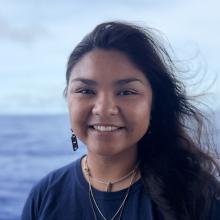
Sabrina Medina
Tell us about your work/research. What kinds of things do you do?
I support and develop educational programs that align with protecting Maui's reef ecosystems. I get to teach my community all about the importance of ocean conservation for corals, sea turtles, seals, seabirds, and more! For example, sometimes sea turtles get caught in marine debris or become injured, so we rescue injured turtles, treat them, and release them back into the ocean. Another part of protecting our ocean wildlife is restoring coral reefs. We grow corals in our land-based nursery until they are healthy and strong, and then we plant them back on the reef to help restore our reefs around the island. There are many ways we protect our wildlife and coral reefs, but we need the help of our community. My job is to inspire students, visitors, fishers, and boaters to work together for the ocean.
What sparked your initial interest in your career?
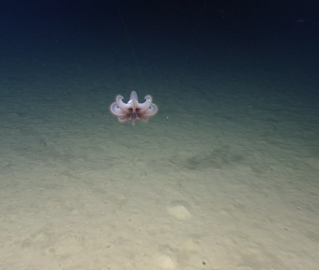
I grew up exploring the tide pools of Southern California, and I was fascinated with the amount of life that filled the pools at my feet. The hours spent observing tiny crabs, sea slugs, and anemones grew my curiosity for the less charismatic critters of the ocean. While studying marine biology in Hawaiʻi, I interned for a coral restoration nursery and learned about the importance of coral reefs to coastal communities, especially islands. These stationary animals that were often mistaken for rocks were responsible for so much life, both in the water and on shore. However, coral reefs are only part of the greater ocean ecosystem. My time working in the Marianas highlighted just how much we have yet to discover about the deep sea and its many odd and interesting creatures. Every part of the ocean is connected, from the California tide pools to Hawaiian coral reefs to the deep sea!
Who influenced you or encouraged you the most?
There are many people who have influenced my journey into science! My mom always encouraged me that, regardless of what I do, I should do it with pride. I carried that with me as I learned to navigate different internships, jobs, and opportunities. Even when she didn't fully understand my work, she cheered me on. My professors throughout my academic career equipped me with the tools needed to build confidence as a scientist. However, my fellow peers in the field empowered me to make my own mark as a science communicator.
What element of your work/study do you think is the most fascinating?
I am truly fascinated by the marine world every day, but one of the most fascinating parts of my work is witnessing how resilient the ocean and its inhabitants are. Corals are able to respond to global stressors like climate change. We can study their resistance to temperature changes; meanwhile, sea turtles can survive despite significant injuries.
How did you get involved with the Ocean Exploration Trust?
I first heard of Ocean Exploration Trust while in college, but I learned more about the Science Communication Fellowship (SCF) from my supervisor in Guam. She was an SCF in 2023 and often shared resources from the OET. Encouraged by her and my goal to sail as part of a research expedition, I applied to be an SCF and join the amazing team this year.
What other jobs led you to your current career?
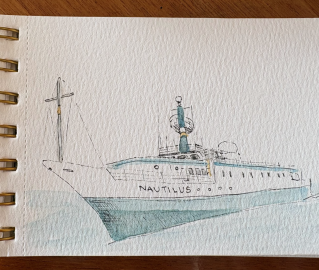
My first job out of college was as a marine naturalist aboard snorkeling and whale-watching vessels. As a trained scientist, observing wildlife was easy, but as a naturalist, I loved interpreting our observations. I continued to work in informal education while obtaining my Master's as well as running several community science programs. My experience working in my community led me to Guam, where I reviewed education and outreach programs and identified best practices and strategies for engagement. My hobbies in art and storytelling lend a hand in further developing educational programs and creating new materials to support place-based learning.
What are your degrees and certifications?
Bachelor of Science in Marine Biology -- University of Hawaii at Manoa
Masters in Conservation and Restoration Science -- University of California Irvine
PADI Advanced Open Water Diver and Freediver
What are your hobbies?
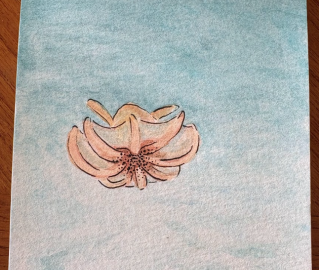
I love to travel and often prefer to embark on solo trips. Many of my travels revolve around other hobbies, including scuba or freediving, surfing, or snowboarding. I really enjoy making art and often take inspiration from the big blue. Media I've used to create ocean-themed art include watercolor, ceramics, polymer clay, acrylic paints, and digital drawings!
What advice would you give someone who wants to have a career like yours?
We need more marine biologists, and they can't all be researchers! I didn't always think of myself as a scientist because I didn’t always feel like I fit the expectations the label called for. I struggled in math and science until a high school biology teacher made the subject come alive through stories and drawings. The impact of one teacher gave me the confidence to pursue science despite these challenges and taught me to use art as a catalyst to learn. There is no single way to belong to science; use the skills and interests that make science accessible to you. Our backgrounds, cultures, stories, and skills strengthen the field for everyone.
Expeditions
Sabrina participated in the following Ocean Exploration Trust expeditions: