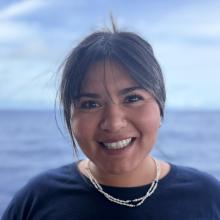
Nayeli Garcia
Tell us about your work/research. What kinds of things do you do?
I am uncovering the hidden biodiversity of an octocoral genus called Scleracis. These corals are understudied and often overlooked, even though they create three-dimensional habitats in some of the darkest parts of the ocean that fuel deep-sea ecosystem biodiversity. My research focuses on understanding how many species actually exist within this genus. To do this, I combine traditional morphology with modern-day phylogenomics through an approach called integrative systematics. I examine previously collected specimens from the Flower Garden Banks off the coast of Florida stored in Erin E. Easton’s lab, as well as historically collected specimens housed at the Smithsonian National Museum of Natural History. Much of my work involves studying the specimens with stereomicroscopy, scanning electron microscopy, micro-X-ray computed tomography, and generating and analyzing genetic data. My research can highlight the benefits of an integrative systematics approach to uncover the realities of octocoral biodiversity, helping us conserve these organisms.
What sparked your initial interest in your career?
I became interested in this career field as a kid who was fascinated by Magic Tree House books such as Dark Day in the Deep Sea that I would read in my middle school library. I also loved watching Planet Earth, which would take me through every emotion from sadness to fascination. Those experiences sparked my interest in all the fascinating things the ocean was still waiting for us to discover. During my bachelor’s degree, I initially became interested in conservation and restoration, particularly beach renourishment. I later met my now-advisor, Dr. Erin E. Easton, who has dedicated her career to uncovering the complexities of the deep sea, specifically octocorals. Reading about her research and discoveries drew me toward wanting to contribute to the biodiversity gaps that still exist within this understudied realm. It felt like an opportunity to contribute to uncovering the unknown, just like the books and documentaries that fascinated me as a kid. With my research, I get to enjoy that feeling of discovery and the excitement of answering questions that have simply not been able to be answered yet.
Who influenced you or encouraged you the most?
I have been fortunate to have a great support system because sometimes it really does take a village. My family, friends, advisor, and husband have all encouraged me to step outside of my comfort zone and continue pursuing questions that can sometimes feel to difficult to answer. They remind me to keep going and stay positive when research gets challenging and encourage me to embrace the uncertainty that comes with discovery, which is the best part.
What element of your work/study do you think is the most fascinating?
The most fascinating thing I have experienced recently was spending four months as an intern at the Smithsonian National Museum of Natural History. I was able to work with historically collected and stored Scleracis samples, including specimens that have been there for decades. While I was there, I also had the opportunity to get behind-the-scenes tours of different departments throughout the museum, which was such a cool experience. One of my favorite parts was walking through the museum at night when it was completely empty, and nothing came alive, if anyone is wondering haha.
How did you get involved with the Ocean Exploration Trust?
I got involved with Ocean Exploration Trust while I was at the Smithsonian. My mentor, Andrea Quattrini, mentioned that there was a spot open on an upcoming expedition, which was crazy because I had been keeping my fingers crossed for an opportunity like this. I spoke with Steve Auscavitch; he shared my name with OET staff, and boom, here I am, boarding my first expedition!
What other jobs led you to your current career?
Before pursuing my current research, I had several research experiences that helped shape the direction I wanted to take in marine science. I worked with a team collecting data for the NOAA Marine Debris database, where we surveyed beach transects, categorized marine debris, and communicated our findings to the public. As an undergraduate research assistant, I worked on a project studying the viability of swash zone organisms in recycled glass and sand cullet and volunteered with the lab’s efforts to monitor water quality at a heavily protected estuary called Bahia Grande. Through these experiences, I learned how to collect and interpret data, work as part of a research team, operate laboratory equipment, troubleshoot problems, and communicate scientific findings. Each experience helped me build the skills and confidence that eventually led me to pursue my master’s degree and my current research on the octocoral, Scleracis.
What are your degrees and certifications?
Bachelor of Science in Marine Biology - University of Texas Rio Grande Valley 2024
Masters of Science in Ocean, Coastal, Earth Sciences - Ongoing
What are your hobbies?
I love all outdoorsy things such as hiking, snorkeling, camping, kayaking, and my favorite is walking my two fur babies at sundown. However, I do love to bed rot and binge-watch shows. My ultimate favorite hobby, though, is to try new coffee shops, especially in new cities, states, and hopefully new countries soon.
What advice would you give someone who wants to have a career like yours?
Don’t be afraid to try things, even if you have no idea where they will lead you. Say yes to opportunities, ask questions, and talk to people in the field because they have so much knowledge to offer. You never know when one conversation or one opportunity will open a door you didn’t even know was there. Most importantly, stay curious and don't get discouraged when answering one question leads to more questions. That is what makes this career so exciting.
Expeditions
Nayeli participated in the following Ocean Exploration Trust expeditions:
