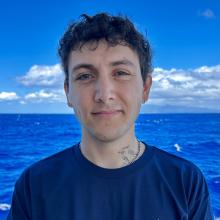
Martin Girardi
Tell us about your work/ research. What kinds of things do you do?
I specialize as a shooting researcher, meaning I work as both a camera operator and a production researcher: liaising with consultants and contributors, pulling archive, informing editorial decisions, organizing kit, and planning for location. As a Video Engineering Intern on this expedition, I’ll assist with switchboard feed management and live-streamed image and audio adjustment from the ROVs’ camera systems, become familiar with troubleshooting and infrastructure maintenance procedures from the onboard engineers, and contribute to education and outreach efforts.
What sparked your initial interest in your career?
I studied evolutionary biology as an undergraduate because I was interested in how past environmental pressures shape the diversity and distribution of organismal traits, and how adaptive mechanisms can be described, reconstructed, and understood. Across levels of granularity, from cellular chemistry to paleoanthropology, college introduced me to broad existential and experiential implications in understanding our own inextricability from these latent natural forces, material processes, and deep histories; grasping life’s complexity as a product of emergence was a powerful unifying insight. At the same time, I found a sort of therapeutic joy in problem-solving through a second major in visual art—initially via sculptural fabrication while working as staff in the university woodshop, and later in photography and animation coursework. Wanting to synthesize these interests, I took a senior-year, nascent science communication elective and then interned at the Pritzker School of Molecular Engineering’s STAGE Center, collaborating on a video series that covered unique scientist motivations in the Chicagoland area. Recognizing that conveying and making accessible both zoology and ecology was an ultimate career goal, I subsequently enrolled in the Wildlife Filmmaking MA at UWE Bristol, affiliated with the BBC Studios Natural History Unit.
Who influenced you or encouraged you the most?
Coordinating supervisors at STAGE Center and the instructors leading my science communication course first introduced me to the public value of demystifying otherwise esoteric science, as well as demonstrated how to make spoken ideas and concepts expressed in direct address resonate with an audience, staying with them in the long run. Similarly, mentors on my MA translated these approaches of engagement to the technical and narrative structures of film and television, and, culminating in a short thesis film, both affirmed and guided my learning through iterative feedback.
What element of your work/ study do you think is the most fascinating?
With regard to this role, I’m super fascinated by the innovative housing constructions and telepresence apparatuses necessary to gather and broadcast footage from the deep ocean; when you need to resist some of the most intense pressures on the planet’s surface and exposure to saltwater can turn your camera encasement into a live electrochemical cell, when dome shape constrains focus and the color temperature of reflected light is constantly shifting, and when you have to reliably encode and beam a transmitted signal from as remote a spot as one can get, working around the inherent instrument limitations that define contemporary methods of studying benthic life requires challenging, highly involved engineered solutions that I’m very much looking forward to delving into and helping juggle. More generally, I’m intrigued by the potential of natural history media to influence public attitudes and legislation. Whether it’s mining, overfishing, waste disposal, ocean noise, or the pervasive effects of climate change, I think corporate investment in the industrial exploitation of the deep sea is becoming more entrenched (pun intended), and I’m particularly excited to witness how science communication—specifically aligned with OET’s own digital context of pulling topside the curious and delicate beauty of these shrouded, enigmatic marine habitats to share with new generations of naturalists—can continue to facilitate the safeguarding of interconnected ecosystem services against this burgeoning frontier.
How did you get involved with Ocean Exploration Trust? How did you become part of the expedition team?
I first applied for the SEIP after encountering E/V "Nautilus"'s stream on social media, and—through a peer and mutual friend—was pointed to past interns (now established, celebrated camera operators back in the US) who were kind enough to talk to me about both the designated responsibilities of the Video Systems Engineering Internship and their own experiences onboard after having graduated from the same niche UK higher education environment that I had.
What other jobs led you to your current career?
Building on my recent graduation, I’m joining "Nautilus"'s science party after a series of independent projects and work experience across Bristolian production companies, film festivals, post-production studios, and kit houses that provided a practical, hands-on comprehension of professional workflows and personnel structures foundational to functioning as a blue-chip camera assistant and researcher.
What are your degrees and certifications?
Dual-major Bachelor of Arts in Biological Sciences (Life, Ecosystems, and Evolution) and Visual Arts (Studio Track) — University of Chicago 2021
Master of Arts in Wildlife Filmmaking — UWE Bristol 2024
What are your hobbies?
I still like to make things! I’ve carried on enjoying the tactile crafts I undertook in college (as well as experimenting with whatever new medium I’d like to try painting, assembling, casting, or weaving). Now that I’m back in Oregon, I also find myself spending time hiking, camping, and exploring the state’s many dramatically diverse ecoregions as frequently as possible.
What advice would you give someone who wants to have a career like yours?
Be open to embracing new media, formats, and platforms: as technologies change, modes of consumption change, and industry demands change in turn. It’s vital to consolidate skills to be well-rounded, not only in expanding the imaging systems or DIT configurations you feel confident in handling, but in the many multidisciplinary development, research, and production management duties you may assume or positions you may need to support throughout the entire pipeline of a project. This emphasized versatility extends to writing and communication skills: yes, in terms of effectively connecting with your intended viewership, but also in being personable and consistent when pitching, networking, and maintaining relationships with both studio employers and NGOs who need filmmakers to mold their stories or share their efforts.
What excites me most about participating in this expedition is the same thing that excites "Nautilus"'s live online viewers: amidst marine snow and unseen landscapes, being privy to entirely novel and otherworldly moments as they unfold.
Expeditions
Martin participated in the following Ocean Exploration Trust expeditions:
