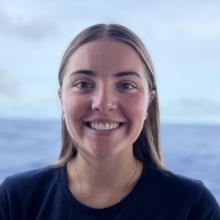
Layne Leggett
Tell us about your work/research. What kinds of things do you do?
I am currently pursuing my master's degree and working on the Barnacle Baseline Project, where I am studying contaminants in barnacles around Tampa Bay. My project is a companion project to a larger contaminant study at USF College of Marine Science under Dr. Steve Murawski called the Tampa Bay Surveillance Project. I chose this type of work because I have a passion for how anthropogenic effects are causing harm to our marine ecosystems. I hope to use the skills I learn in this project and broaden my work with coastal contaminants into the deep sea to better understand how contaminants are impacting our deep-sea ecosystems. While studying these invertebrates and contaminants, I also actively keep up with my seafloor mapping skills as a student member of the Center for Ocean Mapping and Innovative Technologies (COMIT). I hope one day to combine these skills to not only map and understand the physical features of deep-sea environments, but also what kinds of pollutants are present and how they are affecting the organisms of these fragile ecosystems.
What sparked your initial interest in your career?
I knew I wanted to be a marine biologist at a very young age. I grew up in Cincinnati, Ohio, far away from the ocean, so people like Steve Irwin and movies like Free Willy drew me into a career of not only protecting our world’s ecosystems, but marine environments in particular. I remember being heartbroken when the Deepwater Horizon Oil Spill happened. I was just nine years old, and it made me realize how much harm humans can cause to our oceans, even by accident. I knew I wanted to help people understand how much harm we are causing and how to prevent it! It wasn’t until I moved to South Carolina for college that I truly learned how many different careers a marine scientist could have and was introduced to the world of seafloor mapping. I remember the excitement I felt watching ROV dive footage for the first time, anticipating what new organisms or features would be uncovered. The deep sea is a world being constantly uncovered, and as someone who is passionate about conservation, that means even more ecosystems to learn about and protect!
Who influenced you or encouraged you the most?
I have had the pleasure of working with several mentors during my time as a student who have encouraged me through their support and inspiring journeys. During my time as an undergraduate, Dr. Bob Podolsky introduced me to my first marine biology research experience, and Dr. Leslie Sautter introduced me to the world of seafloor mapping and deep-sea research. Both were incredibly influential in helping me navigate the next step in my career. Now, as a graduate student, my advisor, Dr. Steve Murawski, is incredibly supportive and encouraging. He is always pushing his students to challenge ourselves, grow our skills, and constantly build our networks! While these professors have really inspired me as I navigate my career, I wouldn’t be where I am without the encouragement of my parents and family, who never dimmed the passion I had to move away from home to pursue my career as a marine scientist and have supported me every single step of the way.
What element of your work/study do you think is the most fascinating?
I am very fascinated with the world of contaminants in our oceans, both contaminants of known and emerging concern! With the project I am currently working on at USF, we are looking at different organisms and what contaminants are present in their tissues, and it is incredibly intriguing to see the amount of pollutants, like PFAS, in the tissues of a fish that people regularly consume here in Florida! When I am not working on contaminants, my mind is always curious about the discoveries that have yet to be made in the deep sea. One of the most fun things I have done while working with ROV footage and multibeam data in the past was creating educational highlight videos of dives and their most interesting findings!
How did you get involved with the Ocean Exploration Trust?
I became involved with Ocean Exploration Trust through the Center for Ocean Mapping and Innovative Technologies (COMIT) at USF and was invited to participate as a contractor with my background in mapping operations and data processing.
What other jobs led you to your current career?
While my career has consisted of always being a full-time student, I’ve had many research, volunteer, and internship opportunities that have shaped my experience so far as a marine scientist. Growing up, I volunteered as an educator at the Newport Aquarium in Kentucky, where I first found a passion for science communication. I attended the College of Charleston for my undergraduate degree, and while there, I took part in independent research projects in both biology and geology. I studied how microplastics can affect the development of sea urchin larvae. This project introduced me to the world of ecotoxicology and made me interested in how anthropogenic effects are causing harm to our marine ecosystems. Additionally, I was a member of the BEnthic Acoustic Mapping and Survey Program (BEAMS) where I became interested in processing multibeam data and using ROV footage to understand habitats of the areas being mapped thousands of meters beneath the surface. These two experiences solidified my love of research and allowed me to take the next step into graduate school. The summer before I began my master’s degree, I was an intern at Woolpert, where I helped collect and process multibeam data to update navigational charts in the Chesapeake Bay. I am currently a graduate student working with Dr. Steve Murawski, who leads multiple large-scale research projects focusing on both ecotoxicology and seafloor mapping. With his projects spanning both areas of marine science that I am passionate about, I was confident that his lab at USF would be a great fit for my research goals. To keep up with my passion for science communication, I also serve as a science coordinator with SCUBAnauts International and as a science mentor for USF’s Oceanography Camp Especially for Girls!
What are your degrees and certifications?
Bachelor of Science in Marine Biology - College of Charleston 2024
What are your hobbies?
I love shark tooth hunting and weightlifting in my free time! I also love to bake, especially sourdough, and have recently perfected my chocolate chip cookie recipe!
What advice would you give someone who wants to have a career like yours?
While it may seem overwhelming at times, never say no to an opportunity that piques your interest. Not only will it build your skills and experiences, but it will help you narrow down what you are truly passionate about. Also, do your best to never stop building your network as you grow as a scientist, no matter how comfortable you may feel in the moment! I would also say take advantage of opportunities to learn skills like coding and data management as early as you can! Lastly, if you have to take a big risk or move far away from home to pursue a marine science career, know that you will have such a rewarding journey and meet so many amazing people along the way! My dad always told me, "If it was easy, everyone would do it!" This has helped me so much along the way, and I hope it can inspire you too! Taking risks and doing the hard work will help you learn so much about yourself, have very few regrets as your career blossoms, and will help you thrive as a marine scientist!
Expeditions
Layne participated in the following Ocean Exploration Trust expeditions:
