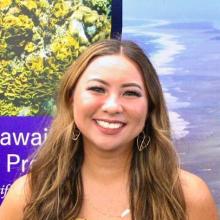
Kelsie (Pīkake) Kuniyoshi
Tell us about your work/ research. What kinds of things do you do?
I specialize in the relationships between Hawaiian names and the organisms, places, and elements they describe, a concept I refer to as "Pilina Inoa". In ʻŌlelo Hawaiʻi, names are rarely arbitrary--they often encode observations about an organism’s form, behavior, habitat, genealogy, or relationship to other living things. By examining these linguistic patterns, we can better understand how our kūpuna documented and organized ecological knowledge. When I work in the field, whether snorkeling, hiking, or just talking story with others, I am only beginning to understand these relationships, as they require long-term observation. There is a surprising amount of ʻike kūpuna that surrounds the deep sea, seamounts, and the species that inhabit these realms, which I also seek to learn.
Much of my research, therefore, takes place in both landscapes and libraries. I compare historical records, Hawaiian-language newspapers, ethnographic accounts, and contemporary scientific literature to identify how Hawaiian names correspond to species and how those names reflect ecological insight. Through this process, naming becomes more than translation. It becomes a way of recovering systems of classification and observation embedded within the language itself. By documenting and revitalizing these relationships between names and organisms, my work strengthens the connections among language, culture, and environmental stewardship in Hawaiʻi.
What sparked your initial interest in your career?
I have been fascinated with names for as long as I can remember. Even as a child, I was curious about why "things," including people, were called what they were. Different cultures have their own naming systems, and those names often carry meanings, histories, and genealogies. I have always been drawn to the idea of nominative determinism, the notion that names can shape or reflect destiny. In my own case, the name “Kelsie” is often translated as “victorious ship,” which I like to interpret as a reminder that whatever huakaʻi I embark on, whether that is a literal voyage by canoe or ship, or an intellectual journey through research, can be guided toward success.
That curiosity about names eventually evolved into my academic path. In the Kumulipo, a Hawaiian cosmology chant, there is a section that states pairs of species that share the same name, or parts of a name, which typically reflect a functional ecology, such as a plant flowering at the same time a fish spawns. However, this concept of organisms sharing the same name (or parts of their names) extends far beyond pairs. This sparked my research on pilina inoa, the relationships embedded within names. By studying how organisms and phenomena are named in ʻŌlelo Hawaiʻi, I hope to better understand how our kūpuna documented ecological knowledge and organized the Hawaiian universe. In many ways, my work asks a simple but powerful question: what can we learn from names alone?
Who influenced you or encouraged you the most?
Every single teacher, kumu, cultural practitioner, etc. have influenced me to where I am today. In many ways, I attribute my love of ʻāina stewardship to my grandparents, with whom I have very early memories of being in the garden, and educationally, I attribute my learnings to my parents, both of whom were formal DOE teachers. Finally, I acknowledge my Kumu Hula, Mandi Scott, who always emphasized the importance of reciprocity, a concept that extends to include nature. To truly steward relationships between people and places is to reciprocate by stewarding them in the same way that they mālama us.
What element of your work/ study do you think is the most fascinating?
The most fascinating thing I have done recently occurred during my expedition aboard the NOAA Okeanos Explorer (EX501), where I witnessed the ʻAkihikeʻehiʻale (Tristramʻs Storm Petrel), a species whose name was recovered and taught to me by members of the Papahānaumokuākea Native Hawaiian Cultural Working Group. This is one of many species I would typically only see in Pō, in the Northwestern Hawaiian Islands. I was lucky enough to watch this bird soar alongside the boat, and fulfill what its name tells us: a bird with a hooked beak that treads on billows. The name and description of this bird, along with its feeding behavior, were documented in He Vahi Huli-Toa Manu Hawaiʻi, and for many years, this Hawaiian bird went without its Hawaiian name. When I got to witness this manu and its behavior, it felt surreal; how fortunate I was to get the opportunity to greet it appropriately, as the ʻAkihikeʻehiʻale!
How did you get involved with Ocean Exploration Trust? How did you become part of the expedition team?
I have been familiar with Ocean Exploration Trustʻs (OET) work for several years now, initially learning about it from numerous colleagues and classmates. I was never able to apply as an undergraduate simply because of the graduation timeline, and now that I am in my graduate studies, I was able to apply to the internship program.
What other jobs led you to your current career?
I have had the opportunity to work in several roles that shaped the direction of my career and helped me arrive at the work I do today. I have formal academic training in Marine Biology and in Curriculum Studies. As such, I have interests in place-based STEM education, where I studied how local knowledge, language, and environmental science can be integrated in meaningful ways for students and communities. Along the way, I have also worked in a variety of science, education, and outreach roles that expanded my perspective on how knowledge is produced and shared. I have developed curriculum and educational resources for schools, worked as a Cultural Liaison on the Okeanos Explorer in the Northwestern Hawaiian Islands, and collaborated with scientists, agencies, and the community on various projects related to Hawaiʻi-based stewardship. These experiences required skills beyond traditional research, including science communication, community engagement, graphic design, curriculum development, and interdisciplinary collaboration.
What are your degrees and certifications?
Bachelor of Science in Marine Biology, Botany Minor, Certificate in Marine Graphic Design -(University of Hawaiʻi at Mānoa, 2023)
Masterʻs of Education in Curriculum Studies (STEMS^2 Cohort 9) - (University of Hawaiʻi at Mānoa, 2024)
PhD Student in Natural Resources and Environmental Management - (University of Hawaiʻi at Mānoa, Expected Graduation: 2030)
What are your hobbies?
I love dancing hula, doing graphic design, working out, hiking, snorkeling, etc.!
What advice would you give someone who wants to have a career like yours?
If you want to pursue a career like mine, my biggest advice is to stay curious and connected about the world and pay attention to the patterns that others might overlook. In my case, that curiosity centered on names—why things are called what they are, and what those names reveal about how people understand the natural world. If you are interested in work that connects language, culture, and science, it is important to build skills in more than one field. Learn the language systems, histories, and cultural contexts that shape knowledge, but also become comfortable with scientific observation, fieldwork, and research methods. The most interesting discoveries often happen at the intersections between disciplines.
It is also important to spend time listening to people who hold knowledge of the places you study, such as community members, cultural practitioners, fishers, farmers, and kūpuna. Many knowledge systems have been carefully developed and refined over generations, and approaching them with humility and respect will help you learn far more than working alone. Do this humbly and gracefully, and be willing to accept that a question might be eternally unanswered, or some knowledge might not be meant for you to uncover.
