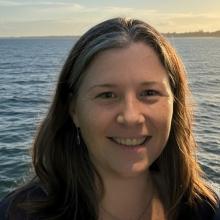
Kelley Suhre
Tell us about your work/research. What kinds of things do you do?
I specialize in project management, maritime archaeology, deep ocean exploration, and the tools and technologies used to access and explore deep-ocean environments. I led deep-sea expeditions in the Atlantic and Pacific Ocean for a decade that investigated a variety of habitats including lost shipwrecks and aircraft. Today, I am applying my understanding of the capabilities needed for these types of investigations to plan the construction of NOAA's next ocean exploration vessel.
What sparked your initial interest in your career?
I grew up reading National Geographic and wanted to be an archaeologist from a young age. My interest in maritime archaeology came from watching the National Geographic documentary, "Secrets of the Titanic" that came out on VHS in the 1980s. The video talked about the history and sinking of the ship, and the technologies the researchers used to discover and document her. I was hooked on Titanic's story and must have watched that video a hundred times as a kid.
Who influenced you or encouraged you the most?
My college professors, supervisors and colleagues helped me to see my strengths, identify opportunities, and point me in new directions to grow my skills and experience throughout my career.
What element of your work/study do you think is the most fascinating?
Archaeology is the study of the human past through the physical material and changes left behind. While the people often no longer exist, Archaeology and science can tell their stories. The wood on a ship can be studied to determine its age, provenance, and where it was constructed. The tool marks on plank can tell you the experience level of the craftsman. Environmental DNA can tell you the type of food or product that was stored in an ancient container. The personal items on a ship tell you where the crew were from, their economic class, and what they cared about. The cargo can tell you about a ship's previous port calls and trade routes. The configuration of a vessel on the seafloor can tell you about the conditions and situations experienced at the surface right before it sank.
How did you get involved with the Ocean Exploration Trust?
My co-worker, Phil Hartmeyer, is the shore-based archaeology lead for this expedition. He invited me and a few other Japanese and NOAA maritime archaeologists to be co-leads because we have the relevant backgrounds and experience for the project, and have worked with him previously.
What other jobs led you to your current career?
In college my work as an Environmental Outreach Coordinator gave me a strong foundation of field work, and people and project management skills that I continue to use in my job to this day. While in college, I also became a scientific SCUBA diver and learned Geographic Information Systems. These helped me get a maritime archaeology internship with my office, which led to a job working with many different types of scientists who received grant funding from our office. Exposure and participation in their projects built my foundational understanding of deep ocean exploration and the tools and technologies we use. After getting my Master's Degree in maritime archaeology, and was able to put all of the skills I had built over the past ten years to use as an Expedition Coordinator, planning and leading expeditions on one of NOAA's ships. The deep understanding of vessel operations I learned as an Expedition Coordinator, combined with my comfort and understanding of vessel construction as a maritime archaeologist, led to my current role as one of the leads for construction of NOAA's next ocean exploration vessel.
What are your degrees and certifications?
B.A. in Integrative Studies: Conservation Studies - George Mason University: New Century College, 2005
M.A. in Maritime Archaeology: University of Southampton, 2009
What are your hobbies?
I love hiking, trail running, gardening and making jewelry.
What advice would you give someone who wants to have a career like yours?
Get involved! Look for internship or fellowship opportunities in your field of interest and give it your best. Identify other skills needed to do the job and find clubs or part-time jobs that will grow your experience and network. When you encounter others in your field(s) of interest, be inquisitive. Ask those with experience about their jobs, how they got to where they are today, how they developed any particular skills that you admire, and if they have any advice. Pursue what excites you, and build on your strengths.
Expeditions
Kelley participated in the following Ocean Exploration Trust expeditions:
