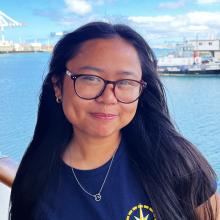
Jhen Allison Seguiwan
Tell us about your work/ research. What kinds of things do you do?
Throughout my time at Southern Utah University (SUU), my research has been deeply connected to my home in American Samoa and my passion for protecting coastal and marine ecosystems. Under the mentorship of Ms. Alphina S. Liusamoa, I focused on understanding environmental challenges, such as habitat loss, the impacts on endangered species in the region, and contributing to conservation efforts that directly benefit my community. I have also worked on applied, community-based projects, including collaborating with the Coral Reef Advisory Group alongside former Invasive Species Program Coordinator Casidhe Mahuka to help implement rain gardens in Faga’alu and Fagasa. This hands-on experience allowed me to address issues like runoff and reef health while engaging directly with conservation efforts. At SUU, I expanded my research to terrestrial systems as a research intern with Dr. Jamie Spinney, where I focused on urban wildlife movement and improving roadway safety for both wildlife and people. Recently, I worked with the Ciguatera Network through the University of Hawai’i Sea Grant College Program alongside Dr. Eileen Nalley, Talofa Fe’a, and fellows Ben Bengil and Koloi Ioane. Through this work, I helped raise awareness about ciguatera, a seafood-borne illness caused by toxins in reef fish, and the importance of educating communities on how it affects both human health and local fisheries.
What sparked your initial interest in your career?
Growing up in American Samoa, the ocean was a central part of my life. My father, a fisherman, introduced me to the ocean and taught me to respect it as both a provider and a home for our community. At first, the ocean felt vast and intimidating, but over time, my curiosity grew, especially about the ecosystems beneath the surface. My interest in environmental and marine science solidified during my senior year of high school through the Summer Youth Employment Program with the Department of Marine and Wildlife Resources, where hands-on conservation work with Ms. Alphina S. Liusamoa showed me that research can directly protect marine life and support local communities.
Who influenced you or encouraged you the most?
My dad has been the greatest influence, teaching me to respect the ocean and understand its importance to my community. I have also been guided by mentors who became key supporters in my scientific journey, including Casidhe Mahuka, Talofa Fe’a, Dr. Jamie Spinney, Dr. Eileen Nalley, and Mrs. Kelley Anderson Tagarino. Through their mentorship and support, I learned how scientific research, collaboration, and community engagement can work together to protect marine ecosystems, support local communities, and strengthen my own skills as a scientist.
What element of your work/ study do you think is the most fascinating?
The most fascinating element of my work is being involved in the ciguatera project in American Samoa because it allows me to connect science directly with my community. What makes it especially meaningful is the opportunity to participate in community outreach and help raise awareness about ciguatera, a seafood-borne illness that affects many Pacific Island communities. Through this project, I also had the opportunity to implement GIS, which allowed me to better understand and visualize patterns related to the issue. I find it rewarding to not only study the science behind the illness but also communicate that knowledge in a way that can help protect people’s health and support local fisheries. Being able to contribute to something that directly benefits my island and increases awareness is what makes this work so impactful and inspiring to me.
How did you get involved with Ocean Exploration Trust? How did you become part of the expedition team?
I became involved with the Ocean Exploration Trust through mentors who guided and inspired me in marine science. Casidhe Mahuka and Talofa Fe’a, who have previously participated in expeditions aboard the ship, shared their experiences and encouraged me to pursue opportunities in ocean exploration. Mrs. Kelley Anderson Tagarino provided the opportunity and support for me to apply to the Nautilus Live Ocean Exploration Trust, which led to my selection for the expedition team. Their mentorship, encouragement, and guidance were essential in helping me take this next step in my career and gain hands-on experience in ocean exploration.
What other jobs led you to your current career?
My path toward this career has been shaped by a combination of research, internships, and community-based work. From working on conservation projects in American Samoa to researching urban wildlife in Utah, each experience has helped me better understand environmental challenges in different ecosystems. Opportunities like collaborating with the Coral Reef Advisory Group and participating in the Ciguatera Network have especially influenced my passion for connecting science with community impact and public awareness. Through my work on the ciguatera project in American Samoa, where I helped implement GIS, I developed a strong interest in using spatial tools to better understand marine environments. Being on board the Nautilus as a seafloor mapping intern, I look forward to building on this experience by gaining hands-on skills in ocean exploration and further exploring the applications of GIS in marine science.
What are your degrees and certifications?
Bachelor of Science in Environmental Science — Southern Utah University, May 2027; Minor in Biology; Academic Certificate in Geographic Information Systems; CPR, First Aid, and Shallow Water Lifeguarding up to 7 feet.
What are your hobbies?
I enjoy snorkeling and freediving, playing the ukulele, and going on adventures!
What advice would you give someone who wants to have a career like yours?
Never stop asking questions. A wise person once taught me, Mrs. Kelley Anderson Tagarino, that it is better to keep asking questions because if you don’t, you will always be left in the dark. That advice has stayed with me ever since. Growing up in American Samoa, what many would call just a “dot on the map,” I realized that opportunities do not always come to you, so you have to be curious enough to go after them. Sometimes that meant asking one more question, sending one more email, or stepping out of my comfort zone. I encourage others to stay curious and never be afraid to ask questions, because you never know where one might lead.
I am most excited to connect with inspiring people on board and experience the advanced technology I have only seen through Nautilus Live, now in person!
Expeditions
Jhen Allison participated in the following Ocean Exploration Trust expeditions:
2026
Gallery Highlights
Related Posts

OET warmly welcomes Jhen Allison Paguiligan Seguiwan, a student at Southern Utah University, to our NA178 Pacific Mapping expedition as a seafloor mapping intern! Learn more about Jhen, from American Samoa, via Samoa News.
