Diana Noto
Tell us about your work/ research. What kinds of things do you do?
I work primarily on the biodiversity of shallow-water reefs, collecting, preserving, and identifying invertebrates to survey diversity and contribute specimens to Invertebrate Zoology museum collections using SCUBA diving, snorkeling, and intertidal fieldwork. My current research focuses on the true crab (brachyuran) biodiversity associated with macroalgae around Guam, and in the past I have been fortunate to travel to the Red Sea to assist with biodiversity surveys. I enjoy making data available to other scientists and sharing exciting discoveries with the public!
What sparked your initial interest in your career?
My undergraduate research with the Florida Museum of Natural History Invertebrate Zoology collection introduced me to the wonderful world of collections, where I fell in love with the diversity and unique life history strategies of marine invertebrates. My subsequent work in the collection and my current work in Guam have solidified my interest in documenting and understanding biodiversity in habitats around the world.
Who influenced you or encouraged you the most?
Like many kids, my parents encouraged my interests in the ocean, and it was assisted by my summers spent attending Girl Scout camp, where I was encouraged to explore nature and learned how to swim, kayak, and sail. Professionally, I have been greatly encouraged by members of my former lab at the Florida Museum.
What element of your work/ study do you think is the most fascinating?
The most fascinating part of my work is the discovery of new species. My current research focuses on shallow-water macroalgae, and even in this habitat only a few meters from shore, we have found species that are likely undescribed and others that have never been reported from Guam before. I am constantly in awe of the diversity we are able to find in the ocean.
How did you get involved with Ocean Exploration Trust? How did you become part of the expedition team?
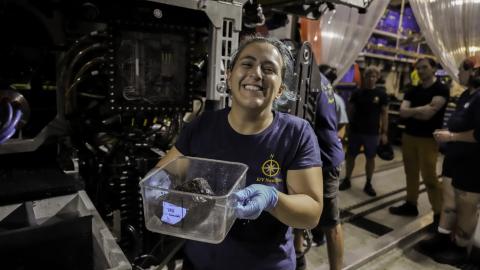
I have always been captivated by the deep sea but have never had the chance to work in it, so when I learned about an opportunity that would blend my collections-based experience with deep-sea research, it felt like a perfect fit. I have also been fortunate to attend talks by Dr. Ballard and other members of Ocean Exploration Trust at my university, which inspired me to apply for the OET Ocean Science Internship.
What other jobs led you to your current career?
During my undergraduate education, I worked across many different labs, including projects on invasive crayfish behavior, CT segmentation of elasmobranchs, invertebrate sample processing for isotope analysis, and morphology of an endemic land snail from Madagascar. I have also spent time working as a camp counselor and for my state's Department of Agriculture. All of these experiences have contributed to the scientist I am today, teaching me lab and data analysis skills as well as how to communicate science to many different audiences.
What are your degrees and certifications?
Masters of Marine Biology, University of Guam (current)
Bachelor of Science in Marine Science, University of Florida 2020
AAUS Scientific Diver 2022
NAUI Advanced Open Water, Rescue, Nitrox Diver 2022
What are your hobbies?
I am lucky to live in a place where I can regularly enjoy my favorite outdoor adventures, like SCUBA diving, free diving, and hiking. I also enjoy photography, crochet, reading, baking, and bouldering with friends.
What advice would you give someone who wants to have a career like yours?
Follow whatever experiences interest you, don’t be afraid to change your path as you learn and try new things, and ask scientists how they got to their current positions! Talking to scientists I’ve worked with about their career trajectories has been some of my favorite and most enlightening conversations.
Expeditions
Diana participated in the following Ocean Exploration Trust expeditions: