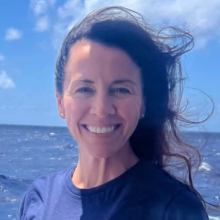
Ashley Cosme
Tell us about your work/research. What kinds of things do you do?
In my science classroom at Crown Point High School, I engage my students in hands-on learning experiences that help them explore and understand the natural world. My students analyze data, ask questions, and investigate real-world scientific phenomena through labs, discussions, and collaborative projects. I encourage critical thinking and curiosity while helping students connect scientific concepts to environmental issues and everyday life. My goal is to build scientific literacy and inspire students to think like scientists as they develop problem-solving skills and a deeper appreciation for the world around them.
As a marine science educator, my work extends well beyond the classroom. I am a partner of NOAA’s Sea Grant Great Lakes Network, where I initiate Great Lakes literacy outreach programs and write original data-driven lessons for the Center for Great Lakes Literacy. I am involved in education, training, and extension projects geared toward the conservation and use of the coasts, Great Lakes, and other marine areas. As a board member of the Great Lakes Educators of Aquatic and Marine Science (GLEAMS), I collaborate with other members to coordinate events that highlight the importance of ocean and Great Lakes exploration.
What sparked your initial interest in your career?
My journey into education began with hands-on experiences in marine science, including tagging sea turtles along Florida's beaches and witnessing ocean conservation work firsthand. Those moments in the field sparked a passion not only for protecting marine life, but also for sharing those experiences with others. That passion led me from the shoreline to the classroom, where I now educate high school students and inspire them to explore marine science, the Great Lakes, ocean conservation, and the wonders of the natural world. I am fortunate to have found a career that combines my undergraduate degree in Marine Biology and my love of education by helping students discover the beauty, mystery, and importance of our oceans and Great Lakes. By bringing ocean topics into the classroom and connecting them to real-world exploration, like the research conducted aboard E/V Nautilus, I hope to inspire students to become curious learners and future stewards of our planet.
Who influenced you or encouraged you the most?
I grew up flying over Lake Michigan with my Dad. Looking down from the plane, there was always something about the unknown beneath the surface of the water that fueled my soul. I had no other choice but to be curious, and this is when I fell in love with water. The adventurous upbringing that my parents provided for my sisters and me has influenced and encouraged me to always continue to explore the natural world, the organisms that inhabit our planet, and the beauty that can be found in every environment.
What element of your work/study do you think is the most fascinating?
One of the most fascinating aspects of being a teacher is my ability to take my own experiences and interests and shape them into hands-on activities where my students can view the world through a different lens that extends beyond their day-to-day life. In my classroom, I enjoy creating experiences that make ocean science come alive for my students. Sharing stories of tagging sharks and sea turtles, collecting data, and observing incredible animals helps spark curiosity and inspires students to see themselves as future scientists and ocean explorers.
How did you get involved with the Ocean Exploration Trust?
Each year, my students participate in the Live Ship-to-Shore interaction with E/V Nautilus. This year, after we had our call with E/V Nautilus, I knew I was ready to be on the other side of the screen. I applied to be a Science Communication Fellow, and now I will embark on the adventure of a lifetime, working alongside scientists and engineers aboard E/V Nautilus and sharing stories of the deep ocean with audiences across the globe.
What other jobs led you to your current career?
My path to becoming a marine science educator has been shaped by a variety of hands-on and professional experiences that deepened both my scientific knowledge and my passion for sharing it with students. Working as a sea turtle field technician allowed me to participate directly in conservation efforts and research, giving me firsthand insight into the challenges marine species face. Serving as a NOAA Teacher at Sea gave me the opportunity to work alongside scientists completing a shark and red snapper survey in the Gulf of Mexico, and bring authentic ocean research experiences back to my classroom. In addition, the Center for Great Lakes Literacy has supported me aboard the EPA’s R/V Lake Guardian, the largest research vessel on the Great Lakes, where I worked alongside scientists, gaining valuable insights into freshwater ecosystems. This has helped me translate complex environmental science concepts into engaging lessons for students. Together, these experiences strengthened my ability to connect real-world marine science with education, and ultimately led me to my current career inspiring students as a marine science educator.
What are your degrees and certifications?
Bachelor of Science in Marine Biology – Eckerd College, St. Pete, Florida
Master of Science in Sports Administration – St. Thomas University, Miami, Florida
STEM Teach and Higher Learning Commission Credentials (Dual Credit Biology Instructor – Purdue University Northwest)
Advanced Open Water Diver
What are your hobbies?
I am a fossil enthusiast and I love digging up the past. I cannot say that I am an expert at identifying all fossils, but I am pretty good at finding treasures along the beach and knowing what animal they came from. I specifically enjoy sifting, diving, and beachcombing for shells and shark teeth. What I appreciate the most about fossil hunting is that I can share this passion with my family. My kids have been on fossil hunting adventures with me from the Calvert Cliffs in Maryland to the beaches of Venice, Florida. There is nothing that can compare to their curiosity and excitement over the remains of an animal that they find washed up on the beach.
I also coach High School Boys Volleyball and enjoy lifting weights in the gym.
What advice would you give to someone who wants to have a career like yours?
If you are interested in marine science education, you should begin by developing a strong foundation in science, particularly in areas such as marine biology, oceanography, ecology, and environmental science. A deep understanding of these subjects will help you explain complex ocean concepts in ways that are engaging and accessible for students. Gaining hands-on experience is also very valuable. Volunteering or working with aquariums, research labs, conservation organizations, or field programs will allow you to experience marine science in action. These real-world experiences can make lessons more meaningful and exciting for students.
In addition to scientific knowledge, strong teaching and communication skills are essential. As a marine science educator, you must be able to translate complicated scientific ideas into lessons that are clear, interactive, and inspiring. It is also beneficial to incorporate field-based learning, such as leading outdoor investigations, conducting water-quality testing, or identifying organisms in their natural habitats. Connecting marine science to real-world issues like climate change, ocean conservation, fisheries, and pollution can help students understand the importance of protecting our oceans. Finally, staying curious and continuing to learn is important in a field that is constantly evolving. Participating in professional development opportunities, such as programs connected to research vessels like E/V Nautilus, can provide valuable experiences and new ideas that you can bring back to your classroom to inspire the next generation of ocean explorers.
Expeditions
Ashley participated in the following Ocean Exploration Trust expeditions:
Gallery Highlights
Related Posts

Science Communication Fellows Ashley Cosme and Yeji Lee spent the day on the bridge with Navigation Officer Adrian Pascu, learning how to manually chart the ship's position and measure distances between specific reference points. E/V Nautilus continues to use paper charts as the primary means of navigation and guidance, as they allow navigation officers to plan routes, verify electronic navigation information, and maintain safe navigation. Paper charts also help the crew aboard E/V Nautilus develop traditional navigation skills, such as plotting positions, measuring distances, and determining bearings. For these reasons, paper nautical charts continue to play an essential role in maritime safety and preparedness.

OET is proud to welcome Crown Point High School, Indiana's Ashley Cosme as one of our 2026 Science Communication Fellows! Learn more via NWITimes.
