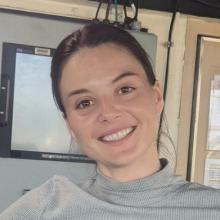
Andi Yoxsimer
Tell us about your work/research. What kinds of things do you do?
As a Resource Protection Specialist, my primary work revolves around the discovery, protection, and management of shipwrecks within Thunder Bay National Marine Sanctuary. This involves conducting multibeam sonar surveys to characterize Lake Huron's lakebed, collecting longitudinal data to determine both natural and anthropogenic impacts on these sites, and working with key stakeholders and community members to increase public awareness of these priceless underwater cultural resources.
What sparked your initial interest in your career?
My fascination with underwater archaeology actually sparked from a simple, lifelong love for scuba diving. Initially, my main goal was to find a career that kept me in the water as much as possible. However, once I began my graduate coursework, my perspective completely transformed. I started to realize just how invaluable submerged sites are for uncovering human history. Shipwrecks function as extraordinary, untouched time capsules. They capture a precise moment in time, preserving what mattered most to the individuals aboard when the vessel went down. By analyzing both the physical ship structure and the artifacts left behind, archaeologists can reconstruct the daily lives of the crew and piece together a much richer picture of the broader culture.
Who influenced you or encouraged you the most?
My family has always been supportive and patient as my career has taken some unexpected turns and led me on some unorthodox adventures. I wouldn't be where I am today without them.
What element of your work/study do you think is the most fascinating?
I enjoy analyzing both the natural and anthropogenic impacts on sites over time. Understanding how these sites are altered by their environment informs what the field of Great Lakes underwater archaeology will look like in the future, and I think solving that puzzle is fascinating.
How did you get involved with the Ocean Exploration Trust?
I wrote my master's thesis about Amakasu Maru No.1, a Japanese WWII shipwreck that was discovered off the coast of Wake Island in 2016. Nautilus is returning to the area during the 2026 season, so I was asked to participate as an archaeologist for the mission.
What other jobs led you to your current career?
I have had a wide variety of jobs that have shaped my interests and qualifications. These include lab technician, yoga instructor, dive guide, hostel receptionist, hydrographer, small boat operator, to name just a few. While many of these seem random (and they are!), every job taught me something that I can apply to my current career in one way or another.
What are your degrees and certifications?
Bachelors of Science in Biology, University of Nevada, Reno 2016
Bachelor of Arts in Anthropology, University of Nevada, Reno 2016
Masters of Arts in History, East Carolina University 2022
Emergency Medical Technician
What are your hobbies?
I love being outside, hiking or running. I also love to cook. I am really interested in learning everything there is to know about beans at the moment!
What advice would you give someone who wants to have a career like yours?
My advice would be to try everything! You never know what skills you will learn in a seemingly unrelated job that may be essential for pivoting you into your desired career.
Expeditions
Andi participated in the following Ocean Exploration Trust expeditions:
