Finding Fossilized Shark Teeth in the Deep Sea

Over the years, while exploring the deep sea, our Corps of Exploration has been fortunate enough to witness (and even sometimes sample) fossilized shark teeth. Sharks are particularly difficult to study in the fossil record because their skeletons are made of cartilage, which does not fossilize well. Luckily for us, sharks lose many teeth over their lifetime, replacing them in a conveyor-belt fashion and leaving evidence behind for us ocean explorers.
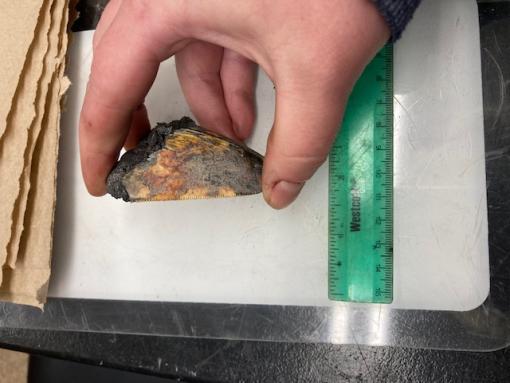
Many of the teeth we find on the ocean floor belonged to the famous Megalodon or its relatives. Otodus (Megaselachus) megalodon, commonly known as megalodon, was among the largest sharks ever to inhabit our planet but went extinct approximately 3.5 million years ago. Megalodon lived across the global ocean, making its teeth not an uncommon find on the abyssal plain. There are, however, many other species of prehistoric sharks whose teeth explorers find.
![Pollerspöck, J., & Straube, N. (2023) Records of Otodus megalodon and Cetacean ear bones. [Data set]](/sites/default/files/styles/responsive_image_sm/public/images/2026-03/Screen%20Shot%202026-03-31%20at%2012.29.00%20PM_0.png?itok=lyfZ2BdF)
Pollerspöck, J., & Straube, N. (2023) Records of Otodus megalodon and Cetacean ear bones. [Data set]
Scientists can examine the tooth’s shape and size to determine what type of shark it belonged too. Even if they don’t have the entire tooth, formulas can help determine its full size and, potentially, the full size of the individual who lost it. By comparing these fossilized teeth with those of living species, scientists can infer the life histories of extinct species. For example, megalodon teeth have the same serration pattern as great white sharks, prompting the assumption that their predation styles are similar.
In 2025, our NA176 expedition took us to the deep sea of the Cook Islands. For three weeks, our Corps of Exploration explored at depths greater than 5,100 meters (17,000 feet). Much of that exploration was concentrated on the abyssal plain- a habitat with stable conditions perfect for finding shark teeth.
All of the shark teeth spotted by our remotely-operated vehicles in this video were found while diving in the waters of the Cook Islands during the 2025 NA176 expedition.
Usually, fossilized megalodon teeth are commonly found near shorelines where fossil beds are exposed to wave action or rivers. The majority of findings occur in locations that are easily accessible from land, while the deep sea remains largely unexplored. Deep-sea fossils are typically collected by dragging nets on the bottom of the seafloor, a methodology that does not allow scientists to determine the exact sampling location, contextual information that is crucial for scientists to determine how fossils formed and what led to their current state. That’s why our in situ (meaning collected in its original location) discoveries are extra important for scientists studying these extinct predators.
In 2022, ROV Hercules unknowingly sampled a fossilized Megalodon tooth during a three-week expedition that explored previously unsurveyed deep-sea habitats in the Johnston Unit of the Pacific Remote Islands Marine National Monument. The sample represents the first reported case of an in-situ observation and subsequent sampling of a fossil megalodon tooth in the deep sea. Collected at a depth of over 10,000 feet (3,090 meters), scientists later confirmed it belonged to a megalodon.
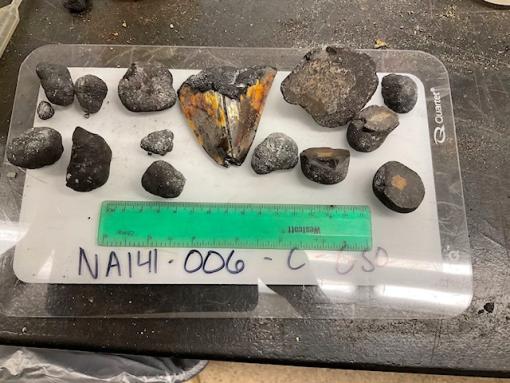
In this case, the fossil was only identified after the sample had been brought to the University of Rhode Island’s Marine Geological Samples Laboratory
Most of the shark teeth we come across during our deep-sea dives are covered in a crust of ferromanganese: a black mineral deposit that precipitates very slowly from seawater and coats objects found on the deep ocean floor. These mineral deposits form at an average rate of 2.5 mm per million years, and their thickness can therefore be used to date objects covered by this coating. We often collect deep sea rocks coated in ferromanganese crust to study the geological history of this region, hence the unknown collection of the covered megalodon tooth.
In 2024, OET’s Media and Outreach Coordinator Jamie Zaccaria connected with Dr. Nicolas Straube and Jürgen Pollerspöck, co-authors of the paper documenting the first in situ discovery of a fossil tooth in 2022. Watch the interview below!
